Shyam's Slide Share Presentations

VIRTUAL LIBRARY "KNOWLEDGE - KORRIDOR"

This article/post is from a third party website. The views expressed are that of the author. We at Capacity Building & Development may not necessarily subscribe to it completely. The relevance & applicability of the content is limited to certain geographic zones.It is not universal.

TO VIEW MORE CONTENT ON THIS SUBJECT AND OTHER TOPICS, Please visit KNOWLEDGE-KORRIDOR our Virtual Library

Showing posts with label space. Show all posts

Saturday, November 22, 2014

Study Investigates How Men and Women Adapt Differently to Spaceflight 11-22


Study Investigates How Men and Women Adapt Differently to Spaceflight

In 2011, a report from a National Academy of Sciences’ decadal survey emphasized the need to examine and understand the influences that sex and gender have on physiological and psychological or behavioral changes that occur during spaceflight. In response, NASA and NSBRI assembled six workgroups to investigate and summarize the current body of published and unpublished human and animal spaceflight research data. 

This diagram shows key differences between men and women in cardiovascular, immunologic, sensorimotor, musculoskeletal, and behavioral adaptations to human spaceflight.
Image Credit: 
NASA/NSBRI

The groups focused on cardiovascular, immunological, sensorimotor, musculoskeletal, reproductive and behavioral implications on spaceflight adaptation for men and women. In June 2013, NASA and NSBRI hosted a virtual workshop to present the groups’ findings. The Journal of Women's Health published the manuscripts in the Nov. 2014 issue, available here. 

spaceflight deeper into the solar system, the health and safety considerations for its astronauts grow increasingly complex. The agency, in partnership with the National Space Biomedical Research Institute (NSBRI), is researching risk-reducing countermeasures and developing technologies to advance human health and ensure operational performance in deep space. Together they are investigating personalized medicine for astronauts who may spend years living and working autonomously away from planet Earth.
A key consideration in personalized medicine is the crewmember’s sex and gender. Although in recent years the definitions have become more nuanced in the clinical community, “sex” is defined here as the classification of male or female according to an individual's genetics and "gender" refers to a person's self-representation as male or female based upon social interactions. We know that on Earth, major components of the human body are influenced by sex and gender factors. Taking gravity away from the equation imposes an entirely new element on our understanding of the health implications of sex and gender differences.
“Fortunately, we have the International Space Station,” said Dr. Marshall Porterfield, Director of Space Life and Physical Sciences Research at NASA Headquarters. “Station provides us with years of biological data on male and female astronauts, and many of them continue to participate in ground-based studies to evaluate the lasting effects of spaceflight.”
the Life Sciences Data Archive (LSDA) and the Lifetime Surveillance of Astronaut Health (LSAH), but there is an imbalance of data available for men and women, primarily due to fewer women who have flown in space. 
The “Impact of Sex and Gender on Adaptation to Space” is a compendium of the work groups’ six individual manuscripts, an executive summary, and a commentary.  It is the most current, comprehensive report on sex and gender differences related to human physiology and psychology in spaceflight and on Earth.
The full compendium is available at http://online.liebertpub.com/toc/jwh/23/11.
Each workgroup included scientists and clinicians from academia, NASA or NSBRI, and other federal agencies and was co-chaired by one representative from NASA or NSBRI and one from the external scientific community. The groups identified certain sex- and gender-related differences that impact the risks and the optimal medical care required by space-faring women and men. It represents innovative research in sex- and gender-based biology that impacts those individuals that are at the forefront of space exploration. 
“Harnessing the power of 21st century personalized medicine, as practiced at leading medical schools and hospitals, will further mitigate the human health risks inherent to long duration deep space missions,” said Jeffrey P. Sutton, M.D., Ph.D., NSBRI’s President, CEO, and Institute Director. 
data available for men and women who have flown in space – 477 men vs. 57 women as of June 2013 – makes it difficult to derive concrete conclusions based on sex and gender alone.In the latest crew selection, NASA selected eight astronauts, comprising four women and four men. This is a positive step toward increasing the participation of female astronauts in spaceflight and experimentation.
“This is the first major integrated examination of the issues of sex and gender in relationship to space exploration,” said Dr. Mark Shelhamer Chief Scientist for NASA’s Human Research Program at Johnson Space Center. “There are, in many cases, sex-based differences in the response to the stressors of space flight.” He believes that is important to recognize—not ignore—such differences, and to provide countermeasures that are appropriate for each subpopulation or even to each individual. 
The Sex & Gender work groups released five recommendations: 

  • Select more female astronauts for spaceflight missions.

  • Encourage and facilitate the participation of more female and male subjects in both ground and flight research studies.

  • Focus on the responses of individual astronauts to spaceflight and return to Earth.

  • Include sex and gender factors in the design of the experiments.

  • Incorporate sex and gender and other individual risk factors into NASA-funded research programs
A summary of the Sex & Gender work groups' major findings is listed below:

  • Orthostatic Intolerance, or the inability to stand without fainting for protracted periods, is more prevalent upon landing in female astronauts than in their male counterparts. One possible reason for this observed difference in orthostatic intolerance between the sexes is reduced leg vascular compliance, which was demonstrated in bed-rest studies – which is a ground analog for spaceflight.

  • Women have greater loss of blood plasma volume than men during spaceflight, and women’s stress response characteristically includes a heart rate increase while men respond with an increase in vascular resistance. Still, these Earth observations require further study in space.

  • The VIIP syndrome (visual impairment / intracranial pressure) manifests with anatomical ocular changes, ranging from mild to clinically significant, with a range of corresponding changes in visual function. Currently 82% of male astronauts vs. 62% of women astronauts (who have flown in space) are affected. However, all clinically significant cases so far have occurred in male astronauts.

  • Changes in function and concentration of key constituents of the immune system related to spaceflight have been reported. However, differences between male and female immune responses have not been observed in space.  On the ground, women mount a more potent immune response than men, which makes them more resistant to viral and bacterial infections; once infected, women mount an even more potent response. This response, however, makes women more susceptible to autoimmune diseases. It is not clear if these changes on the ground will occur during longer space missions, or missions that involve planetary exploration (exposure to gravity).

  • Radiation presents a major hazard for space travel. It has been reported that female subjects are more susceptible to radiation-induced cancer than their male counterparts; hence radiation permissible exposure levels are lower for women than men astronauts.

  • Upon transition to microgravity after arriving at the International Space Station (ISS), female astronauts reported a slightly higher incidence of space motion sickness (SMS) compared with men. Conversely, more men experience motion-sickness symptoms upon return to Earth. These data were however not statistically significant, due both to the relatively small sample sizes and small differences in the incidence of SMS reported by the men and women astronauts.

  • Hearing sensitivity, when measured at several frequencies, declines with age much more rapidly in male astronauts than it does in female astronauts. No evidence suggests that the sex-based hearing differences in the astronaut population are related to microgravity exposure.

  • The human musculoskeletal response to gravity unloading is highly variable among individuals and a sex-based difference was not observed.

  • Urinary tract infections in space are more common in women and have been successfully treated with antibiotics.

  • There is no evidence of sex differences in terms of behavioral or psychological responses to spaceflight. Analysis of ISS astronauts’ neurobehavioral performance and sleep measures showed no sex or gender differences using the Psychomotor Vigilance Test (PVT) of alertness and Visual Analog Scales of workload, stress, and sleep quality. Since all all astronaut candidates undergo a robust process of psychological screening and selection,  the likelihood of an adverse behavioral health condition or psychiatric disorder is greatly diminished.


Wednesday, May 7, 2014

Magnetic Map of Milky Way 08-05


Magnetic Map of Milky Way


The magnetic field of our Milky Way galaxy as seen by the Planck satellite, a European Space Agency mission with significant NASA contributions. This image was compiled from the first all-sky observations of polarized light emitted by interstellar dust in the Milky Way. Light can become polarized when it is emitted by or scatters off dust and other surfaces; in this state, the electric and magnetic fields of individual light waves are aligned parallel to each other.
Darker regions correspond to stronger polarized emission, and the striations indicate the direction of the magnetic field projected on the plane of the sky. The dark band running horizontally across the center corresponds to the galactic plane. Here, the polarization reveals a regular pattern on large angular scales, which is due to the magnetic field lines being predominantly parallel to the plane of the Milky Way. 
The data also reveal variations of the polarization direction within nearby clouds of gas and dust. This can be seen in the tangled features above and below the plane, where the local magnetic field is particularly disorganized.
The magnetic field is displayed using a visualization technique called line integral convolution. The image is a Mollweide projection of the full celestial sphere, with the plane of the galaxy aligned with the horizontal axis of the oval. Certain areas in the image, mostly at high galactic latitude, have been masked out.
 The overall intensity in these regions is low, complicating the separation of foreground from cosmic microwave, and infrared, background components. Further data analysis will improve this by the time of the full data release in late 2014.
Credits: ESA and the Planck Collaboration

Wednesday, April 16, 2014

Odd Tilts Could Make More Worlds Habitable 04-17

Odd Tilts Could Make More Worlds Habitable

Pivoting planets that lean one way and then change orientation within a short geological time period might be surprisingly habitable, according to new modeling by NASA and university scientists affiliated with the NASA Astrobiology Institute.
The climate effects generated on these wobbling worlds could prevent them from turning into glacier-covered ice lockers, even if those planets are somewhat far from their stars. And with some water remaining liquid on the surface long-term, such planets could maintain favorable conditions for life.
"Planets like these are far enough from their stars that it would be easy to write them off as frozen, and poor targets for exploration, but in fact, they might be well-suited to supporting life," said Shawn Domagal-Goldman, an astrobiologist at NASA's Goddard Space Flight Center in Greenbelt, Md. "This could expand our idea of what a habitable planet looks like and where habitable planets might be found."
graphical depiction of planet orbits
Tilted orbits might make some planets wobble like a top that's almost done spinning, an effect that could maintain liquid water on the surface.
Image Credit: 
NASA's Goddard Space Flight Center
The new modeling considers planets that have the same mass as Earth, orbit a sun-like star and have one or two gas giants orbiting nearby. In some cases, gravitational pulls from those massive planets could change the orientation of the terrestrial world's axis of rotation within tens to hundreds of thousands of years – a blink of an eye in geologic terms.
Though it might seem far-fetched for a world to experience such see-sawing action, scientists have already spotted an arrangement of planets where this could happen, in orbit around the star Upsilon Andromedae. There, the orbits of two enormous planets were found to be inclined at an angle of 30 degrees relative to each other. (One planet was, as usual, farther from the star than the other planet.)
Compared to our solar system, that arrangement looks extreme. The orbits of Earth and its seven neighboring planets differ by 7 degrees at most. Even the tilted orbit of the dwarf planet Pluto, which really stands out, is offset by a relatively modest 17 degrees.
"Knowing that this kind of planetary system existed raised the question of whether a world could be habitable under such conditions," said Rory Barnes, a scientist at the University of Washington in Seattle who was part of the team that studied the orbits of the two Andromedae planets.
The habitability concept is explored in a paper published in the April 2014 issue of Astrobiology and available online now. John Armstrong of Weber State University in Ogden, Utah, led the team, which includes Barnes, Domagal-Goldman, and other colleagues.
The team ran thousands of simulations for planets in 17 varieties of simplified planetary systems. The models the researchers built allowed them to adjust the tilt of the planetary orbits, the lean in the axes of rotation, and the ability of the terrestrial planet's atmosphere to let in light.
In some cases, tilted orbits can cause a planet to wobble like a top that's almost done spinning – and that wobbling should have a big impact on the planet's glaciers and climate. Earth's history indicates that the amount of sunlight glaciers receive strongly affects how much they grow and melt. Extreme wobbling, like that seen in some models in this study, would cause the poles to point directly at the sun from time to time, melting the glaciers. As a result, some planets would be able to maintain liquid water on the surface despite being located nearly twice as far from their stars as Earth is from the sun.
"In those cases, the habitable zone could be extended much farther from the star than we normally expect," said Armstrong, the lead author of the paper. "Rather than working against habitability, the rapid changes in the orientation of the planet could turn out be a real boon sometimes."

Monday, April 7, 2014

NASA Electromagnetic Spectrum 04-07

The Electromagnetic Spectrum

As it was explained in the Introductory Article on the Electromagnetic Spectrum, electromagnetic radiation can be described as a stream of photons, each traveling in a wave-like pattern, carrying energy and moving at the speed of light. In that section, it was pointed out that the only difference betweenradio waves, visible light and gamma rays is the energy of the photons. Radio waves have photons with the lowest energies.Microwaves have a little more energy than radio waves.Infrared has still more, followed by visible, ultraviolet, X-raysand gamma rays.
The amount of energy a photon has can cause it to behave more like a wave, or more like a particle. This is called the "wave-particle duality" of light. It is important to understand that we are not talking about a difference in what light is, but in how it behaves. Low energy photons (such as radio photons) behave more like waves, while higher energy photons (such as X-rays) behave more like particles.
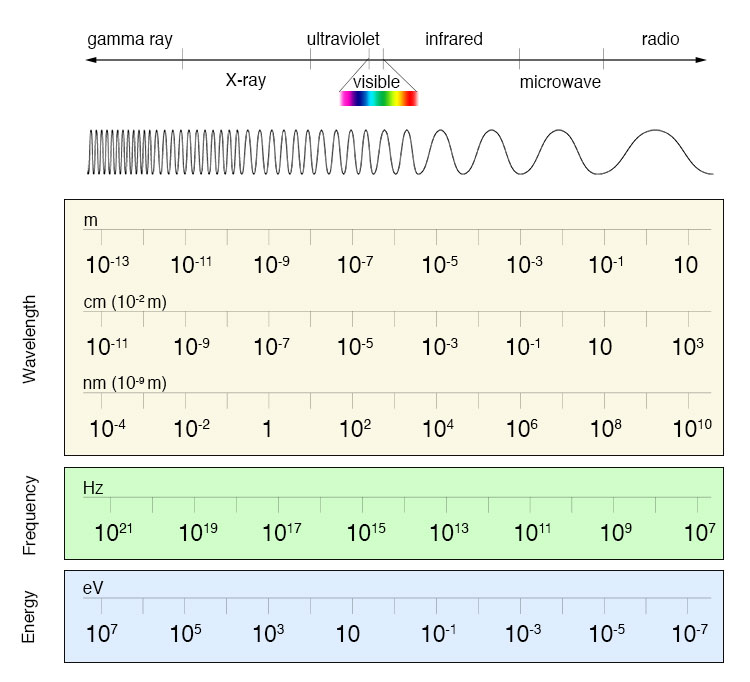
The electromagnetic spectrum can be expressed in terms of energy, wavelength or frequency. Each way of thinking about the EM spectrum is related to the others in a precise mathematical way. Scientists represent wavelength and frequency by the Greek letters lambda (λ) and nu (ν). Using those symbols, the relationships between energy, wavelength and frequency can be written as:
wavelength equals the speed of light divided by the frequency
or
λ = c / ν
and
energy equals Planck's constant times the frequency
or
E = h × ν
Where:
  • λ is the wavelength
  • ν is the frequency
  • E is the energy
  • c is the speed of light, c = 299,792,458 m/s (186,212 miles/second)
  • h is Planck's constant, h = 6.626 x 10⁻²⁷ erg-seconds
Both the speed of light and Planck's constant are constant – they never change in value.
Illustration showing conversions between wavelength, frequency and energy
Conversion between wavelength, frequency and energy for the electromagnetic spectrum. (Click image for a larger version.)

Astronomy Across the Electromagnetic Spectrum

While all light across the electromagnetic spectrum is fundamentally the same thing, the way that astronomersobserve light depends on the portion of the spectrum they wish to study.
For example, different detectors are senstive to different wavelenths of light. In addition, not all light can get through the Earth's atmosphere, so for some wavelengths we have to use telescopes aboard satellites. Even the way we collect the light can change depending on the wavelength. Astronomers must have a number of different telescopes and detectors to study the light from celestial objects across the electromagnetic spectrum.
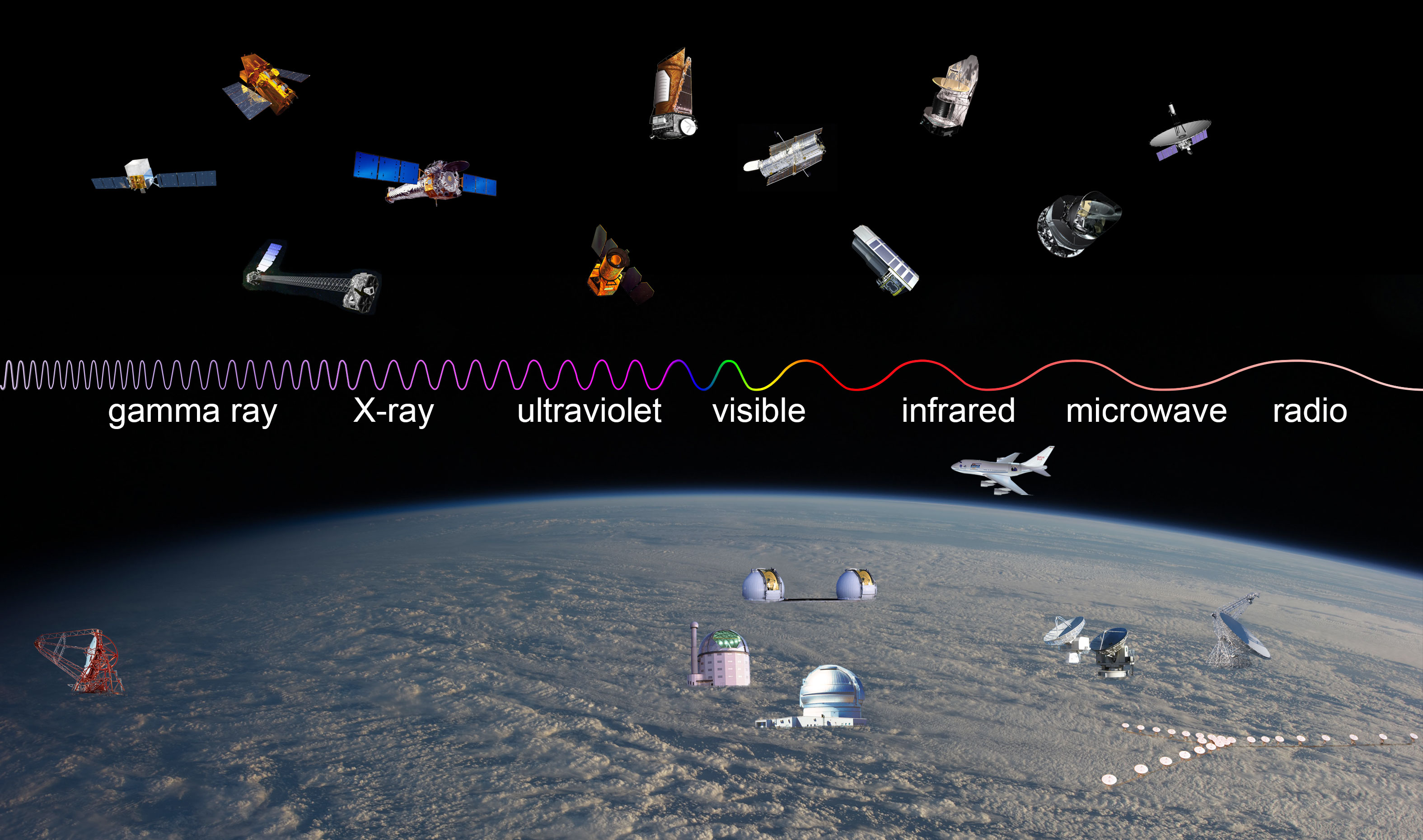
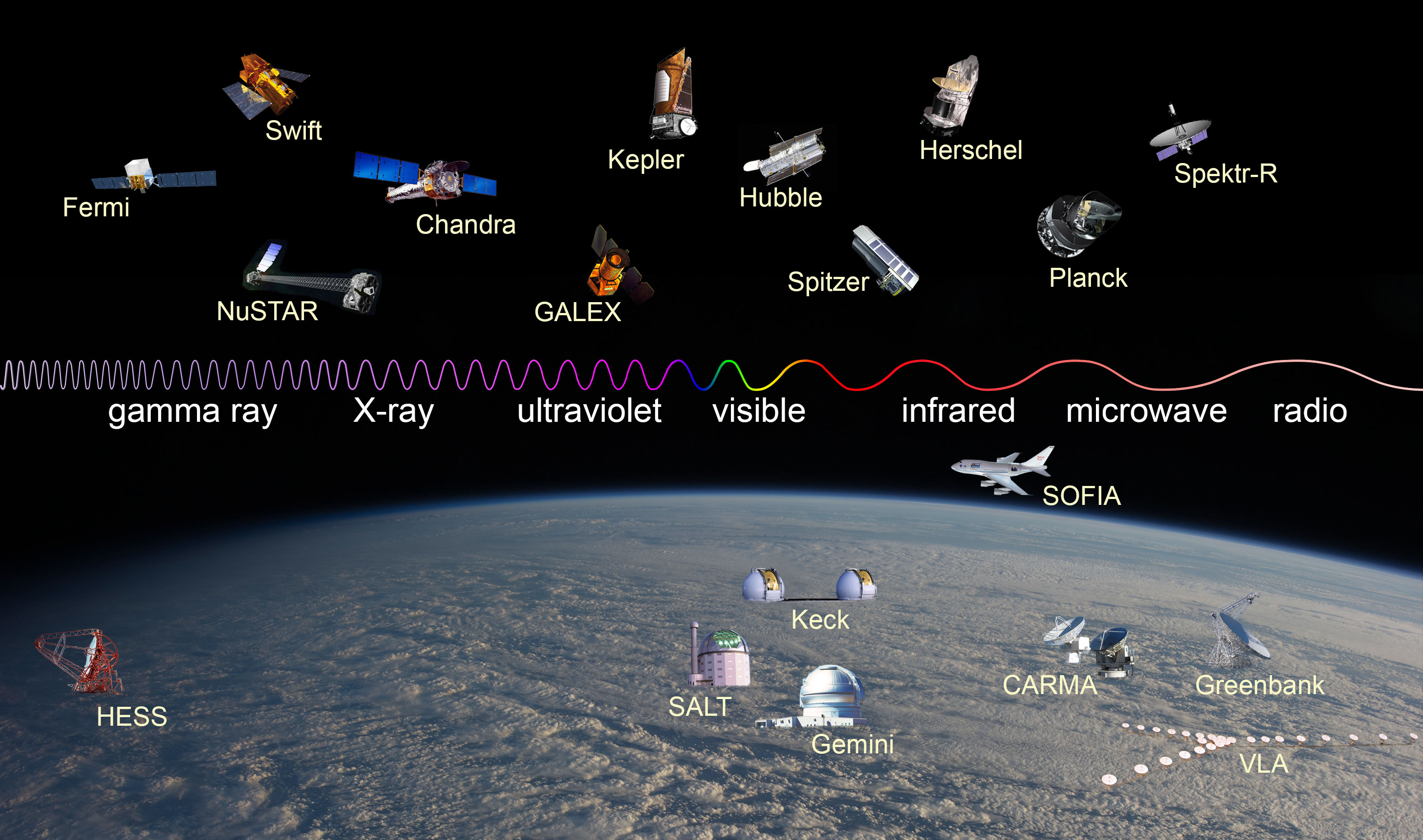
illustration showing different telescopes that observe each band 
 of the electromagnetic spectrum
A sample of telescopes (operating as of February 2013) operating at wavelengths across the electromagnetic spectrum. Several of these observatories observe more than one band of the EM spectrum, and those are placed within the band of their primary instrument(s).
The represented observatories are: HESS, Fermi and Swift for gamma-ray, NuSTAR and Chandra for X-ray, GALEX for ultraviolet, Kepler, Hubble, Keck (I and II), SALT, and Gemini (South) for visible, Spitzer, Herschel, and Sofia for infrared, Planck and CARMA for microwave, Spektr-R, Greenbank, and VLA for radio. Click here to see this image with the observatories labeled.

Thursday, December 5, 2013

Full View: Saturn's Streaming Hexagon 12-05

 
In Full View: Saturn's Streaming Hexagon - This colorful view from NASA's Cassini mission is the highest-resolution view of the unique six-sided jet stream at Saturn's north pole known as "the hexagon." This movie, made from images obtained by Cassini's imaging cameras, is the first to show the hexagon in color filters, and the first movie to show a complete view from the north pole down to about 70 degrees north latitude.

This movie shows a view from directly over the north pole, keeping up with the rotation of the planet so that all the motion seen on the screen is the motion of the hexagonal jet stream or the storms inside of it, without any added motion from the spinning of the planet itself. The original images were re-projected to show this polar view.

High-resolution views of the hexagon have only recently become possible because of the changing of the seasons at Saturn and changes in the Cassini spacecraft’s orbit. The north pole was dark when Cassini first arrived in July 2004. The sun really only began to illuminate the entire interior of the hexagon in August 2009, with the start of northern spring.  In late 2012, Cassini began making swings over Saturn's poles, giving it better views of the hexagon.


Image credit: NASA/JPL-Caltech/SSI/Hampton

 
#nasa #space #solarsystem #saturn #cassini #filters #spacecract