Shyam's Slide Share Presentations

VIRTUAL LIBRARY "KNOWLEDGE - KORRIDOR"

This article/post is from a third party website. The views expressed are that of the author. We at Capacity Building & Development may not necessarily subscribe to it completely. The relevance & applicability of the content is limited to certain geographic zones.It is not universal.

TO VIEW MORE CONTENT ON THIS SUBJECT AND OTHER TOPICS, Please visit KNOWLEDGE-KORRIDOR our Virtual Library

Showing posts with label Physics. Show all posts

Monday, November 6, 2017

A strange new world of light 11-06


Metasurface generates new states of light for fundamental research and applications.

There’s nothing new thing under the sun — except maybe light itself.

Over the last decade, applied physicists have developed nanostructured materials that can produce completely new states of light exhibiting strange behavior, such as bending in a spiral, corkscrewing and dividing like a fork.

These so-called structured beams not only can tell scientists a lot about the physics of light, they have wide range of applications from super resolution imaging to molecular manipulation and communications.

Now, researchers at the Harvard John A. Paulson School of Engineering and Applied Sciences have developed a tool to generate new, more complex states of light in a completely different way.
The research is published in Science.

“We have developed a metasurface which is a new tool to study novel aspects of light,” said Federico Capasso, the Robert L. Wallace Professor of Applied Physics and Vinton Hayes Senior Research Fellow in Electrical Engineering at SEAS and senior author of the paper. “This optical component makes possible much more complex operations and allows researchers to not only explore new states of light but also new applications for structured light.”

The Harvard Office of Technology Development has protected the intellectual property relating to this project and is exploring commercialization opportunities.


The new metasurface connects two aspects of light, known as orbital angular momentum and circular polarization (or spin angular momentum). Polarization is direction along which light vibrates. In circularly polarized light, the vibration of light traces a circle. Think about orbital angular momentum and circular polarization like the motion of a planet. Circular polarization is the direction in which a planet rotates on its axis while orbital momentum describes how the planet orbits the sun.

View at the original source

Monday, June 12, 2017

Figuring out superconductors 06-13


Physicists create anti ferromagnet that may help develop, monitor key materials.  


From the moment when physicists discovered superconductors — materials that conduct electricity without resistance at extremely low temperatures — they wondered whether they might be able to develop materials that exhibit the same properties at warmer temperatures.

The key to doing so, a group of Harvard scientists say, may lie in another exotic material known as an antiferromagnet.

Led by physics professor Markus Greiner, a team of physicists has taken a crucial step toward understanding those materials by creating a quantum antiferromagnet from an ultracold gas of hundreds of lithium atoms. The work is described in a May 25 paper published in the journal Nature.

“We have created a model system for real materials … and now, for the first time, we can study this model system in a regime where classical computers get to their limit,” Greiner said. “Now, we can poke and prod our antiferromagnet. It’s a beautifully tunable system, and we can even freeze time to take a snapshot of where the atoms are. That’s something you won’t be able to do with an actual solid.”

But what, exactly, is an antiferromagnet?

Traditional magnets, the kind that you can stick to your refrigerator, work because the electron spins in the material are aligned, allowing them to work in unison. In an antiferromagnet, however, those spins are arranged in a checkerboard pattern. One spin may be pointed north, while the next is pointing south, and so on.

Understanding antiferromagnets is important, Greiner and physics professor Eugene Demler said, because experimental work has suggested that, in the most promising high-temperature superconductors — a class of copper-containing compounds known as cuprates — the unusual state may be a precursor to high-temperature superconductivity.

Currently, Demler said, the best cuprates display superconductivity at about minus 160 degrees Fahrenheit, which is cold by everyday standards, but far higher than for any other type of superconductor. That temperature is also warm enough to allow practical applications of cuprate superconductors in telecommunications, transportation, and in the generation and transmission of electric power.

“This antiferromagnet stage is a crucial stepping-stone for understanding superconductors,” said Demler, who led the team providing theoretical support for the experiments. “Understanding the physics of these doped antiferromagnets may be the key to high-temperature superconductivity.”
To build one, Greiner and his team trapped a cloud of lithium atoms in a vacuum and then used a technique they dubbed “entropy redistribution” to cool them to just 10 billionths of a degree above absolute zero, which allowed them to observe the unusual physics of antiferromagnets.

“We have full control over every atom in our experiment,” said Daniel Greif, the postdoctoral fellow working in Greiner’s lab. “We use this control to implement a new cooling scheme, which allows us to reach the lowest temperatures so far in such systems.”

View at the original source

Monday, September 1, 2014

Physicists ask photons 'Where have you been?' 09-03


Physicists ask photons 'Where have you been?'


An artist's impression of the double-slit experiment


A new version of the famous double-slit experiment has allowed physicists in Israel to measure a phenomenon that is bizarre even by the counterintuitive standards of quantum mechanics. By placing a double-slit experiment along one path of a larger double-slit experiment, the researchers have shown that photons traverse a section of the apparatus that they neither enter nor exit. The effect, the team argues, is best understood by invoking a little-used interpretation of quantum mechanics that was first proposed in 1964.
Perhaps the simplest and starkest demonstration of wave–particle duality is the famous double-slit experiment. Particles such as photons or electrons that are emitted discretely behave as waves when they pass through two slits and build-up an interference pattern when detected individually on a screen.
In this latest version of the experiment, Lev Vaidman and colleagues at Tel-Aviv University used Mach–Zehnder interferometers as double slits and photons as particles. The optical interferometer uses a beamsplitter to divide the photon beam into two separate paths that are then recombined and sent to a detector. A difference in the lengths of the two paths dictates how the beams interfere when recombined, which affects the intensity measured by the detector.

Three possible paths


In the Tel Aviv experiment, an inner Mach–Zehnder interferometer is placed in one path of an outer interferometer so that the recombined beam continues its journey through the outer device and on to a detector (see figure below). This means that a photon has three possible paths from source to detector. The goal of the experiment is to find out which paths are taken by at least some photons arriving at the detector. This is called a weak measurement, and is consistent with the laws of quantum mechanics because it does not involve measuring the path of any specific photon.

Diagram showing the two-interferometer experiment

Vibrating mirrors bring the two-state vector formalism into focus

To make their measurements, the researchers set all the mirrors in the interferometer vibrating slightly, each at a different frequency. As a mirror vibrates, it alters the pathlength of any light reflecting from that mirror. This alters the phase difference when the beam is recombined, changing the intensity at the detector. As every mirror is vibrating at a unique frequency, oscillations in the detected intensity at a particular frequency indicated that photons have touched a specific mirror.
The researchers arranged the two pathlengths through the inner interferometer so that the two paths interfered destructively when they recombined. Therefore, no light could leave the inner interferometer. One might expect, therefore, that the only oscillation in the detected intensity would come from the mirror bypassing the inner interferometer, but this was not what the researchers found.

Bizarre conclusion

The detected intensity did indeed oscillate at the frequency of this bypass mirror, but it also oscillated at the frequencies of the mirrors in the inner interferometer. It did not, however, oscillate at the frequencies of the mirrors directing light into or out of this inner interferometer. This leads to the bizarre conclusion that some photons received by the detector had passed through the inner inteferometer, but had never entered it and never left it.
The researchers believe that this validates an unconventional interpretation of quantum theory called the two-state vector formalism. It was first proposed in 1964 by Yakir Aharonov, Peter Bergmann and Joel Lebowitz. Here, the probability of finding a particle in a particular place is the product of two vectors: one evolving forwards in time from the source and one evolving backwards in time from the detector.
A photon can touch a mirror if and only if both waves are non-zero at that point. The inner interferometer causes any wave leaving it to be identically zero. The forward-evolving wave is zero on the way out, and so no photons can be found here. The backward-evolving wave travels backwards through the interferometer and is therefore zero on the way in, so no photons can be found here either. Within the inner interferometer, however, both forward- and backward-evolving waves are non-zero, and so photons pass through both arms (see figure).

Intuitions and explanations

Vaidman stresses that the two-state vector formalism does not actually make different predictions from the conventional wave-mechanics approach devised by Erwin Schrödinger in the 1920s. However, the results of this experiment seem highly counterintuitive and are difficult to rationalize using the traditional method. "You can define constants and you can have intuitions about what is going on using the two-state vector formalism," says Vaidman, "But it's not something that standard quantum mechanics cannot explain in the end."
Onur Hosten of the University of Illinois at Urbana-Champaign, who was not involved in the experiment, says that whether you consider the experiment using the two-state vector formalism or using the conventional wave-mechanics approach, the effect is generated by the fact that performing a weak measurement inevitably perturbs the system. Oscillating the mirrors does itself change the pathlengths, thereby destroying the perfect destructive interference between the two paths of the inner interferometer and allowing the wavefunction to leak out. The probability of a photon leaking out is effectively zero, however, because the probability is proportional to the square of the wavefunction, which tends to zero much faster than the wavefunction itself. "From my perspective, it's really interesting to understand why you get the results you do," says Hosten, adding "but it's also interesting that a weak measurement gives you some disconcerting answers."
The results are to be published in Physical Review Letters. A preprint is available on arXiv.
  • Weak measurements are explained in detail in the article "In praise of weakness" by Aephraim Steinberg, Amir Feizpour, Lee Rozema, Dylan Mahler and Alex Hayat of the University of Toronto.

Monday, April 7, 2014

NASA Electromagnetic Spectrum 04-07

The Electromagnetic Spectrum

As it was explained in the Introductory Article on the Electromagnetic Spectrum, electromagnetic radiation can be described as a stream of photons, each traveling in a wave-like pattern, carrying energy and moving at the speed of light. In that section, it was pointed out that the only difference betweenradio waves, visible light and gamma rays is the energy of the photons. Radio waves have photons with the lowest energies.Microwaves have a little more energy than radio waves.Infrared has still more, followed by visible, ultraviolet, X-raysand gamma rays.
The amount of energy a photon has can cause it to behave more like a wave, or more like a particle. This is called the "wave-particle duality" of light. It is important to understand that we are not talking about a difference in what light is, but in how it behaves. Low energy photons (such as radio photons) behave more like waves, while higher energy photons (such as X-rays) behave more like particles.
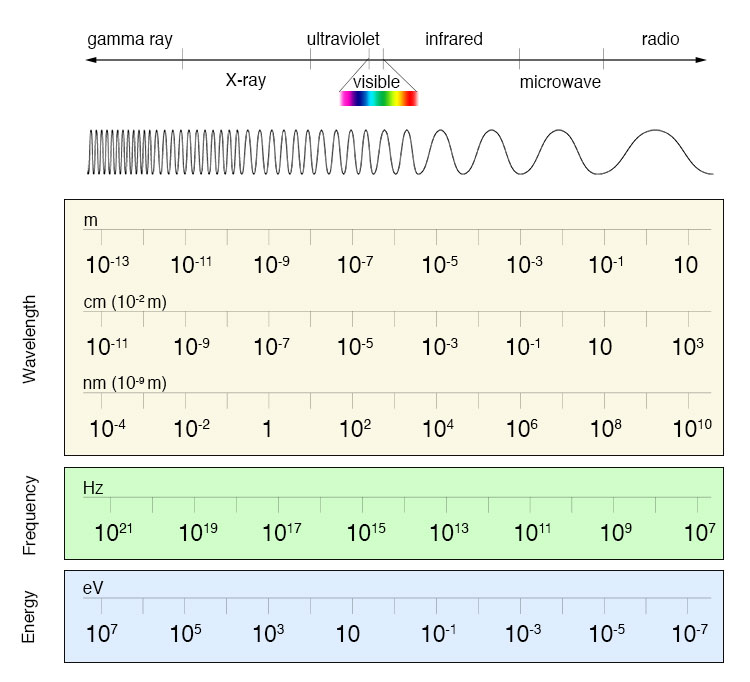
The electromagnetic spectrum can be expressed in terms of energy, wavelength or frequency. Each way of thinking about the EM spectrum is related to the others in a precise mathematical way. Scientists represent wavelength and frequency by the Greek letters lambda (λ) and nu (ν). Using those symbols, the relationships between energy, wavelength and frequency can be written as:
wavelength equals the speed of light divided by the frequency
or
λ = c / ν
and
energy equals Planck's constant times the frequency
or
E = h × ν
Where:
  • λ is the wavelength
  • ν is the frequency
  • E is the energy
  • c is the speed of light, c = 299,792,458 m/s (186,212 miles/second)
  • h is Planck's constant, h = 6.626 x 10⁻²⁷ erg-seconds
Both the speed of light and Planck's constant are constant – they never change in value.
Illustration showing conversions between wavelength, frequency and energy
Conversion between wavelength, frequency and energy for the electromagnetic spectrum. (Click image for a larger version.)

Astronomy Across the Electromagnetic Spectrum

While all light across the electromagnetic spectrum is fundamentally the same thing, the way that astronomersobserve light depends on the portion of the spectrum they wish to study.
For example, different detectors are senstive to different wavelenths of light. In addition, not all light can get through the Earth's atmosphere, so for some wavelengths we have to use telescopes aboard satellites. Even the way we collect the light can change depending on the wavelength. Astronomers must have a number of different telescopes and detectors to study the light from celestial objects across the electromagnetic spectrum.
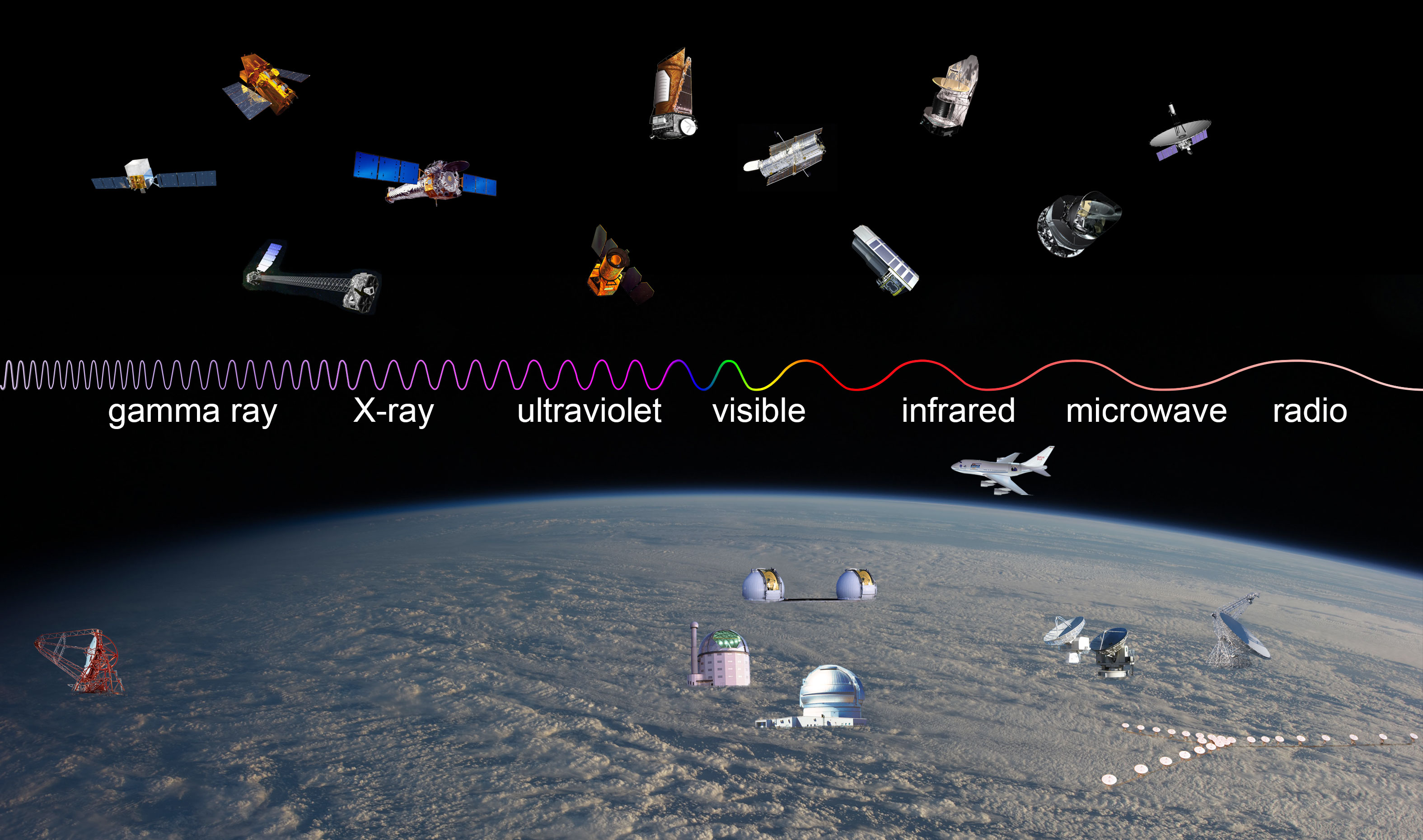
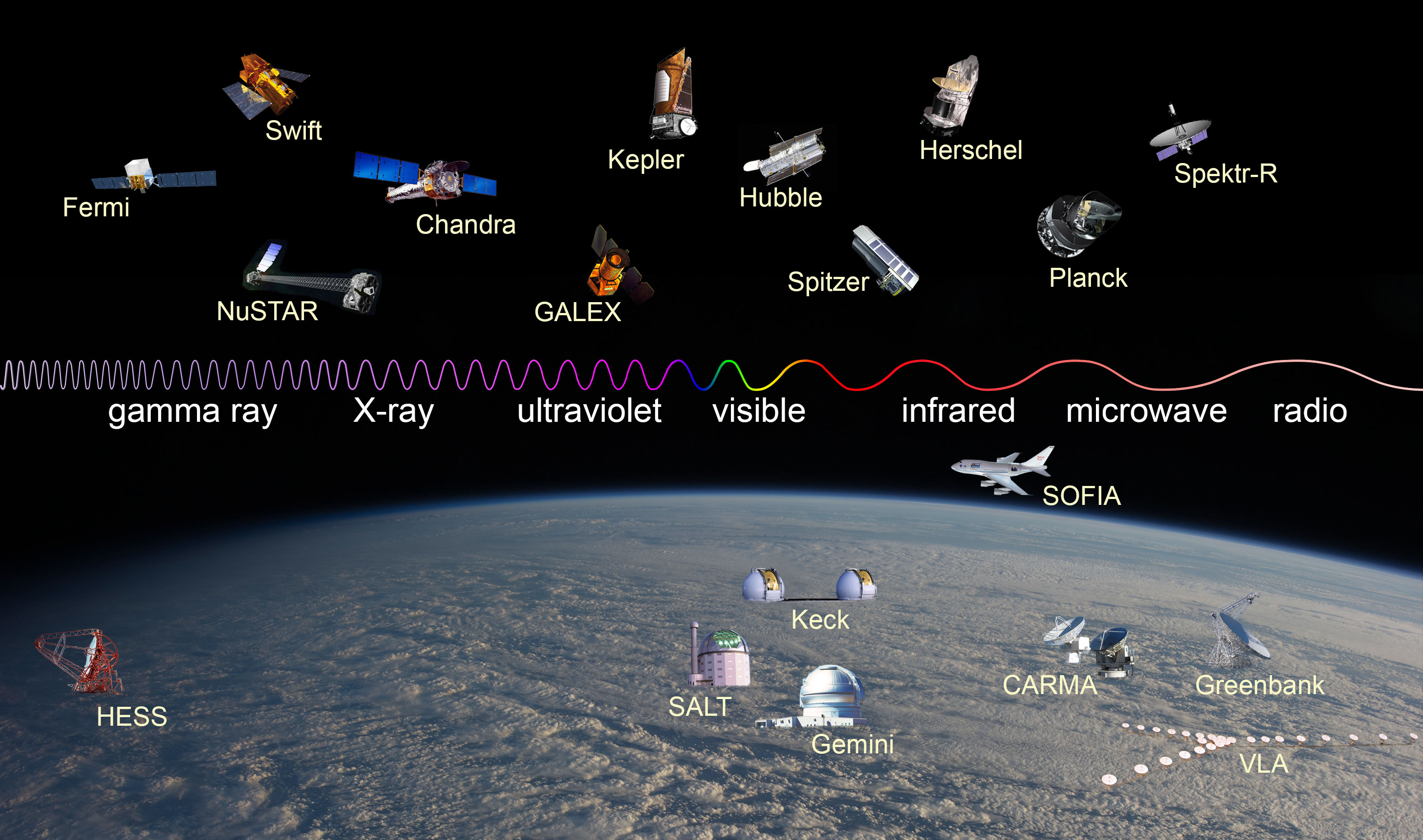
illustration showing different telescopes that observe each band 
 of the electromagnetic spectrum
A sample of telescopes (operating as of February 2013) operating at wavelengths across the electromagnetic spectrum. Several of these observatories observe more than one band of the EM spectrum, and those are placed within the band of their primary instrument(s).
The represented observatories are: HESS, Fermi and Swift for gamma-ray, NuSTAR and Chandra for X-ray, GALEX for ultraviolet, Kepler, Hubble, Keck (I and II), SALT, and Gemini (South) for visible, Spitzer, Herschel, and Sofia for infrared, Planck and CARMA for microwave, Spektr-R, Greenbank, and VLA for radio. Click here to see this image with the observatories labeled.