Shyam's Slide Share Presentations

VIRTUAL LIBRARY "KNOWLEDGE - KORRIDOR"

This article/post is from a third party website. The views expressed are that of the author. We at Capacity Building & Development may not necessarily subscribe to it completely. The relevance & applicability of the content is limited to certain geographic zones.It is not universal.

TO VIEW MORE CONTENT ON THIS SUBJECT AND OTHER TOPICS, Please visit KNOWLEDGE-KORRIDOR our Virtual Library

Showing posts with label Astrophysics. Show all posts

Wednesday, January 31, 2018

Computational astrophysics team uncloaks magnetic fields of cosmic events 01-31


The development of ultra-intense lasers delivering the same power as the entire U.S. power grid has enabled the study of cosmic phenomena such as supernovae and black holes in earthbound laboratories. Now, a new method developed by computational astrophysicists at the University of Chicago allows scientists to analyze a key characteristic of these events: their powerful and complex magnetic fields.


In the field of high-energy density physics, or HEDP, scientists study a wide range of astrophysical objects—stars, supermassive black holes at the center of galaxies and galaxy clusters—with laboratory experiments as small as a penny and lasting only a few billionths of a second. By focusing powerful lasers on a carefully designed target, researchers can produce plasmas that reproduce conditions observed by astronomers in our sun and distant galaxies.


Planning these complex and expensive experiments requires large-scale, high-fidelity computer simulation beforehand. Since 2012, the Flash Center for Computational Science of the Department of Astronomy & Astrophysics at UChicago has provided the leading open computer code, called FLASH, for these HEDP simulations, enabling researchers to fine-tune experiments and develop analysis methods before execution at sites such as the National Ignition Facility at Lawrence Livermore National Laboratory or the OMEGA Laser Facility in Rochester, N.Y.


"As soon as FLASH became available, there was kind of a stampede to use it to design experiments," said Petros Tzeferacos, research assistant professor of astronomy and astrophysics and associate director of the Flash Center.


During these experiments, laser probe beams can provide researchers with information about the density and temperature of the plasma. But a key measurement, the magnetic field, has remained elusive. To try and tease out magnetic field measurements from extreme plasma conditions, scientists at MIT developed an experimental diagnostic technique that uses charged particles instead, called proton radiography.


In a new paper for the journal Review of Scientific Instruments, Flash Center scientists Carlo Graziani, Donald Lamb and Tzeferacos, with MIT's Chikang Li, describe a new method for acquiring quantitative, high-resolution information about these magnetic fields. Their discovery, refined using FLASH simulations and real experimental results, opens new doors for understanding cosmic phenomena.
"We chose to go after experiments motivated by astrophysics where magnetic fields were important," said Lamb, the Robert A. Millikan Distinguished Service Professor Emeritus in Astronomy & Astrophysics and director of the Flash Center. "The creation of the code plus the need to try to figure out how to understand what magnetic fields are created caused us to build this software, that can for the first time quantitatively reconstruct the shape and strength of the magnetic field."
Skyrocketing experiments
In proton radiography, energetic protons are shot through the magnetized plasma towards a detector on the other side. As the protons pass through the magnetic field, they are deflected from their path, forming a complex pattern on the detector. These patterns were difficult to interpret, and previous methods could only make general statements about the field's properties.
"Magnetic fields play important roles in essentially almost every astrophysical phenomena. If you aren't able to actually look at what's happening, or study them, you're missing a key part of almost every astrophysical object or process that you're interested in," said Tzeferacos.
By conducting simulated experiments with known magnetic fields, the Flash Center team constructed an algorithm that can reconstruct the field from the proton radiograph pattern. Once calibrated computationally, the method was applied to experimental data collected at laser facilities, revealing new insights about astrophysical events.
The combination of the FLASH code, the development of the proton radiography diagnostic, and the ability to reconstruct magnetic fields from the experimental data, are revolutionizing laboratory plasma astrophysics and HEDP. "The availability of these tools has caused the number of HEDP experiments that study magnetic fields to skyrocket," said Lamb.
The new software for magnetic field reconstruction, called PRaLine, will be shared with the community both as part of the next FLASH code release and as a separate component available on GitHub. Lamb and Tzeferacos said they expect it to be used for studying many astrophysics topics, such as the annihilation of magnetic fields in the solar corona; astrophysical jets produced by young stellar objects, the Crab Nebula pulsar, and the supermassive black holes at the center of galaxies; and the amplification of magnetic fields and acceleration of cosmic rays by shocks in supernova remnants.
"The types of experiments HEDP scientists perform now are very diverse," said Tzeferacos. "FLASH contributed to this diversity, because it enables you to think outside the box, try different simulations of different configurations, and see what plasma conditions you are able to achieve."

Monday, January 1, 2018

Astrophysics Reveals The Origin Of The Human Body 01-02


At the smallest level, the human body is made up of particles: mostly atomic nuclei and electrons.  


The elements in the human body. While, by mass, we are mostly Oxygen, Carbon, Hydrogen, and Nitrogen, there are dozens of elements essential to life processes in the human body.


Although there are some 90 naturally occurring elements, they originate from a huge variety of places prior to ever arriving on Earth.


The Big Bang produces matter and antimatter, with slightly more matter being created at some point, leading to our Universe today. In the earliest stages, before any stars form, only hydrogen, helium, and trace amounts of lithium are produced. 


The hot Big Bang provides the origin of the lightest elements:
hydrogen and helium, which still make up 98% of today's Universe.


An artist's impression of the environment in the early Universe after the first few trillion stars have formed, lived and died. The existence and life cycle of stars is the primary process that enriches the Universe beyond merely hydrogen and helium.

Stars that live, burn, and die provide that other 2%, claiming responsibility for the complex molecules contained in our Universe.


 The creation of free neutrons during high-energy phases in the core of a star's life allow elements to be built up the periodic table, one at a time, by neutron absorption and radioactive decay. Supergiant stars and giant stars entering the planetary nebula phase are both shown to do this via the s-process. 

Small stars, like the Sun, fuse light elements into heavier ones, slowly building the high-end of the periodic table by adding neutrons one-at-a-time. 


Supernova remnant G1.9+0.3, perhaps the galaxy's most recent supernova, as imaged by Chandra in 2013. The signatures of supernova remnants and ejecta lead us to conclude exactly how much of each heavy element originates from this source.

Larger stars end their lives in supernovae, with their cores collapsing and imploding, expelling huge amounts of burned fuel back into the Universe.


In the final moments of merging, two neutron stars don't merely emit gravitational waves, but a catastrophic explosion that echoes across the electromagnetic spectrum and a slew of heavy elements towards the very high end of the periodic table.

Meanwhile, white dwarfs and neutron stars merge and explode, enriching the Universe even further.


This image from NASA’s Chandra X-ray Observatory shows the location of different elements in the Cassiopeia A supernova remnant including silicon (red), sulfur (yellow), calcium (green) and iron (purple). Each of these elements produces X-rays within narrow energy ranges, allowing maps of their location to be created.


Owing to NASA's Chandra X-ray telescope, we can observe how much of each heavy element comes from recent supernova explosions.


The elements of the periodic table, and where they originate, are detailed in this image above. The vast majority of the human body, including the majority of our oxygen, carbon, nitrogen, phosphorous, calcium, and iron, all owe their primary origin to massive stars that have gone supernova.

When it comes to the human body, the majority of what makes us up comes from supernovae, not any other source. 


The biggest find? Every element required to make DNA is found in the aftermath of exploding stars.  


Mostly Mute Monday tells the cosmic story of an astronomical object, image, or phenomenon in pictures, visuals, and no more than 200 words.


Monday, April 7, 2014

NASA Electromagnetic Spectrum 04-07

The Electromagnetic Spectrum

As it was explained in the Introductory Article on the Electromagnetic Spectrum, electromagnetic radiation can be described as a stream of photons, each traveling in a wave-like pattern, carrying energy and moving at the speed of light. In that section, it was pointed out that the only difference betweenradio waves, visible light and gamma rays is the energy of the photons. Radio waves have photons with the lowest energies.Microwaves have a little more energy than radio waves.Infrared has still more, followed by visible, ultraviolet, X-raysand gamma rays.
The amount of energy a photon has can cause it to behave more like a wave, or more like a particle. This is called the "wave-particle duality" of light. It is important to understand that we are not talking about a difference in what light is, but in how it behaves. Low energy photons (such as radio photons) behave more like waves, while higher energy photons (such as X-rays) behave more like particles.
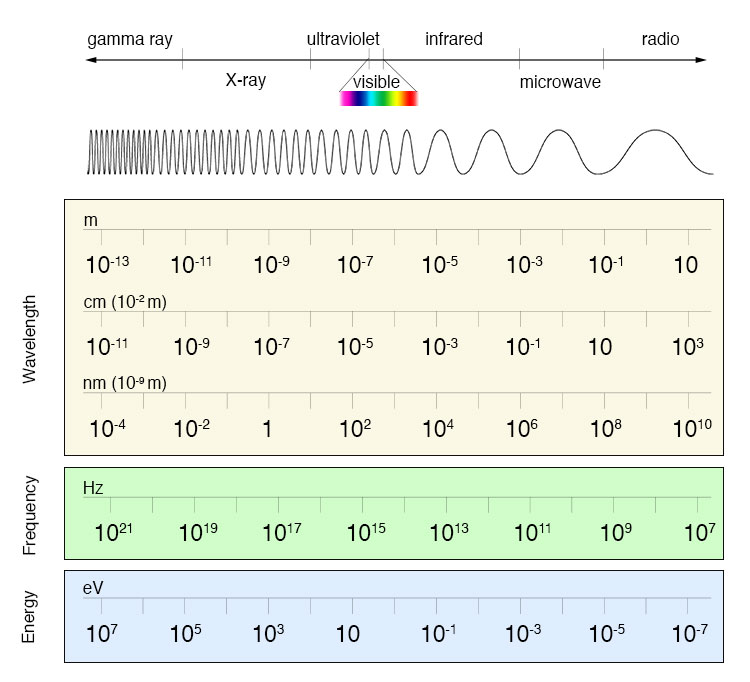
The electromagnetic spectrum can be expressed in terms of energy, wavelength or frequency. Each way of thinking about the EM spectrum is related to the others in a precise mathematical way. Scientists represent wavelength and frequency by the Greek letters lambda (λ) and nu (ν). Using those symbols, the relationships between energy, wavelength and frequency can be written as:
wavelength equals the speed of light divided by the frequency
or
λ = c / ν
and
energy equals Planck's constant times the frequency
or
E = h × ν
Where:
  • λ is the wavelength
  • ν is the frequency
  • E is the energy
  • c is the speed of light, c = 299,792,458 m/s (186,212 miles/second)
  • h is Planck's constant, h = 6.626 x 10⁻²⁷ erg-seconds
Both the speed of light and Planck's constant are constant – they never change in value.
Illustration showing conversions between wavelength, frequency and energy
Conversion between wavelength, frequency and energy for the electromagnetic spectrum. (Click image for a larger version.)

Astronomy Across the Electromagnetic Spectrum

While all light across the electromagnetic spectrum is fundamentally the same thing, the way that astronomersobserve light depends on the portion of the spectrum they wish to study.
For example, different detectors are senstive to different wavelenths of light. In addition, not all light can get through the Earth's atmosphere, so for some wavelengths we have to use telescopes aboard satellites. Even the way we collect the light can change depending on the wavelength. Astronomers must have a number of different telescopes and detectors to study the light from celestial objects across the electromagnetic spectrum.
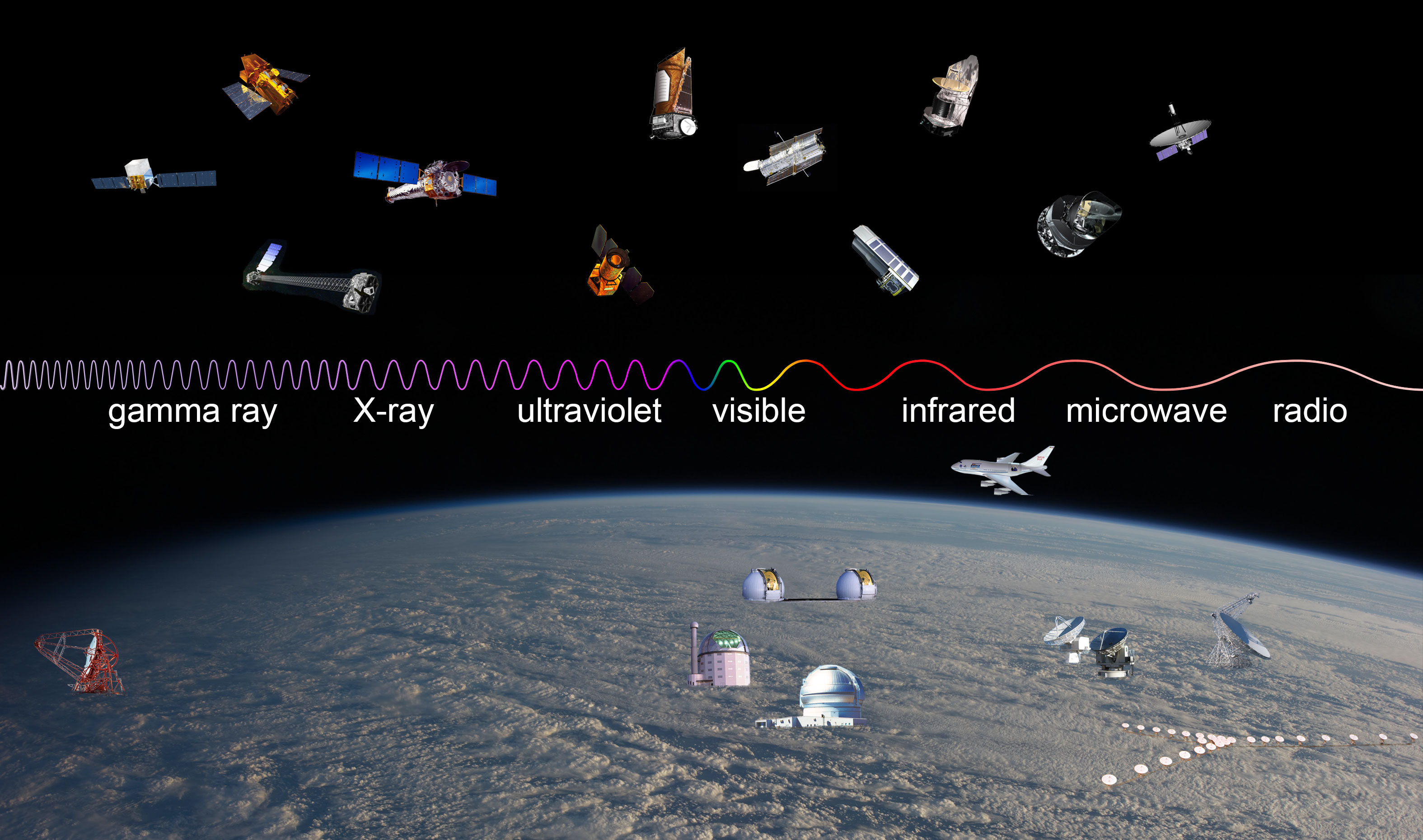
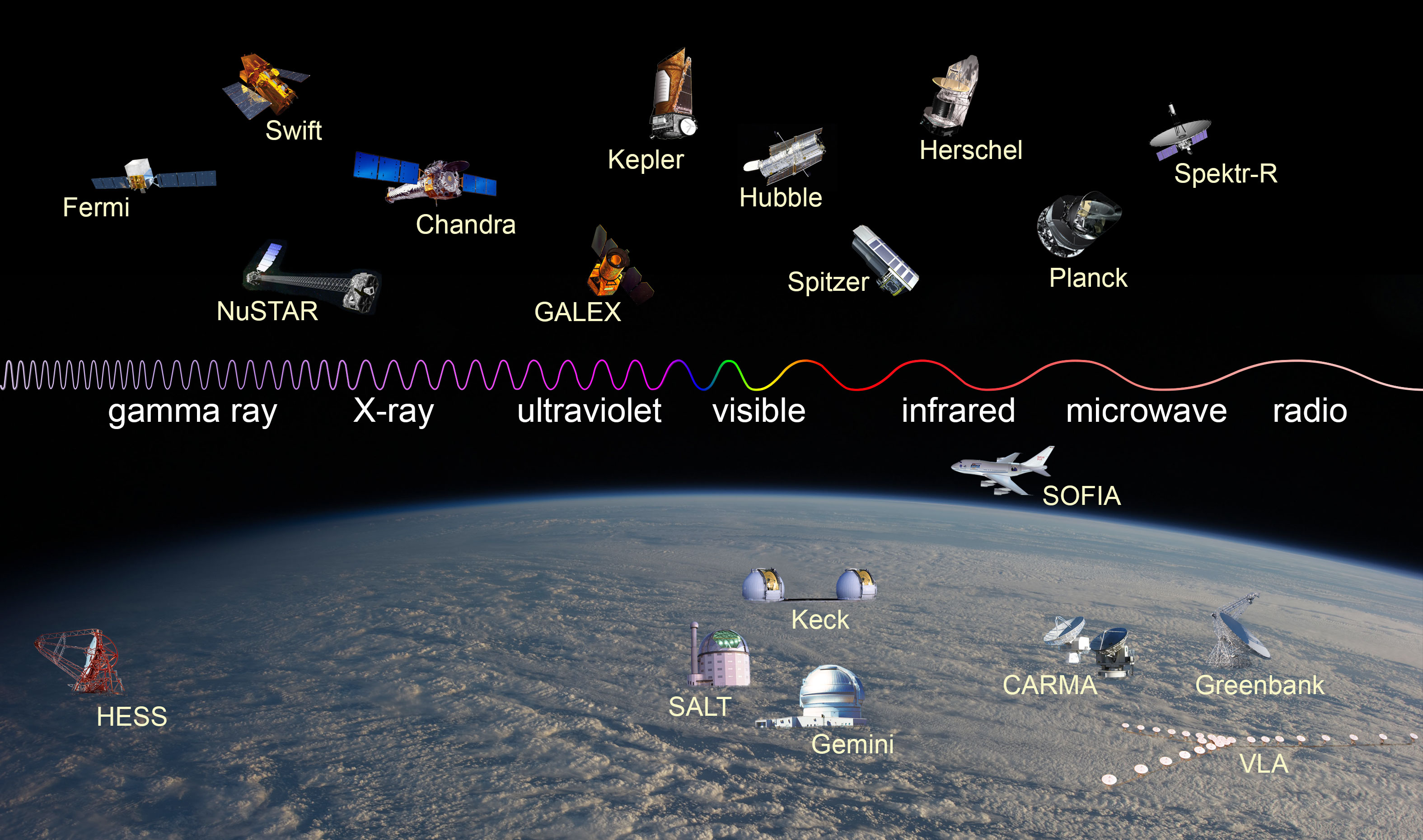
illustration showing different telescopes that observe each band 
 of the electromagnetic spectrum
A sample of telescopes (operating as of February 2013) operating at wavelengths across the electromagnetic spectrum. Several of these observatories observe more than one band of the EM spectrum, and those are placed within the band of their primary instrument(s).
The represented observatories are: HESS, Fermi and Swift for gamma-ray, NuSTAR and Chandra for X-ray, GALEX for ultraviolet, Kepler, Hubble, Keck (I and II), SALT, and Gemini (South) for visible, Spitzer, Herschel, and Sofia for infrared, Planck and CARMA for microwave, Spektr-R, Greenbank, and VLA for radio. Click here to see this image with the observatories labeled.

Saturday, July 27, 2013

Snow Falling around Infant Solar System 07-27


Snow Falling around Infant Solar System


Cambridge, MA - The sight of a snowfall can thrill children, but the first-ever snow line seen around a distant star gives astronomers an even greater thrill because of what it reveals about the formation of planets and our solar system's history.

Astronomers using the new Atacama Large Millimeter/submillimeter Array (ALMA) telescope have taken the first-ever image of a snow line in an infant solar system. This frosty landmark is thought to play in an essential role in the formation and chemical make-up of planets around a young star.

On Earth, snow lines typically form at high elevations where falling temperatures turn atmospheric moisture to snow. In much the same way, snow lines are thought to form around young stars in the distant, colder reaches of the disks from which solar systems form. Depending on the distance from the star, however, other more exotic molecules can freeze and turn to snow.

Familiar water ice freezes out first, then moving outward in concentric circles other abundant gases like carbon dioxide (CO2), methane (CH4), and carbon monoxide (CO) freeze, forming a frost on dust grains, which are the building blocks of planets and comets.

ALMA spotted a never-before-seen CO snow line around TW Hydrae, a young star 175 light-years away from Earth. Astronomers believe this nascent solar system has many of the same characteristics that our own Solar System had when it was just a few million years old. The results were published in Science Express.

"ALMA has given us the first real picture of a snow line around a young star, which is extremely exciting because of what it tells us about the very early period in the history of our own Solar System," said Chunhua "Charlie" Qi, a researcher with the Harvard-Smithsonian Center for Astrophysics in Cambridge, Mass., who led the international research team with Karin Oberg, a researcher with Harvard University and the University of Virginia in Charlottesville.

"We can now see previously hidden details about the frozen outer reaches of another solar system, one that has much in common with our own when it was less than 10 million years old," said Qi.

Snow lines have, until now, only been detected by their spectral signatures; they have never been imaged directly, so their precise location and extent could not be determined.

This is because snow lines form exclusively in the relatively narrow central plane of a protoplanetary disk. Above and below this region, stellar radiation keeps the gases warm, preventing them from forming ice. Only with the insulating effect of the concentrated dust and gas in the central plane of the disk can temperatures drop sufficiently for CO and other gases to cool and freeze.

Normally, this outer cocoon of hot gas would prevent astronomers from peering inside the disk where the gas had frozen out. "It would be like trying to find a small, sunny patch hidden within a dense fogbank," said Oberg.

The astronomers were able to pierce the intervening CO fog by instead hunting for a different molecule known as diazenylium (N2H+). This fragile molecule is easily destroyed in the presence of CO gas, so would only appear in detectable amounts in regions where CO had frozen out, and is hence a proxy for CO ice.

Diazenylium shines brightly in the millimeter portion of the spectrum, which can be detected by radio telescope like ALMA here on Earth.

ALMA's unique sensitivity and resolution allowed the astronomers to trace the presence and distribution of diazenylium, finding a clearly defined boundary approximately 30 astronomical units (AU) from TW Hydrae (one AU is the Sun-Earth distance).

"Using this technique, we were able to create, in effect, a photonegative of the CO snow in the disk surrounding TW Hydrae," said Oberg. "With this we could see the CO snow line precisely where theory predicts it should be -- the inner rim of the diazenylium ring."

Snow lines, astronomers believe, serve a vital role in the formation of a solar system. They help dust grains overcome their normal tendency to collide and self-destruct by giving the grains a stickier outer coating. 

They also increase the amount of solids available and may dramatically speed up the planet formation process. Since there are multiple snow lines, each may be linked to the formation of specific kinds of planets.

Around a Sun-like star, the water snow line would correspond approximately to the orbit of Jupiter and the CO snow line would roughly correspond to the orbit of Neptune. The transition to CO ice could also mark the starting point where smaller icy bodies like comets and dwarf planets like Pluto would form.

Oberg also points out that the CO snow line is particularly interesting since CO ice is needed to form methanol, which is a building block of more complex organic molecules that are essential for life. Comets and asteroids could then ferry these molecules to newly forming Earth-like planets, seeding them with the ingredients for life.

These observations were made with only a portion of ALMA's eventual full complement of 66 antennas. The researchers hope future observations with the full array will reveal other snow lines and provide additional insights into the formation and evolution of planets.

This release is being issued jointly with NRAO.

ALMA, an international astronomy facility, is a partnership of Europe, North America and East Asia in cooperation with the Republic of Chile. ALMA construction and operations are led on behalf of Europe by ESO, on behalf of North America by the National Radio Astronomy Observatory (NRAO), and on behalf of East Asia by the National Astronomical Observatory of Japan (NAOJ). The Joint ALMA Observatory (JAO) provides the unified leadership and management of the construction, commissioning and operation of ALMA.

The National Radio Astronomy Observatory is a facility of the National Science Foundation, operated under cooperative agreement by Associated Universities, Inc..

Headquartered in Cambridge, Mass., the Harvard-Smithsonian Center for Astrophysics (CfA) is a joint collaboration between the Smithsonian Astrophysical Observatory and the Harvard College Observatory. CfA scientists, organized into six research divisions, study the origin, evolution and ultimate fate of the universe.