Shyam's Slide Share Presentations

VIRTUAL LIBRARY "KNOWLEDGE - KORRIDOR"

This article/post is from a third party website. The views expressed are that of the author. We at Capacity Building & Development may not necessarily subscribe to it completely. The relevance & applicability of the content is limited to certain geographic zones.It is not universal.

TO VIEW MORE CONTENT ON THIS SUBJECT AND OTHER TOPICS, Please visit KNOWLEDGE-KORRIDOR our Virtual Library

Showing posts with label Bio medical research. Show all posts

Thursday, June 20, 2019

AI analyzes language to predict schizophrenia 06-21


AI analyzes language to predict schizophrenia.....

A machine learning method found out a hidden clue in people’s language that can predict psychosis episodes. 


A machine learning method uncovered a hidden clue in people’s language predictive of the later manifestation of psychosis: the frequent use of words associated with sound. A paper published by the journal npj Schizophrenia released the findings by scientists from Emory University and Harvard University.

Hidden details

The researchers developed a new machine-learning methodology to more precisely quantify the semantic richness of people’s conversational language (a known indicator for psychosis). Their results indicated that automated analysis of the two language variables (more frequent use of words associated with sound and speaking with low semantic density, or vagueness) can predict if an at-risk person will later develop psychosis with an impressive 93 percent accuracy.
Trained clinicians had not noticed how individuals at risk for psychosis use more words associated with sound than the average population, though abnormal auditory perception is a pre-clinical symptom.
“Voices: Living with Schizophrenia” by WebMD, YouTube.
Machine learning can spot patterns in people’s use of language that even doctors who have undergone training to diagnose and treat those at risk of psychosis may not notice. “Trying to hear these subtleties in conversations with people is like trying to see microscopic germs with your eyes,” says first study author Neguine Rezaii, a fellow in the Department of Neurology at Harvard Medical School. That being said, it is possible to use machine learning to find subtle patterns hiding in people’s language. “It’s like a microscope for warning signs of psychosis,” she adds. Rezaii started working on the study while she was a resident in the Department of Psychiatry and Behavioral Sciences at Emory University School of Medicine.
“Trying to hear these subtleties in conversations with people is like trying to see microscopic germs with your eyes,” Neguine Rezaii, fellow in the Department of Neurology at Harvard Medical School.

Behind the data

Researchers first used machine learning to establish “norms” for conversational language. They fed a computer software program the online
conversations of 30,000 users of Reddit, a popular social media platform where people have informal discussions about a wide array of sujects. The software program, known as Word2Vec, utilizes an algorithm to change individual words to vectors, assigning each one a location in a semantic space based on its meaning. Such with similar meanings are positioned closer together than those with different meanings.
They also developed a computer program to perform “vector unpacking,” or analysis of the semantic density of word usage. Previous work has measured semantic coherence between sentences. Vector unpacking enabled the researchers to quantify how much information was packed into each sentence. After generating a baseline of “normal” data, the researchers applied the same techniques to diagnostic interviews of 40 participants that had been conducted by trained clinicians, as part of the multi-site North American Prodrome Longitudinal Study (NAPLS), funded by the National Institutes of Health. 
Vector unpacking enabled the researchers to quantify how much information was packed into each sentence.
The automated analyses of the participant samples were then compared to the normal baseline sample and the longitudinal data on whether the participants converted to psychosis.
"This research is interesting not just for its potential to reveal more about mental illness, but for understanding how the mind works” concludes senior author Phillip Wolff, a professor of psychology at Emory.

Tuesday, February 10, 2015

Newly Discovered Networks among Different Diseases Reveal Hidden Connections 02-11

Newly Discovered Networks among Different Diseases Reveal Hidden Connections


Enormous databases of medical records have begun to reveal connections among diseases that could provide insights into the biological missteps that make us sick.


Stefan Thurner is a physicist, not a biologist. But not long ago, the Austrian national health insurance clearinghouse asked Thurner and his colleagues at the Medical University of Vienna to examine some data for them. The data, it turned out, were the anonymized medical claims records — every diagnosis made, every treatment given — of most of the nation, which numbers some 8 million people. The question was whether the same standard of care could continue if, as had recently happened in Greece, a third of the funding evaporated. But Thurner thought there were other, deeper questions that the data could answer as well.
In a recent paper in the New Journal of Physics, Thurner and his colleagues Peter Klimek and Anna Chmiel started by looking at the prevalence of 1,055 diseases in the overall population. They ran statistical analyses to uncover the risk of having two diseases together, identifying pairs of diseases for which the percentage of people who had both was higher than would be expected if the diseases were uncorrelated — in other words, a patient who had one disease was more likely than the average person to have the other. They applied statistical corrections to reduce the risk of drawing false connections between very rare and very common diseases, as any errors in diagnosis will get magnified in such an analysis. Finally, the team displayed their results as a network in which the diseases are nodes that connect to one another when they tend to occur together.
The style of analysis has uncovered some unexpected links. In another paper, published on the scientific preprint site arxiv.org, Thurner’s team confirmed a controversial connection between diabetes and Parkinson’s disease, as well as unique patterns in the timing of when diabetics develop high blood pressure. The paper in the New Journal of Physics generated additional connections that they hope to investigate further.
Eventually, Thurner and a growing number of other researchers hope to use these disease networks to generate hypotheses about how diseases operate at the molecular level. “Is this disease caused by a gene?” Thurner said. “Is it caused by a defect in the metabolic network? Is it due to environmental things that affect certain genes? Things like this. This is the aim.”
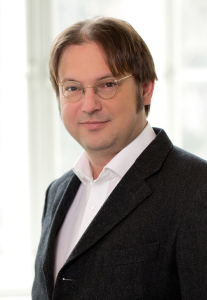
Stefan Thurner analyzed the anonymized medical records of all of Austria.
Medical University of Vienna/Matern
Stefan Thurner analyzed the anonymized medical records of all of Austria.
The work is being driven by the realization that diseases, as defined in medicine, sound like tidy, distinct entities, but are messier in reality. Diseases tend to be defined by their symptoms. But the molecular roots of a disease may have biological effects that go far beyond our current understanding. Certain diseases tend to follow others or have high rates of comorbidity, and though it isn’t clear why, it may be because they arise from related biological flaws.
“The idea is, connections at the cellular level get amplified at the population level, and they emerge as comorbidity,” said Albert-László Barabási, a physicist at Northeastern University who has published several landmark papers in this area, including a 2009 article in PlOS Computational Biology that helped inspire Thurner, as well as a 2011 review of the field in Nature Reviews Genetics. Using a disease network, a researcher might suggest that biologists look for new disease genes shared between diseases one and two, for instance, where there seems to be a strong connection.
Biologists typically look for genetic connections by using genome-wide association studies, which statistically associate genetic markers with disease. But at Harvard Medical School, another research team is attempting to find the same connections by mapping networks of a very different kind: the molecular networks at work in a cell.
Networks of Life
The inside of a cell seethes with activity, as tiny molecules, enormous proteins and strands of DNA wash around each other going about their business. Each actor’s business is some set of other actors — a protein, for instance, might snip pieces off of other proteins, ferry molecules around, or jump-start the manufacturing of DNA. It takes its cues from other actors, which can make it work faster or more slowly or send it off to distant regions where it’s needed.
The functioning of the cell can take on a very different character if even a single member of this molecular social network starts to behave oddly. Before long, the effects ripple outward from the initial flaw, causing problems — disease — on the level of the organism. A disease is in some sense just an expression of the underlying dynamics of this social structure. Thurner hopes his disease networks can eventually help uncover some of these flaws.
And it’s here at the sub-microscopic end of things that Joseph Loscalzo, a professor at Harvard Medical School and a long-time collaborator of Barabási’s, is mapping his own network. He and his team start by gleaning data from numerous databases on which proteins interact with each other and how. Then, using a computer model, they sketch out the social network within an average cell, connecting individual genes and proteins to one another if they happen to interact. Loscalzo’s team has built a diagram with 13,460 protein nodes and 141,296 links. (These interactions probably account for only about 20 to 25 percent of the total, Loscalzo says, but it’s a start.) Then they isolate just the nodes that have been statistically linked to a given disease. They call this set of nodes the disease module.
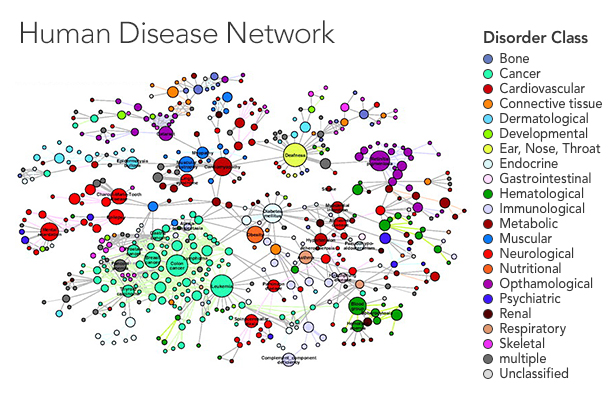
A human disease network maps out connections between diseases — if patients who have one disease tend to also have another, the two disease nodes are connected.
Olena Shmahalo/Quanta Magazine; source: Albert-László Barabási
A human disease network maps out connections between diseases — if patients who have one disease tend to also have another, the two disease nodes are connected.
One disease module they’ve studied is for pulmonary hypertension — high blood pressure in the lungs, which can cause heart failure. They looked at all the molecular pathways that genome-wide association studies suggested were involved. They then studied which pathways grow more active in animal models and in pulmonary hypertension patients under stress. Their disease module revealed that two proteins previously linked to some forms of the disease were part of the same molecular pathway and that they work together to cause errors in cell proliferation, which may be linked to the symptoms of the disease. The researchers published their findings in the journal Pulmonary Circulation.
Another module looks at Type 2 diabetes. Researchers have linked diabetes to about 200 spots on the genome through genome-wide association studies. “The first 18 or so of those are highly significant, but the last 182 or so are just at the margin,” Loscalzo said. But in the disease module, it was clear that some of those 182 genes were highly connected hubs in the social network, a state of affairs that a genome-wide association study alone is not equipped to reveal. “We’ve explored three of those [genes] now, and they highlight pathways that had been peripherally believed to be associated with diabetes but never demonstrated in any careful way,” he said.
Combining Loscalzo’s molecular networks with Thurner and Barabási’s disease networks would help to create a bridge between correlation and mechanism. If comorbid diseases share overlapping molecular networks, researchers could use the networks to understand the biochemical mechanisms behind them. These two kinds of networks, very different in how they are built, are united only by the idea that data can reveal connections that otherwise would pass unnoticed. But together these networks have the potential to open new doors in the study of disease.
“Once you draw a network, you are drawing hypotheses on a piece of paper,” Thurner said. “You are saying, ‘Wow, look, I didn’t know these two things were related. Why could they be? Or is it just that our statistical threshold did not kick it out?’” In network analysis, you first validate your analysis by checking that it recreates connections that people have already identified in whatever system you are studying. After that, Thurner said, “the ones that did not exist before, those are new hypotheses. Then the work really starts.”
It is worth remembering that both techniques are still relatively new. Loscalzo can reel off ways that his results could be flawed — the sprawling incompleteness of the data on protein-protein interactions is a major concern, but so are the methods used to gather the data, which are the best currently possible but far from perfect. And Thurner and his students are still gathering collaborators in biology who can test their hypotheses. After they published their first results from the database a couple of years ago, Thurner said wryly, “we thought we would have a hundred people sitting in our office,” looking to collaborate. So far, the response has been more of a trickle.
“It’s not uncontroversial,” said Andrey Rzhetsky, a professor of genetics at the University of Chicago with a background in mathematical biology who has published on comorbidity networks. “Some people feel very strongly about big data sets — almost to the point of fanatic refusal to accept results from large-scale analysis.” The argument, he explains, is that there are unknown biases in large data sets. In the case of databases like Thurner’s, these biases stem from the different ways doctors enter information into medical records, the way ethnicity is accounted for, and so on. Rzhetsky acknowledges the danger of biases but believes they do not eliminate the usefulness of the data, provided researchers are careful with their interpretations. “I do think it’s the direction for the future, but it’s far from a solved problem,” he said. He was intrigued by the article in the New Journal of Physics. “The model is extremely simple, but the direction is great,” he wrote in an email.
Loscalzo is aware of his colleagues’ scrutiny. “When I give talks about network medicine,” he said, “I’ve gotten three kinds of responses. At one end of the spectrum are generally young people … who say this is a great idea, I hadn’t thought about this before. … At the other end of the spectrum I have people my age or older who say: ‘What are you talking about? I’m a member of the National Academy and that’s all based on reductionist biology, I’m not going to change my strategy.’ Then in the middle you’ve got this broad swath of people who have a healthy skepticism and who want there to be some sort of proof that these notions can give us new insights. And that’s what we’ve been working on.”

Tuesday, December 11, 2012

"Fiscal Cliff" Threatens to Impede Biomedical Discoveries 12-12


"Fiscal Cliff" Threatens to Impede Bio-medical Discoveries


Brianna Commerford felt a lump. After a few months of feeling mildly ill, she was diagnosed with stage IV Hodgkin’s lymphoma. She was devastated, she was scared, and she was only 9 years old.
Five years later, Brianna is still alive thanks to an experimental treatment she received from the Children’s Oncology Group. Devoted to curing childhood and adolescentcancer, the COG is a clinical trials group that is primarily supported by the U.S. National Institutes of Health (NIH), the largest sponsor of biomedical research in the world.
This month scientists nationwide are petitioning to protect lifesaving research programs like this one before January, when the federal government will automatically slash—or “sequester”—8.2 percent ($2.5 billion) of the NIH budget for 2013 unless Congress stops the move. The money will be withheld because of provisions in the Budget Control Act of 2011 that aimed to cut spending. Combined with the scheduled finale of the Bush-era tax cuts, the provisions are expected to push the country over the now proverbial fiscal cliff.
Separate from the scheduled downsizing of Medicare (2 percent or $14 billion), the NIH cuts threaten to corrode the foundations of biomedical education and research in the U.S. Agencies including the National Science Foundation, NASA and the Department of Defense would also be saddled with lighter coffers. The prospect of deep cuts is particularly alarming to biomedical researchers because the cutbacks would come at a time of already strained budgets.
From 1999 to 2003 the federal allocation for the NIH doubled, which triggered a tremendous boom in the biomedical workforce, according to a 2008 report from an NIH advisory committee  . In the years following, though, federal support has failed to keep pace with this expansion in labor; rising inflation and three cuts to the NIH budget in the last seven years have meant that budgeted funds largely go to maintaining the status quo rather than to fresh initiatives.
With fewer awards available, this shortfall has incited fierce competition for federal grants, and consequently the success rate for winning an NIH grant is now at its lowest level in American history. The global financial meltdown of 2008 strained matters further when several private foundations were forced to shut down.
“The sequester could affect both existing and future grants,” says Christy Gullion, an advocate for the University of Washington, which would potentially lose $83 million next year. She has been lobbying in Washington, D.C., since the summer of 2011, when lawmakers resolved the debt-ceiling crisis by passing the Budget Control Act. “We are in uncharted territory if the sequester takes effect.”
Far from the nation’s capital in the birch forests of Maine, many aspiring biologists opt to spend their free hours in the laboratory of Richmond Thompson, a neuroscientist at Bowdoin College. His studies on how different chemicals in the brain—such as vasopressin, vasotocin and testosterone—affect social behavior offer the perfect research opportunity for intrepid minds.
Thompson’s mentorship program receives part of its support from the NSF through its Broader Impacts initiative, which emphasizes undergraduate education and provides monies for students to perform research during the summer.
“At small schools like Bowdoin, we use undergraduates to do a lot of our research,” says Thompson. “If the money starts to disappear, not only does our research start to slow down, but it also means far fewer experiences for undergraduates.”
Another scientist fearing the aftermath of the sequestration is Puneet Opal, a neurologist at Northwestern University who has published an editorial opposing the cuts in The Atlantic  . He studies spinocerebellar ataxia type 1 (SCA1), a genetic brain disorder that strikes in adulthood, causing the progressive loss of balance and of muscle control in the face.
Opal’s lab recently discovered a connection between motor dysfunction in mouse models of SCA1 and VEGF, a protein that promotes the growth of blood vessels. His lab wants to study this link in patients, but whether clinical studies can begin will ultimately depend on receiving grants from the NIH next year.
This doomsday scenario has some wondering: is U.S. biological research too dependent on the NIH? At many universities, the NIH pays for almost everything: grad students, professor salaries and equipment. Nature published an analysis   on December 6 week that suggests this relationship can actually stifle scientific ingenuity. But even the study’s author, John Ioannidis, believes research funding “should be dramatically increased overall, and even more so for investigators with bold ideas.”
Last week the Associated Medical Schools of New York held a press conference urging Congress to find a resolution. One in 10 doctors in the U.S. is trained in New York, and medical centers are among the state’s biggest employers. The New York economy stands to lose approximately $1.25 billion in 2013 if the NIH budget cuts are made.
“It would imperil thousands of people,” said Jerrold Nadler (D-NY), who was joined at the meeting by fellow U.S. House representatives Charlie Rangel (D-NY) and Carolyn Maloney (D-NY), academic deans from NYC-based medical centers and patient advocates, including 14-year-old cancer survivor Brianna Commerford.
Fighting back tears during her testimony, Brianna expressed her gratitude for the scientists who discovered the drug that saved her life. “No kid should have to endure the pain and suffering that comes with a cancer diagnosis,” she says. “Research is a sign of hope for these kids and their families. Taking funds away will certainly take the hope away…from everybody.”