Shyam's Slide Share Presentations

VIRTUAL LIBRARY "KNOWLEDGE - KORRIDOR"

This article/post is from a third party website. The views expressed are that of the author. We at Capacity Building & Development may not necessarily subscribe to it completely. The relevance & applicability of the content is limited to certain geographic zones.It is not universal.

TO VIEW MORE CONTENT ON THIS SUBJECT AND OTHER TOPICS, Please visit KNOWLEDGE-KORRIDOR our Virtual Library

Showing posts with label social media platforms.. Show all posts

Wednesday, February 25, 2015

Leveraging Social Networks to Drive Collaboration and Improve Execution 02-25


Leveraging Social Networks to Drive Collaboration and Improve Execution.


Image credit : Shyam's Imagination Library

Tuck Executive Education partners with companies to address unique challenges they face. As part of a learning initiative with a custom client, Tuck Professors Pino Audia and Adam Kleinbaum designed, administered, and analyzed a network survey completed by over 1,000 directors and managers at the company. The respondents identified the managers, directors, and vice presidents they most regularly interfaced with in carrying out their role at the organization to generate survey data that showed how they saw their own network and how others perceived them. Summary data was used in faculty-led sessions to help participants understand the informal roles people play in organizations and to think what their results say about the roles they play. 

Representative examples they discussed include: Participating executives explored the power of building relationships across divisions, functions, and levels and the benefits of different types of networks. For example, Sparse networks are useful for efficiently gathering and disseminating information Dense networks are useful for effectively coordinating work in a cohesive group   This is powerful learning for leaders of an organization that is committed to innovation. For example, someone with a large and sparse network is more likely to see innovation opportunities across the organization and promote the possibilities. 

These “superconnectors.” have networks that are Large, in the sense that many other people cite them as contacts Sparse, in the sense that they are connected to people in disparate parts of the organization, who are not otherwise linked to each other Integrative, in the sense that they bring together contacts across divisional boundaries   When it comes to execution, someone with a dense network may be more likely to have the kind of deep relationships needed to bring together people and resources needed to implement the idea. In addition to sharing individual reports with program participants, network survey data can be used by human resources professionals to understand and improve collaboration across the organization, foster a “one-company” mindset, and leverage the strengths of different divisions and departments to drive innovation. Are functions or departments that are expected to work together well-connected through the networks of their members? Are individual high performers under- or overestimating their networks? 

A social network survey can help the organization: Map which parts of the organization are isolated Identify where breaking down silos may improve collaboration Identify high-potentials who are powerful but not part of the formal power structure Identify superconnectors Promote and move around those who are good at networking to build a stronger organization Map where women and minorities are isolated in order to strengthen diversity and inclusion Identify mentors for key hires from outside the organization   Social network analysis can help break down silos by measuring individual networks and how they link disparate units.

Aggregate data can provide division heads and functional heads with a way to assess alignment of individual networks to the needs of their unit and guide corrective actions; this is especially important for functions or divisions that are expected to work together to maximize effectiveness. If you are interested in working with us on a social network analysis initiative, some key steps include the following: Conduct an organizational assessment to get alignment on desired outcomes, participants to be included in the analysis, and an understanding of interdependence among units. Collect and analyze network data, using either survey data or electronic communication data, such as e-mail or instant messaging Produce reports at both the individual and organizational level Design and deliver leadership development sessions focused on the analysis Help create follow-up interventions.

Sunday, February 15, 2015

How Twitter plans to move beyond its 288 million monthly active users 02-15

How Twitter plans to move beyond its 288 million monthly active users

With tweet syndication and video, the social media giant is looking to spread its influence across the wider web and this is good news for marketers.


In a series of recent announcements, Twitter has started to flesh out its vision for commercialising its massive off-platform reach. Syndicated tweets will allowmarketers to take their real-time content efforts and spread them right across the wider web, while the increased focus on video hints at longer-term opportunities.Facebook managed to turn its mobile weakness into one of its biggest strengths, the question now is whether Twitter can capitalise on the opportunity that its wider cultural footprint offers it to do the same.
It’s easy to admire Twitter’s vision to be the closest connection between people and what’s most important to them, but it takes something of a leap of faith to believe they’re going to do that for more of us than any other service. The 288 million monthly active users announced on their recent earnings call is a mightily impressive number, but less so when compared with Facebook’s 1.39 billion usersor the numbers for platforms you might never have heard of including QQ, QZone,WeChat or even Instagram, all of which have at least 300 million users.
Far from being a distant pipe dream though, the most surprising fact is perhaps that Twitter may be pretty close to achieving its world leading ambitions. Around 500 million additional logged out users visit the site each month, and in Q3 2014 alone there were approximately 185bn impressions of tweets off of Twitter. These tweets appear in newspapers and magazines, get quoted on TV, are embedded across the internet, and even pop up in Google search results, in fact the only way to completely avoid Twitter’s wider reach is to avoid these other media outlets altogether.
It’s a powerful story, and one enticing to marketers who know that ultimately they need to get their messages in front of as many of the right consumers as possible. This high visibility across other media, and heavy personal use within the industry, are some of the reasons brands have already begun heavily investing on the platform with its quarterly earnings hitting nearly $500m. Twitter’s challenge, and the reason Wall Street investors remain hesitant, is that to date there has been little opportunity to commercialise this off-platform reach.
While the idea of brand messages spreading out to an audience of hundreds of millions of non-users is appealing to marketers, the unfortunate reality is that it isn’t their tweets currently benefiting from this scale. Around big sporting events for instance, mainstream media picks up messages from the players, sporting experts, or even whichever member of the Kardashians happened to attend – unfortunately they don’t typically also include your favourite car brand’s latest promotions. Traditional celebrities, established experts and a new world of social influencers are driving this scale, not the brands who most want to benefit from it.
The new syndicated tweets product allows brands to take any of their Twitter content and push it out as native advertising to millions of consumers across a series of partners, starting with Flipboard and Yahoo! Japan. This presents a powerful opportunity to scale up all content campaigns and will help silence critics who in the past have used suggestions of Twitter’s low local user penetration to dismiss the platform.
Real-time marketing isn’t right for every brand, but for those who do go down that route, being able to break that activity out of social jail makes it a lot more disruptive and impactful. Brands looking to respond to big events have struggled, with very few exceptions, to get much share of voice but being able to take their latest content and push it right across the internet will help drive truly meaningful scale.
Of course just as Twitter themselves have started to talk about the broader opportunities on the native platform, syndicated Tweets will also do much more – helping drive direct response initiatives, CRM work and more general campaign & sponsorship extensions. When you consider how Twitter has evolved the tweet over the past couple of years (with cards bringing a range of functionality from website previews to interactive elements) you start to see the beginnings of a vision for a completely new ad format, anchored by a brand’s Twitter presence.
And as for video? Both Facebook and Twitter have made heavy advances in their own native functionality and built out powerful propositions for marketers, but the latter’s additional reach might yet be its trump card here too. Journalists are used to embedding tweets into their articles and as more of this content becomes video based they will naturally start embedding that too. Twitter will begin to find its video content playing out in the far corners of the web right where so many of its Tweets are already being read.
While embedded text ultimately offers little commercialisation opportunities, we’re far more used to seeing advertising associated with video – over the coming months Twitter will begin serving hundreds of billions of video impressions right across the internet, each one potentially an opportunity to engage consumers with carefully targeted pre-roll videos (although they’ve made no announcement of such a product to date). It’s an area that Facebook lags behind in and although YouTube has a long history of being the embedded video format of choice Twitterlooks set to be its most credible threat in years.


Friday, February 13, 2015

Facebook Continues To Dominate Social Logins, Expands Lead To 61% Market Share 02-13


Facebook Continues To Dominate Social Logins, Expands Lead To 61% Market Share


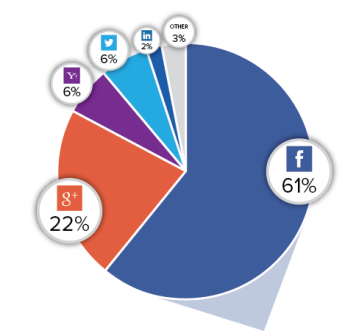
Facebook has long been the dominant player in social logins and it continues to expand its lead, according to the latest data from identity management platform Gigya.

For the first time since 2011, Facebook surpassed the 60 percent mark and powered 61 percent of all social logins on Gigya’s network in the last quarter of 2014 (up from 58 percent in the previous quarter and up 10 percent from a year ago).


For the most part, Facebook is taking market share away from Google at this point. Google’s overall share on Gigya’s network dropped from 24 percent in the third quarter of 2014 to 22 percent in the last quarter.

On mobile, Facebook’s dominance is even more pronounced. There, it owns 77 percent of all social logins, up from 62 percent in the previous quarter. All of those gains came at the expense of Google, which dropped from 28 percent to only 16 percent.


Facebook is pretty much dominant across all business segments. It powers 72 percent of social logins on e-commerce sites, for example, and 76 percent on education and non-profit sites. The one small exception is media sites, where it “only” has a 55 percent market share. That’s not a bright spot for Google either, though, as it only owns about 21 percent of that market, too, while Twitter and Yahoo are relatively popular with 11 percent and 8 percent market share, respectively.

I asked Gigya CEO Patrick Salyer how he explains this trend. “We’re seeing that Facebook’s line-by-line controls for Facebook Login are making a big difference for how consumers interact with Facebook as an identity provider,” he told me. “While the difference was most pronounced on mobile in Q4 2014, we’re seeing an overall trend that Facebook continues to make progress in the war for identity.”

Looking ahead, he also believes Apple’s Touch ID could become a major threat to existing log-in providers. “If it gets traction with developers as an authentication mechanism on mobile apps, it could really start to eat Facebook’s lunch in identity.”
Yahoo, by the way, saw the largest drop. Yahoo once accounted for 18 percent of all logins and is now down to 6 percent — on par with Twitter’s social log-in numbers, which have grown slowly over the last year.

View at the original source

Thursday, November 8, 2012

Do You Hire For IQ Or Klout Score? 11-08


Do You Hire For IQ Or Klout Score?
BY ANDREW RAZEGHI 
 OCTOBER 29, 2012

What is the right balance between intelligence and social connectivity? From an innovation perspective, this difference is very significant. In fact, it can mean the difference between success and failure.

In the past decade, the word “friend” became a verb, the word “like” became a noun, and “tweet” became more than a birdsong. Social technology--originally designed for communication between college co-eds--has since brought down governments in Egypt and Tunisia. Thomas Payne would have been proud.
We are outrageously connected. Today, the average American has roughly 600 online and offline relationships (ironically, our number of “close friends” has remained relatively unchanged at 2.16. And yes, the 0.16 is the one who still owes you money.)
As a result of our hyper-connectivity, we are fast-moving from what management scholar Peter Drucker called the knowledge economy to a social economy. The line is quickly blurring between the value of what we know and who we know. This then begs the question: which is more important? Is it more valuable to have the answer? Or is it more valuable to know who has the answer?
In an academic environment we call the latter cheating. But in the corporate world, does it really matter if you know the answer to the problem, or is it more important that you can find out who does? In very practical terms, consider the impact of our social economy on recruiting new employees and professional development. Given a choice of hiring an expert with a high IQ or a generalist with a high Klout score (a measure of social influence), whom do you hire? Or does it depend upon the task? In sales and marketing roles, the extent of one’s personal and professional network along with his or her influence score should be considered. Shouldn’t it?
What is the right balance between intelligence and social connectivity? From an innovation perspective, this difference is very significant. In fact, it can mean the difference between success and failure.
Consider one of the most famous innovation battles: Tesla vs. Edison.
Nikola Tesla, the multi-talented engineer and father of Alternating Current (AC), was--no doubt--a genius. His knowledge in electrical and mechanical engineering led to a series of inventions that had impacts on radio communication, X-ray technology, and even attempts at intercontinental wireless transmission (his famed Wardenclyffe Tower). Yet, although he beat Edison in setting the electrical standard, he was a recluse and ultimately lived his finals days in room 3327 at the New Yorker Hotel where died in poverty in 1943.
On the other hand, we have his nemesis--Thomas Edison. Edison, whose Direct Current (DC) lost out to Tesla’s technology, led a fruitful life and died a wealthy man. What was the difference between Tesla and Edison?
While there are many, perhaps the most notable difference when it comes to innovation was the nature of their social networks. Tesla had essentially one productive relationship: George Westinghouse (who licensed and commercialized Tesla’s technologies). Edison, on the other hand, was famously well connected. Edison understood the power of social networking long before it became a pick-up tool for college co-eds. Among Edison’s network were automotive pioneer Henry Ford, tire innovator Harvey Firestone, naturalist and essayist John Burroughs, Bishop William Anderson, and--for good measure--the then sitting President of the United States, Warring G. Harding. Known famously as the Vagabonds, in 1918, this creative crew even went camping together in the Smokey Mountains (in Ford’s cars using Firestone’s tires of course).
While Tesla invented in isolation, Edison created out loud. He understood the value of a social network. And while Edison’s original patent application for the electric light bulb was rejected, he acquired and licensed technologies and attracted the best and brightest engineers to join him in the commercialization of his electrical lighting system.
This difference between innovating privately and innovating out loud is one of the most significant differentiators between successful innovators and those that fail. It largely explains the success of new venture accelerators, corporate new venture groups, and even academic researchers. Those with the most robust, engaged, and diverse social networks win. For example, I am a Limited Partner at the new venture accelerator Excelerate Labs in Chicago. Each summer summer, our ten portfolio companies are connected to and coached by over 150 mentors. Imagine not only the sparks of insight that are encouraged, but imagine the connections that are made. Success only happens to those who innovate out loud. Your idea is worthless if no one cares about it, but it’s worth even less if no one knows about it.
Herein lies the fundamental--and often misunderstood--difference between creativity and innovation. Creativity is how you think. Innovation is how you act. In academic circles, cognitive scientists study creativity. Social scientists study innovation. Of course, creativity and innovation are intrinsically connected. However, while most innovators are also creative not all creators are often innovative. Creative people--artists, designers, and inventors--frequently lack the social and political skills required to make their ideas commercially viable. And so they fail.
Organizations suffer the same fate. Those organizations that encourage innovation among their employees yet do not provide the channels of distribution--both internally and externally--for those ideas to be socialized within the company and within the market, often do nothing more than create great expectations and equally great frustration among employees. In order to succeed, we must teach individual employees how to be innovators as much as creators. Thinking differently is only half the battle. Acting differently (notably, learning how to socialize new ideas) can be the difference between success and failure. One of the greatest opportunities to improve talent development is in helping employees learn how to create internal and external coalitions for their creative ideas. Building political equity and market acceptance of an idea is not a skill explicitly taught in school, yet it is perhaps the most fundamental skill that will be required for organizations to succeed in the future.
This shift FROM a knowledge economy TO a social economy raises a number of questions for you to consider with your team:
·         How do you currently evaluate and place prospective employees?
·         Do you consider the social influence of new talent in your recruiting process?
·         Do you have a process for evaluating which types of projects should be managed collaboratively (socially) versus individually?
·         Where appropriate, how do you encourage and foster social networking across your organization?
·         How do you encourage and foster external collaboration outside of your company and across sectors of industry?
·         What incentives and performance management systems do you have in place to encourage “creative teaming” vs. “functional innovation”?
·         What are you doing to help your leaders understand their role in transitioning from a knowledge economy to a social economy?