Shyam's Slide Share Presentations

VIRTUAL LIBRARY "KNOWLEDGE - KORRIDOR"

This article/post is from a third party website. The views expressed are that of the author. We at Capacity Building & Development may not necessarily subscribe to it completely. The relevance & applicability of the content is limited to certain geographic zones.It is not universal.

TO VIEW MORE CONTENT ON THIS SUBJECT AND OTHER TOPICS, Please visit KNOWLEDGE-KORRIDOR our Virtual Library

Showing posts with label Start-up Founders. Show all posts

Monday, September 10, 2012

10 business courses we wish they offered in college 09-10


10 business courses we wish they offered in college

September 10, 2012: 8:37 AM ET


By Martin Zwilling
sadgradFORTUNE -- I'm sure that every one of us who has been out in the business world for a few years can look back with perfect hindsight and name a few college courses we should have taken. What's more disconcerting to me is that I can name a few that weren't even offered, and more than a few students who graduate ill-prepared for the real world!
I won't even try to cover here the ones you didn't find for your personal life, like managing personal finances and credit. But on the business side, here is my list of useful courses that we wish existed, but as far as I know, still aren't generally available:
  1. Basic Office Politics. Office politics involves the complex network of power and status that exists within every business, large and small. Don't you wish that someone had prepped you on how to read the body language, interpret office gossip, and when to hit the delete key on your email rather than the send key?
  2. Business Writing for Email. Writing in business is not the same as in an academic environment. In school, you're taught to stretch weak ideas to reach your document page limit. The business world expects exactly the opposite. The challenge is to communicate your idea in one page, and close the deal quickly without a big slide presentation.
  3. Touch-Typing for Dummies. How many hours a day does the average professional and executive today spend hunched over a computer keyboard "hunting and pecking"? Throughout a career lifetime, just think of the return on that investment.
  4. Dress for Success. "You are what you wear" works in business, just like it did in high school. But no one tells you the business norms, so Gen-Y'ers come to work in jeans, baseball caps, tattoos, flip-flops and expect to be treated as executives.
  5. Demystifying Business Logic. Another term for this is how to be a skeptic. Understand the ways people can mislead deliberately or accidentally with numbers, bad logic and rhetoric. There's some untruth hidden in 99% of everything you're told. Can you find it?
  6. Business Budgets and Benefits. The focus here would be on the actual nuts and bolts of how things get budgeted and financed in business. This will pay big dividends in getting your favorite project funded, or justifying your own salary, or negotiating a bonus.
  7. Business Sales Techniques. We can find tons of "marketing' courses in colleges and universities but everyone must think that "selling" is intuitively obvious. The art of selling is complex blend of relationships, persuasion techniques, negotiation, and knowledge.
  8. Root-Cause Problem Analysis. Business professionals need to analyze problems from a big picture perspective. Most classes in college focus on a narrow area of interest, which just teach students to focus on problems through one lens. That's how unforeseen consequences go unforeseen.
  9. Minimizing Business Workloads. In the office world there's always way more work than there is time to do it. You need to be able to figure out what not to do, and how to not do it, by organizing and prioritizing, and still impress your boss with your thoroughness.
  10. Job Hunting Basics. People need realistic expectations about how much effort and time it takes to get just about any job. Atrocious resumes and social network antics will kill your career. The difference between job descriptions and accomplishments seems to elude most people.
The real problem for many of these, I suspect, is finding qualified instructors to teach. Until then, the best alternative I can recommend is to sign up for job internships at every opportunity, while still in school. You might find on-the-job experiences more valuable than all your other courses, or you might change your major.
Amazingly, it seems that people in business are more highly educated these days, but less prepared than ever before. What's another course that you wish you had taken in school, but didn't realize was missing until too late? There's another generation right behind us that needs to know.
Marty Zwilling is CEO & Founder of Startup Professionals Inc.

Saturday, May 12, 2012

The Salesman and the Developer 05-13


The salesman and the developer

A salesman and a developer go on a bear hunting trip.
They arrive at the cabin in the woods and start unpacking the car, moving stuff into the cabin, getting things ready for a week of bear hunting in the wilderness. The salesman quickly gets bored of this and says:
"Tell you what, you continue unpacking and getting everything ready, and I'm going to go and find us a bear."
The developer sighs and nods (he's used to salesmen), and continues setting up while the salesman vanishes in the woods.
Half an hour later, as the developer is about three quarters done with getting things ready (the cabin is now all neat and tidy at last), he hears a very loud growl as he comes out of the cabin. Twenty metres away, the bushes start shaking. Out shoots the salesman. Right behind him, a huge, snarling, drooling, roaring monster of a bear. It's twice the size of a normal bear, and it's very, very angry.
As the developer hides behind a chair, the salesman runs right up to the cabin, with the bear on his heels, and just as he's about to go through the door he quickly leaps to the side. The bear crashes past him right into the cabin, and the salesman deftly closes the door right behind, locking the bear in. Loud noises can be heard as the bear begins trashing the inside of the cabin.
The developer emerges from behind the chair. The salesman cheers and says:
"Woohoo! That's the first one. Now, you kill him and skin him, I'll go find us another!"

Two perspectives

There are two ways to understand this story, and which way you favoured largely depends on whether you're a "builder" type or a "sales" type.
If you're a builder type, you see this as a great story that illustrates a common problem with salespeople: they don't seem to care about what happens after they make the sale. Actually delivering the project is hard work, but by then the sales guys have moved on to something else, so they don't care (and, as an additional problem, in some industries the salespeople will sell stuff that can't be realistically delivered).
However, if you're a sales type (like my cofounder, Paulina), you have a different perspective on this story. It's yet another story that makes fun of salespeople while completely discounting just how hard it is to not only find that damn bear, but bring it back and get it through the door.
Who's right, then? Both, of course. In business, you need both to find and sell clients, and the ability to then deliver what you sold them. One without the other is not a business.

Sales is not optional

Many people who "do startups" these days are from a technology background. In other words, they're builders rather than salespeople. And, like all builders, they tend to disregard sales as something that can happen later, something secondary that we'll solve when we get to it.
Well, sales isn't secondary. Speaking as a builder type myself, and having experienced businesses both with competent sales and without, I now believe that having someone whose job it is to go and find clients willing to give you money from day one is so important, that I would not start any company without such a person.
Sales don't happen without someone energetically pushing the product, service, or whatever it is you're intending to sell. Some may dream of products that sell themselves, like Dropbox or the original Apple II, but even awesome products like those took serious sales effort to get off the ground. Apple had Steve Jobs, one of the master salesmen of his generation, pushing the product everywhere he could and striking bold deals to get the company off the ground. Dropbox endlessly tweaked their referral scheme before they went viral.
Some few businesses like Google or Facebook or Instagram get to figure out the business model later. They can do without sales, perhaps. But this model only works in one place in the world, and unless you're starting up in the Silicon Valley bubble, your business is not a business without sales.

Sunday, April 8, 2012

Are first born more likely to be a Start-up Founder???


Why You’re A Startup Founder: Nature And Nurture


baby computer
Editor’s note: Pokin Yeung founded two startups, GeckoGo and Askomatics, and is currently blogging and helping out various other startups. Follow her on Twitter @pokin.
Just over a month ago, a random conversation with another startup founder over lunch turned into a full-blown research project.
“You and I are both first-born children,” I mused to my friend, “I wonder if that had any influence on why we chose to start businesses.”
I theorized that first borns were often given more responsibility growing up, and wondered if this role served as training wheels for building startups. I also wondered if our upbringing had an influence on things like when we start, what we start, or how much money we raise — and ultimately, how successful we are with our businesses.
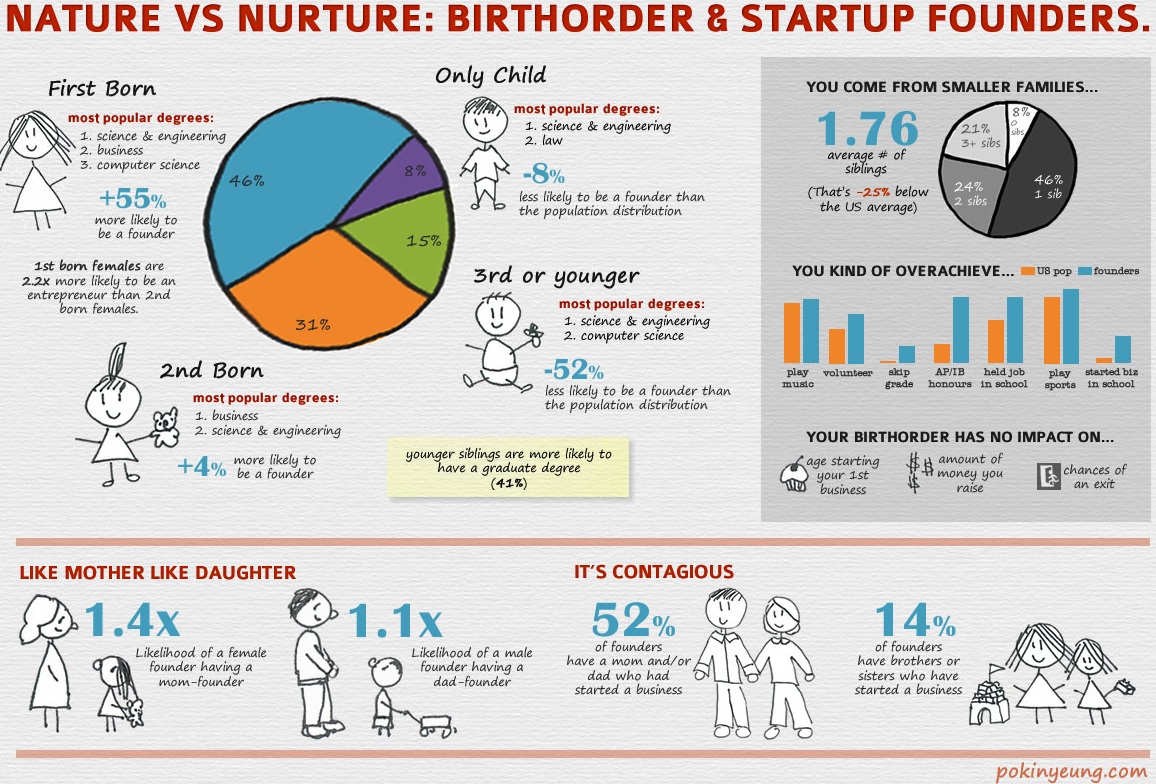
Four weeks, a survey of 318 founders, and a lot of data-crunching later, here are my conclusions:
Family Matters
  1. Your birth order does influence the likelihood you will be a founder. If you’re a first-born, you are more likely to be a founder — 55 percent more likely than the population distribution. Just under half (46 percent) of our founders were first-born children, and I fit into this category. If you come from a two-child family, this effect is larger. You’re 63 percent more likely to be a founder than the second born child.
  2. If you’re female, this effect is huge. Female first-borns are 118 percent more likely than second-born females to be founders if they come from a two-child family. I fit into this category, too. Maybe the capricious nature of sibling relationships combined with the leadership (read: guess-who’s-in-trouble-if-something-happens-to baby-sis) role gives us more comfort in the rock-and-roll world of starting companies.
  3. Second-born children are slightly more likely than the general population to be founders, but beyond that the chances actually decrease.
  4. Third-born or later children are 52 percent less likely to be a founder.
  5. Only children are underrepresented, and it’s statistically significant. Only children have been described as “First Borns on Steroids.” They are typically more likely to become CEOs and be hyper-achievement oriented.  Yet they are underrepresented in our study. Could it be that only children prefer to rule larger, more established companies?  Or is it something about the uncertain dynamic of having siblings to fight with that gives first borns the skills and motivation to take the leap?
  6. There is no correlation between your birth order and your chance of raising money or having a successful exit.
Startups run in the family
The data suggest that your parents can shape your inclination to become a founder – especially if your mom was an entrepreneur and you’re a girl. Female entrepreneurs are 1.4 times more likely to have a mom who was also a founder. Over 50 percent of our founders surveyed have a parent who had also started a business, and 14% of respondents have a brother or sister who’s taken the leap. So it seems having a good role model matters — especially for females. Organizations like Women 2.0 are a good start, and more access to mentorship programs during the formative years could make a big difference in bringing more female founders into play.
Higher education or trial by fire?
Startup founders have to do a lot of multi-tasking, but two things that don’t seem to mix are school and startups. Most founders tend to wait till school is done before starting their first business. In general, by the time founders are 25
  • 74 percent of you had started a business if you didn’t have a college degree.
  • 55 percent if you had a bachelor’s degree.
  • 24 percent if you had a graduate degree.
Also, 50 percent of you waited till after 30 to start your first business if you had a graduate degree.
How else do you compare against the population? For starters, you overachieve.
Startup founders in general tend to overachieve. You are 6.4 times more likely to have skipped a grade, and 6 times more likely to start some sort of business endeavor (selling candies, anyone?) while still in school. Across the board, startup founders are more likely to more likely to do things like play sports, play a musical instrument, or hold a part-time job while still in high school. Maybe it’s a desire for learning, general well-roundedness and drive for growth that creates the motivations for founders to strike out on their own? Or maybe it’s a curiosity about the world. Lots of potential theories and areas of further research.
So what next?
The specific circumstances that push founders to take the leap definitely involves more than the sequence in which founders arrive to their families, but it does seem clear that once you become a founder, you stand to quite strongly influence future generations to come.
There were other interesting areas of research, including the types of adversity faced by startup founders growing up, and it’s what I want to dig into next. If anyone is interested who didn’t participate in my study before, I’d love to ask you some questions here.
startup-birthorder-infographic