Shyam's Slide Share Presentations

VIRTUAL LIBRARY "KNOWLEDGE - KORRIDOR"

This article/post is from a third party website. The views expressed are that of the author. We at Capacity Building & Development may not necessarily subscribe to it completely. The relevance & applicability of the content is limited to certain geographic zones.It is not universal.

TO VIEW MORE CONTENT ON THIS SUBJECT AND OTHER TOPICS, Please visit KNOWLEDGE-KORRIDOR our Virtual Library

Saturday, October 31, 2015

Enormous, ‘catastrophic’ landslide in northern Canada almost went undetected by humans 10-31


It was enough rock and ice to equal the weight of 33 million pickup trucks. And for an earth-shattering two minutes, it barrelled down a mountain at nearly 200 km/h, pulverizing everything in its path.

And the Yukon didn’t even know it was there.

“Most likely it would have been missed,” said Colin Stark, one of two Columbia University geologists who spotted the “catastrophic” event from more than 5,000 kilometres away.

Expected to rank among the world’s 10 largest landslides for 2015, the slide saw a massive chuck of rock and ice slough off Mount Steele, Canada’s fifth highest peak.

If the Oct. 11 slide had struck in a populated region of India or China, hundreds would be dead. Even in Canada’s sparsely populated Rocky Mountains, it would have at least blocked a highway or buried a wilderness lodge.

But it occurred in a remote corner of Kluane National Park, Canada’s Wales-sized contribution to a swath of protected land stretching all the way to Anchorage, Alaska.

Jennoit/Jenn/Wikipedia

“That particular area, as the crow flies, is about 70 kilometres to the Alaska Highway; people aren’t back there very often,” said Jeff Bond with the Yukon Geological Survey.

Quite often, said Bond, the only way remote Yukon landslides are recorded is if some bystander happens to phone it in.

“We hear about them from helicopter pilots who say, ‘hey, did you guys know about this big slide?’ ”
In the summer of 2014, for instance, a landslide plowed into a creek within Kluane National Park, violently creating Canada’s newest lake. But it wasn’t until six months later that the change happened to be spotted by an off-duty parks employee who was out for a hike.

Credit for discovering the Oct. 11 avalanche falls to Stark and his research partner, Göran Ekström.
Operating out of Columbia University’s Department of Earth and Environmental Sciences, they have pioneered a way of discovering landslides by sifting through data typically used to detect earthquakes.

In the case of Mount Steele, one of the few witnesses to more than 45 megatons of falling rock and ice was “YUK8,” an unmanned Canadian seismic monitoring station located only 25 kilometres away.

Confirmation then came in via Landsat 8, a NASA Earth-monitoring satellite that focused in on the remote mountain and noted that vast areas of the surrounding peaks and glaciers had been blackened by debris.

Jsayre64/Wikipedia Commons

“The fact that the debris fell on ice contributed to the long debris field,” NASA wrote in a subsequent post.

Named for Sam Steele, the Yukon’s indomitable top Mountie during the Klondike Gold Rush, Mount Steele has proved to be surprisingly delicate of late.

In 2007, the mountain first found its way into geology textbooks with a slide that buried an area larger than Vancouver’s Stanley Park, and shook the ground with the force of a 5.2 earthquake.
That time, the only witnesses were a research team led by glaciologist Garry Clarke, who just happened to be nearby when they heard the distinctive roar of a mountain falling over.
“They got dusted by the ice avalanche, actually,” Bond said.

Mount Steele is part of the Saint Elias Mountains, which includes Canada’s highest peak, Mount Logan. Amid regular earthquakes and landslides, it’s also a good candidate for Canada’s most geologically interesting corners.

Just last year, in fact, a mountain face broke off nearby Mount La Perouse, in Alaska, creating one of North America’s largest known natural landslides.

View at the original source


Sunday, October 11, 2015

Do today’s philanthropists hurt more than they help? 10-11


Do today’s philanthropists hurt more than they help?


As philanthropy enters a second golden age, real social change is getting lost in the hype of market-based giving.

In one of his short stories, “Counterfeit Money,” Charles Baudelaire describes a fictional encounter between two friends who come across a beggar in the street.
In this short piece, the narrator and friend offer the beggar spare change, but the friend offers a much larger coin. The narrator commends him for his generosity. The friend accepts the compliment and then adds, once they’re out of earshot of the beggar, “It was a counterfeit coin.”
The narrator is astounded. Not only has his friend duped the beggar on purpose, what’s worse, he feels self-congratulatory for his gift. His satisfaction lies in the fact that the beggar doesn’t realize that he has been duped. The narrator sees that his friend’s “aim had been to do a good deed while at the same time making a good deal; to earn forty cents and the heart of God; to win paradise economically; in short to pick up gratis the certificate of a charitable man.”
Baudelaire’s story was written in the latter half of the 19th century, a time when industrialists such as Andrew Carnegie and John D. Rockefeller Sr. began channelling their vast fortunes into some of the greatest acts of philanthropy ever known. From Carnegie’s spending on public libraries to Rockefeller’s investment in biomedical advances, their giving helped to shift charity from the dispensing of alms in a largely unsystematic manner to a business in itself, overseen by paid philanthropic advisors.

Many did not feel grateful for the robber barons’ generosity, however. In his essay, “The Soul of Man Under Socialism,” Oscar Wilde berated the tendency of benefactors to use their charity as a bulwark against redistributive demands.
“The best among the poor,” Wilde wrote, “are never grateful. They are ungrateful, discontented, disobedient, and rebellious. They are quite right to be so … Why should they be grateful for the crumbs that fall from the rich man’s table? They should be seated at the board, and are beginning to know it.”
As philanthropy enters a second golden period, with the gifts from benefactors such as Bill Gates and Warren Buffett rivaling those offered toward the end of the gilded age, sceptics are starting to ask: Are Wilde’s and Baudelaire’s concerns still relevant? Are today’s philanthropists knowingly dispensing “false coins?” Are they trying to “pick up gratis the certificate of a charitable man?”
In most cases, the answer is a firm no. Charity is dispensed in good faith, with empathy toward close and distant strangers. And yet, at the same time, a new trend is growing: philanthrocapitalism, a more muscular philanthropy that seeks to combine profits with poverty alleviation. The effort to do a good deed while at the same time making a good deal is the driving impetus behind the new philanthropy. Another question Baudelaire raised still lingers: Who benefits more from charitable acts, the giver or the receiver?
At the forefront of the new philanthropy is the effective altruism movement, something upheld as radically different from earlier philanthropic approaches through a purportedly novel emphasis on measuring the results of giving. A pioneer in the movement is Peter Singer, the controversial bioethicist who has praised Buffett and Gates for being “the most effective altruists in history.”
His praise rests on the magnitude of their giving rather than evidence of their effectiveness. It’s true that in dollar terms, their generosity is jaw-dropping. Joel Fleishman points out in The Foundation that Buffett’s 2006 announcement of a gift of $31 billion to the Gates Foundation represented, in 2006 dollars, more than Rockefeller Sr. and Carnegie gave away combined.
But as a proportion of the overall U.S. Gross Domestic Product, the size of today’s foundations pales next to their predecessors. The Ford Foundation’s endowment in the early 1960s represented more than double the share of U.S. GDP in comparison to the Gates Foundation 50 years later. Ever since the 1970s, overall charitable giving in the U.S. “as a share of GDP has rarely strayed far from 2 percent,”Suzanne Perry points out in the Chronicle of Philanthropy, “despite the huge growth in the number of charities and fundraisers and periodic crusades to encourage greater giving.”

Corporations have become far stingier. Mark Kramer and Michael Porter pointed out in the early 2000s that corporate philanthropy as a proportion of corporate profits dropped since the 1980s. Since then it’s sunk even further, from 2.1% of pretax profits in the mid-1980s to 0.8% in 2013.
Singer’s presumption that Buffett and Gates are any more effective than earlier philanthropists isn’t backed by data. Some of the Gates Foundation’s work has led to measurable gains. Vaccination rates are rising; global child mortality has fallen—the foundation’s work in global health has contributed to these gains. But in comparison to government donors, Gates Foundation grants are a small drop in the global health landscape: The U.S. government has committed over $65 billion to global HIV/AIDs programs alone. That’s double the amount of overall giving by the Gates Foundation toward U.S. education, global health, and global agriculture since its inception.
To date, there has been far more hype than hard evidence about effective altruism’s achievements; its progress often seems to be measured and underpinned by self-sustaining feedback loops. Donors privilege what critics see as low-hanging fruit: aid projects where measuring the effect is relatively easy to do.
We hear a lot about the positive effects of different programs, such as the benefits of deworming efforts worldwide that were once thought to have contributed dramatically to education attainment in developing nations, until a recent review from independent health research group Cochrane cast doubt on that link. Far less attention is paid to counterfactuals, such as the cost to welfare programs when tax revenue is lost as a result of philanthropists receiving lucrative tax exemptions for pet projects.
Today’s philanthropy enthusiasts are never short on hyperbole. An organizer of a recent effective altruism conference at Google’s Quad campus in Mountain View reportedly averred that “effective altruism could be the last social movement we ever need.” But it’s clear that rises in global giving over the past 10 years have not made a dent in reducing economic inequality in rich nations such as the United States or Britain.
Individual philanthropic foundations have grown at a fast clip in the U.S. over the past 15 years: In that span, the number of individual foundations has doubled from about 40,000 to over 85,000. But this surge hasn’t helped alleviate extreme poverty. A 2012 report from the National Poverty Center at the University of Michigan points out that within the U.S., “the prevalence of extreme poverty rose sharply between 1996 and 2011.”

One of the biggest ironies facing 19th-century philanthropy was the question of whether growing charity simply exacerbated economic inequality by thwarting demands for better wages and the right to unionize.
Carnegie published his first “Wealth” essay, in which he urged the rich to share their spoils, just a few years before the Homestead battle of 1892, one of the bloodiest labor standoffs in U.S. history, where he brutally stamped out burgeoning union efforts even while liberally dispensing charity to his workers. “Paradoxically,” David Nasaw, Carnegie’s biographer, has pointed out, “Carnegie … became, if anything, more ruthless in pursuit of profits once he had determined that those profits would be distributed during his lifetime.”
“In remonstrating that only the millionaire could be trusted to dispense his millions, and that whatever that millionaire thought ‘best’ was best,” Nasaw adds, “Carnegie was promulgating a profoundly antidemocratic gospel, almost feudal in its paternalism.”
Effective altruists insist that private charity is the best means for improving livelihoods. ‘Today’s philanthrocapitalists see a world full of big problems that they, and perhaps only they, can and must put right,’ Matthew Bishop and Michael Green write inPhilanthrocapitalism: How Giving Can Save the World, a book that’s become something of a bible for the new philanthropists.
In contrast to claims of novelty, the results-oriented approach of today’s donors is little different than Carnegie or Rockefeller, who were both outspoken about the need to give away their money in an efficient and effective manner.
And just as in Carnegie’s day, philanthropy is often upheld as justification for gross profiteering.
“I donated a total of $5,000,000 to various causes recently. Looking forward to telling you all about it,” Martin Shkreli, the CEO of Turing Pharmaceuticals who was vilified for raising the price of Daraprim by 5,000%, tweeted in mid-September.
This is a prime example of philanthrocapitalism in action: the use of philanthropy to thwart attention to business practices that hamper access to life-saving medicines. And much like in Carnegie’s time, many aren’t buying it.

Friday, October 2, 2015

3D Computer Chips Could Be 1,000 Times Faster Than Existing Ones 10-02

3D Computer Chips Could Be 1,000 Times Faster Than Existing Ones


© Max Shulaker A new method of creating computer chips could provide much faster performance than was previously possible. The new design uses a special material called carbon nanotubes, which allows memory and processor layers to be stacked in three…


A new method of designing and building computer chips could lead to blisteringly quick processing at least 1,000 times faster than the best existing chips are capable of, researchers say.

The new method, which relies on materials called carbon nanotubes, allows scientists to build the chip in three dimensions.

The 3D design enables scientists to interweave memory, which stores data, and the number-crunching processors in the same tiny space, said Max Shulaker, one of the designers of the chip, and a doctoral candidate in electrical engineering at Stanford University in California.

Reducing the distance between the two elements can dramatically reduce the time computers take to do their work, Shulaker said Sept. 10 here at the "Wait, What?" technology forum hosted by the Defense Advanced Research Projects Agency, the research wing of the U.S. military.

Progress slowing

The inexorable advance in computing power over the past 50 years is largely thanks to the ability to make increasingly smaller silicon transistors, the three-pronged electrical switches that do the logical operations for computers.

According to Moore's law, a rough rule first articulated by semiconductor researcher Gordon E. Moore in 1965, the number of transistors on a given silicon chip would roughly double every two years. True to his predictions, transistors have gotten ever tinier, with the teensiest portions measuring just 5 nanometers, and the smallest functional ones having features just 7 nanometers in size. (For comparison, an average strand of human hair is about 100,000 nanometers wide.)
The decrease in size, however, means that the quantum effects of particles at that scale could disrupt their functioning. Therefore, it's likely that Moore's law will be coming to an end within the next 10 years, experts say. Beyond that, shrinking transistors to the bitter end may not do much to make computers faster.

Long commute time

The main roadblock to faster computers is not flagging processor speed, but a memory problem, Shulaker said.

Big-data analysis requires the computer to draw some tiny piece of data from some previously unknown spot in truly staggering troves of data. Then, the computer must shuttle that information via an electrical signal back and forth across the (relatively) vast inches of wire between the computer's memory (typically a hard drive) and the processors, facing the speed bump of electrical resistance along the entire path.

"If you try to run that in your computer, you would spend over 96 percent of the time just being idle, doing absolutely nothing," Shulaker said. "You're wasting an enormous amount of power." While the Central Processing Unit (CPU) waits for a piece of data to make the return trip from the memory, for instance, the computer is still hogging power, even though it's not calculating a thing.
Solving the memory-CPU "commute time," however, is tricky. The two components can't be put in the same wafer because silicon-based wafers must be heated to about 1,800 degrees Fahrenheit (1,000 degrees Celsius), while many of the metal elements in hard drives (or solid state drives) melt at those temperatures, Shulaker said.

Carbon nanotubes

To get around this issue, Shulaker and his advisers at Stanford University, Subhasish Mitra and H.-S. Philip Wong,  looked to a completely different material: carbon nanotubes, or miniscule mesh rods made of carbon atoms, which can be processed at low temperatures. Carbon nanotubes (CNTs) have electrical properties similar to those of conventional silicon transistors.

In a head-to-head competition between a silicon transistor and a CNT transistor, "hands down, the CNT would win," Shulaker told Live Science. "It would be a better transistor; it can go faster; it uses less energy."

However, carbon nanotubes grow in a disorderly manner, "resembling a bowl of spaghetti," which is no good for making circuits, Shulaker said. As such, the researchers developed a method to grow nanotubes in narrow grooves, guiding the nanotubes into alignment.
But there was another hurdle. While 99.5 percent of the nanotubes become aligned, a few stragglers will still be out of position. To solve this problem, the researchers figured out that drilling holes at certain spots within the chip can ensure that even a chip with wayward tubes would work as expected. 

Another problem is that while most CNTs have the properties of a semiconductor (like silicon), a few act just like an ordinary conducting metal, with no way to predict which tubes will misbehave. Those few conducting tubes can ruin an entire chip, and having to toss even a fraction of the chips wouldn't make financial sense, Shulaker added. As a remedy, Shulaker and his colleagues essentially "turn off" all the semiconducting CNTs, leaving huge jolts of current to circulate through the remaining conducting nanotubes. The high current heats up and breaks down only the conducting nanotubes, which blow like nano-scale fuses, Shulaker said.

In 2013, the team built a CNT computer, which they described in the journal Nature. That computer, however, was slow and bulky, with relatively few transistors.

Now, they have created a system for stacking memory and transistor layers, with tiny wires connecting the two. The new 3D design has slashed the transit time between transistor and memory, and the resulting architecture can produce lightning-fast computing speeds up to 1,000 times faster than would otherwise be possible, Shulaker said. Using the new architecture, the team has built a variety of sensor wafers that can detect everything from infrared light to particular chemicals in the environment.

The next step is to scale the system further, to make even bigger, more complicated chips.

View at the original source


Monday, September 7, 2015

IoT, cloud and Big Data analytics reshape vertical markets 09-07

IoT, cloud and Big Data analytics reshape vertical markets


The advent of the Internet of Industrial Things (IoIT) has triggered an influx of services such as cyber security and advanced maintenance, and this has dramatically widened business opportunities in the manufacturing services sector, according to a new study from Frost & Sullivan.

As integration with information and communication technologies (ICT) such as big data analytics and cloud-based platforms form the crux of next-generation manufacturing services, solution providers are developing new services that address security and operational improvement as well as maintenance and support, the firm says.

The study, Services 2.0: The New Business Frontier for Profitability, notes that big data analytics is poised to change the maintenance services models across the manufacturing sector.

“In line with the emerging trend of IoIT, manufacturing services are also evolving into a connected ecosystem supported by a single control center,” Srikanth Shivaswamy, Frost & Sullivan industrial automation and process control senior research analyst, said in a statement. “The demand for interoperability and maximum transparency across multiple products and processes is lending credence to the concept of connected operations.”

Such extensive integration will mean high costs for manufacturers, the report says. The convergence of ICT with conventional services will require sophisticated platforms. But the deployment of advanced process controls and smart communication systems will increase efficiency and compensate for the large investments.

Strengthening information security infrastructure, a recent addition to the framework of industrial services, will be vital for the uptake of IoIT-based modules, Frost & Sullivan says. Innovations in investigation, threat detection and self-aware platforms will be critical.

Sunday, September 6, 2015

The Difference Between Content Marketing and Inbound Marketing (and Why It Matters) 09-06


The Difference Between Content Marketing and Inbound Marketing (and Why It Matters)


During a 1967 post-fight interview with Muhammad Ali, legendary sports broadcaster Howard Cosell said to the fiery champ, “You’re being extremely truculent.” Without pausing to catch his breath, Ali replied, “Whatever ‘truculent’ means, if that’s good, I’m that.”
I’ve always thought Ali’s response was the coolest quip in sports history. Yet somehow I’d forgotten all about it until a couple years ago, when someone asked me to explain the difference between “content marketing” and “inbound marketing.”  I suggested she let others fret about terminology and instead focus on creating awesome stuff that doesn’t even feel like marketing in the first place. In other words, if it’s good, be that.
Perhaps it's because I have a “content marketing” title at the company that coined the term “inbound marketing," but lately I’ve spent quite a bit of time thinking about the distinction. So as part of our annual State of Inbound survey, we put the question to more than 3,500 marketing and sales professionals.
Specifically, we asked, “Which of the following best describes the relationship between ‘content marketing’ and ‘inbound marketing’?” and provided five options:
  1. They are synonyms.
  2. Content marketing is a subset of inbound marketing.
  3. Inbound marketing is a subset of content marketing.
  4. The two are fundamentally different.
  5. Don’t know.
Before we dive into what the audience said, I’ll share my perspective. I believe content marketing is a subset of inbound marketing, but like the Arc Reactor to Iron Man, there is no inbound without content. Content is inbound’s lifeblood. What I think, of course, doesn’t matter at all. Ultimately, it comes down to what marketers think. And it turns out, we all think a lot alike.
Front-office (marketing, sales, services) professionals generally agree that content marketing is a subset of inbound marketing. Marketers are particularly united in this definition.
Content-vs-Inbound-By-Department
When we first saw the above data, we felt validated, but skeptical. We wondered if sample bias was skewing the results. After all, HubSpot sells inbound marketing software, and nearly half of our survey respondents are our partners or customers -- so perhaps we were sampling an audience that had been preconditioned to favor inbound?
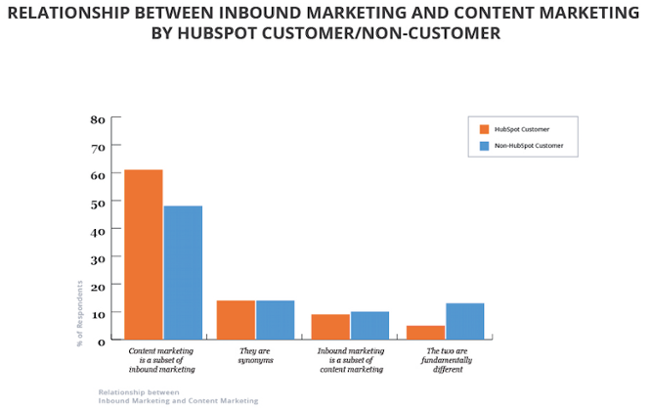
We tested this possibility by comparing responses from HubSpot customers to non-customers. As you can see in the below chart, there’s little variance between the two groups. In fact, nearly half of marketers who don’t use HubSpot believe content is a subset of inbound marketing – that’s five times as many as those who feel inbound is a subset of content marketing.

Just as HubSpot has positioned itself around the inbound marketing concept, other marketing automation vendors have introduced their own terminology. Does one’s choice in marketing platform influence her perception of inbound and content marketing terminology? We sliced the data by marketing automation usage to find out.
Here's what we found: Marketers generally share a common understanding of inbound/content marketing, regardless of what marketing software they run.

Finally, we wanted to ask the same question of a completely different audience. So we promoted a one-question survey on Facebook, targeting North American adults with an interest in either digital marketing, inbound marketing, or content marketing. Though the data is a bit more variable than the responses to the HubSpot State of Inbound survey,respondents were three times as likely to consider content a part of inbound than vice versa. See below.

So what does all this mean, and does it really matter? It does.
Marketers should think in terms of “and” not “or” when it comes to the content/inbound relationship. Success relies on both. Content may help fuel your inbound engine, but there are similarly valuable inbound projects -- like technical SEO, freemium trials, interactive tools -- that may exist outside of the content marketer’s scope. If you aren’t availing yourself of the full spectrum of inbound practices, you are limiting the potential impact you can have as a marketer or marketing leader. In other words, your inbound initiative should be a superset -- inclusive of your content assets, but not limited to them. There are implications for organizational structure, roles and responsibilities, as well as skills procurement. 
Or you can worry about creating the kind of marketing people love, and let the pundits attach terms to your output. That works too. After all, as truculent as Ali was, he’ll always be remembered simply as the greatest.

Friday, September 4, 2015

Aligning Corporate Learning With Strategy 09-03

Aligning Corporate Learning With Strategy


Too many corporate learning and development programs focus on the wrong things. A better approach to developing a company’s leadership and talent pipeline involves designing learning programs that link to the organization’s strategic priorities.
advertisement


Survey after survey of CEOs points to a shortage of leadership and management talent as a leading concern. In an era when the capabilities of knowledge workers, not technology or capital, is often the key constraint on growth (particularly in emerging markets), this is hardly a surprise. The mystery is how ineffectual the response has been. It’s not that companies aren’t willing to invest in developing their people. They spend heavily in this area: In 2012, companies in developed economies spent nearly $400 billion on training. And yet, at least one study concludes that the majority of managers believe that employee performance wouldn’t suffer if their own company’s learning function were eliminated altogether! As corporate learning professionals, we find this lack of appreciation dismaying.

The fact is that much of the investment and effort that organizations spend on learning is focused on the wrong things. For example, companies often ask us to assess whether the types of learning experiences they provide their employees are “cutting-edge.” The proliferation of online courses and just-in-time knowledge available through mobile apps is prompting organizations to rethink traditional approaches to learning, so it’s understandable that many corporate learning leaders are paying more attention to innovative modes of instruction. In our view, technology has the potential to expand and democratize the reach of learning in organizations. Moreover, research in neuroscience and the science of learning is revealing more every day about how effective learning experiences engage the cognitive and emotional centers of our brains. But breakthrough advances will only be possible when learning is linked to business goals. In our opinion, the emphasis should be on strategic alignment of learning rather than on how learning is delivered.

The importance of alignment in learning and development is receiving increasing attention. In 2009, the European Foundation for Management Development (EFMD), based in Ixelles, Belgium, established a system for accrediting corporate learning organizations that included a set of criteria for assessing how well corporate learning aligns with overall corporate strategy. EFMD’s Corporate Learning Improvement Process, which one of us helped develop, was the first effort of its kind to define research-based assessment standards for evaluating and accrediting corporate universities and learning functions. One notable finding in the accreditation reviews was the relatively weak performance on measures of learning alignment and wide disparities among organizations on this dimension. This article builds on the research in this area to identify underlying causes of poor learning alignment and best practices of leading companies.

The word learning, which has largely replaced training in the corporate lexicon, suggests “knowledge for its own sake.” However, to justify its existence, corporate learning needs to serve the organization’s stated goals and should be based on what works. We see many corporate universities turning toward the academic paradigm, choosing to become gateways to the array of learning resources available from edX, Coursera, TED, Khan Academy, and social networking sites. Many companies assign much of the responsibility for deciding what, when, and how they learn to employees. But in our view, this approach won’t address the talent conundrum: There’s too much focus on learning and not enough on meaningful development.

If corporate learning and development is to remain relevant, learning leaders must shoulder the burden of developing the company’s talent capabilities and supporting strategic priorities. CEOs and top executives also have a critical role. Although many corporate initiatives might benefit from personal attention from the top, developing the company’s leadership talent must be on the list. The good news is that many top leaders seem interested in making this happen: In one survey of global CEOs, respondents said developing the leadership and talent pipeline was where they wanted to spend more of their personal time.6 Personal engagement and leadership on the part of the CEO can make a huge difference in setting the right tone for the organization.

About the Research

This article draws both on the authors’ experience in the area of corporate learning and talent development as researchers and managers of corporate learning functions as well as on a three-year program of research with global organizations recognized as leaders in the area of leadership and talent development. The research examined the approaches companies have taken to ensure strategic alignment of corporate learning initiatives with the business priorities of the CEO agenda.

The findings come from interviews and written diagnostic surveys completed by 87 senior learning and development professionals from 61 organizations who participated in an IMD open-enrollment executive education program. Additional research was conducted through in-person interviews with learning and development executives, senior line managers, and participants in corporate learning programs at global companies across a range of industries, including Capgemini, General Electric, Hilti, Nike, Royal Dutch Shell, UniCredit Group, and Unilever. In a few cases, interview subjects also responded to written questions. Several of the organizations made available internal company documents detailing elements of their company strategy and the history, rationale, and decision-making processes involved in the development of their corporate learning initiatives.

For their part, some corporate learning executives are also rising to the challenge. They are beginning to take a more strategic view of their businesses and a proactive stance on the role of learning and development in delivering value — matching what we call the corporate “learning agenda” with the demands of talent development and business goals. We will describe some of these learning executives’ practices, which can serve as a model for implementing a corporate learning strategy. (See “About the Research.”)

Mapping the CEO Agenda

When two of us worked as management consultants, we typically began engagements with new clients by developing a profile of what we call the “CEO agenda.” Culled from analyst reports, corporate websites, and personal interviews, the CEO agenda allowed us to identify the mission-critical concerns of the company’s top leadership and tailor discussions to that agenda. Effective learning leaders take a similar approach, developing a learning agenda for their organizations that is reflective of the CEO’s priorities. Mapping the CEO’s agenda is the first step in aligning learning with strategy. (See “Guiding Questions for Learning Executives.”)

GUIDING QUESTIONS FOR LEARNING EXECUTIVES


Consider the example of Paddy Coyne, vice president of enterprise learning, leadership development, and global talent at Royal Dutch Shell plc. After starting his career at Shell as a project engineer, Coyne then spent 14 years with the management consulting firm McKinsey & Company Inc. before returning to Shell in 2007. When Shell’s previous CEO Peter Voser was appointed CEO in 2009, the company announced plans to concentrate on global business lines that would enable it to be “the world’s most competitive and innovative energy company.”7 Coyne saw an opportunity to rethink the way the company developed its leaders in accordance with Voser’s vision.

Following extensive internal and external conversations on the changing nature of Shell’s context and leadership needs, a project team reporting to the CEO and head of HR identified four leadership attributes they saw as critical for future leaders, essentially replacing the leadership model that had been in place for more than a decade. This meant changing Shell’s approach to developing leaders, placing “in-role” development through on-the-job experiences at the heart of a new leadership development system.

The guiding principle (commonly expressed as “Shell leaders personally develop the best people”8) emphasized line manager responsibility for cultivating desired behaviors. This required learning and HR professionals to adopt new ways of working and to revamp the leadership development portfolio to focus on key leadership transition points. To ensure that learning continued to support the needs of the business, Coyne formed advisory panels of business leaders to guide the development of new programs.

Although Shell’s effort is still ongoing, it’s an example of corporate learning that links professional development directly to business goals.9 Starting with the CEO agenda helps cut through the noise of multiple initiatives vying for attention to reveal the few, critical, “must-win battles” that the CEO is committed to achieve.

How does this approach differ from the starting point of most learning and development programs? Typically, the first step in a new learning initiative is a training needs assessment, which uses surveys and in-depth interviews with business leaders to understand the skills gaps and “pain points” they want training to address. For example, a global consumer goods company we’ve worked with conducted such an assessment for a new leadership development program aimed at midlevel leaders across a number of its operating divisions. The company engaged a team of instructional design consultants to survey dozens of managers, asking them to rank the top development needs of leaders in multiple categories. The collected and tabulated responses demonstrated a desire for additional training in areas including coaching for performance, inspirational leadership, and communications. The course that emerged was a diverse smorgasbord of skills training. Although all of the skills selected were valuable, as a group they did not reflect anything specific about the organization or its strategy. Indeed, the conclusions of these types of training needs assessments tend to be similar across organizations. Given that midlevel managers at many large corporations face some of the same challenges, this is not surprising. What is missing from the picture, however, is a connection to the unique circumstances of the business and the priorities critical to its success.

No matter how talented the instructors or how dedicated the learners, these kinds of learning interventions based on needs assessments are unlikely to move the needle on the business priorities that matter most. Furthermore, by outsourcing the process, the company’s learning leaders missed an opportunity to get “close to the business” in a meaningful way. In some cases, consultants who also provide instructional design and training delivery to the same clients may have vested interests in the outcomes of a needs assessment and can skew the analysis. As discussed above, a better approach is to start from the business agenda to ensure that training supports the capabilities required by the company’s strategy.

Mapping the CEO agenda as a starting point for the learning strategy is powerful because it provides focus for training activities that allow learning leaders to link development initiatives to specific business goals. Yet this approach remains more the exception than the rule. One reason for this may be that declared business priorities (for example, “growth”) are sometimes ambiguous. Learning leaders need to unpack the CEO agenda to identify the key drivers — for example, “doubling sales of new products in emerging markets” — to which learning resources can be directed. Companies that are able to align the mission, focus, processes, and capabilities of their learning assets with tangible business goals truly have a corporate learning strategy.

In many companies, the governance structures for learning and development can dilute the immediacy of the contact with the rest of the business. One study found that less than a third of companies have chief learning officers reporting directly to the CEO or company board.10 More often, learning reports to the head of HR or other functional leaders. This is no reason, however, for learning executives to be disconnected from the strategic agenda. Rather, they need to be proactive in discussing and working with this agenda. Interactions between learning functions and executives in other parts of the business are too often squandered in administrative debates over allocation of training costs and learning hours delivered. Chief learning officers need to take a more strategic approach, and the company’s senior executives must ensure that capability-building efforts are directed at the things that matter most to the company.

Mapping the CEO agenda and its implications for corporate learning is thus the first step in constructing the company’s learning agenda. The next is to operationalize the learning agenda through the portfolio of learning and development activities.

Aligning Learning and Development Resources

After mapping the CEO agenda, it’s important to take an inventory of existing learning and development resources: Companies need to do this on a regular basis to ensure that the activities in place reflect the company’s learning strategy. In our experience, however, conducting such a “learning inventory” is often overlooked.

A few years ago, one of us reviewed the global learning programs for a large, decentralized multinational and was alarmed to find that the majority of spending on learning activities could not be properly accounted for due to lax budgeting procedures among dozens of scattered learning teams working with hundreds of external vendors. Although this situation was extreme (it amounted to tens of millions of dollars), it is not atypical of some large organizations. Just getting a handle on the learning portfolio already deployed can be a challenge.

In addition to doing an inventory of the current training portfolio, the assessment should include a review of the company’s development infrastructure. For example, when Shell decided to transform its approach to leadership development, it had a fairly traditional talent management process in which line managers largely outsourced responsibility for talent development to HR professionals. The new process amounted to a paradigm shift, involving an integrated approach to in-role development, key talent processes, and learning programs. These efforts were designed to help accelerate the development of employees through carefully orchestrated on-the-job learning experiences while making business leaders responsible for building the strength of talent pipelines. The move therefore required a complete rethinking of the development ecosystem, including promotion and succession planning processes and the supporting role played by HR and learning professionals.

Companies should, however, be cautious about making wholesale changes to learning portfolios and organizational structures. Occasionally, such changes are warranted in light of shifts in the company’s mission or business context. Yet radical changes in training curricula can cause major disruptions. Although Shell chose to retire its entire learning portfolio, in part to signal a clear break with the past, this entailed a six-month pause in the delivery of leadership training worldwide as the company reset the focus and emphasis of learning programs. General Electric Co., by contrast, took a more gradual approach. In 2010, GE began to phase in substantial changes to the direction and content of its executive leadership programs for its most senior leaders, while also maintaining many of the deeply rooted structures and features it had used over the years.11

Time and again, we’ve seen new chief learning officers dump existing programs for reasons of turf or temperament rather than strategy. That’s a mistake. As long as the company’s strategy does not change, the link between the corporate learning agenda and the CEO agenda should be relatively stable over time. Reorganizations tend to occur all too frequently in corporate learning departments, but they should be limited to situations where they are warranted — for example, when the learning agenda is misaligned with corporate strategy or the strategy changes.

Some corporate learning organizations adopt explicit mission statements linked to business objectives as a way of embedding the priorities of the CEO agenda into their guiding principles. As the company’s strategy evolves, the learning mission needs to do so as well. Capgemini, a global provider of IT services and consulting headquartered in Paris, founded its corporate university during a period of rapid growth through mergers and acquisitions. The corporate university launched with a mission of being the “heart, home, and hub” of the group — the place where leaders from diverse, decentralized businesses physically came together, developed personal bonds, and built a connection to the company. In 1998, the company purchased a property near its Paris headquarters to serve as the physical location and symbol of the university. In keeping with its mission of cultural integration, the majority of university learning programs were delivered on the campus through 2007.

However, as Capgemini moved into a new phase of growth, the role of its corporate university changed accordingly. Between 2007 and 2012, the university became the driver of global content, ensuring that common methodologies and ways of working were rolled out in a consistent way to the disparate business units. It also organized worldwide learning events centered on business priorities with global implications. To reflect the new reality, the university’s mission statement was revised to reflect its new role. By 2012, the emphasis shifted to virtual and local delivery of programs; less than 3% of university learning took place at the central campus.

Responding to customers’ demands for more integrated IT solutions, Capgemini shifted its strategy once more. In 2013, it reframed the mission of the university to ensure that learning initiatives supported the CEO’s push to break down silos and build linkages between business units. In a sense, this represented a return to the founding mission of the university as a “hub” for exchange and relationship building. Accordingly, the central campus again took on a more prominent role as a learning forum and meeting place for company executives.

Gaining Buy-In for the Learning Agenda

As with the CEO agenda, the learning agenda should articulate the essential strategic initiatives for corporate learning. However, choices about what to keep, eliminate, or add to bring learning activities in line with business priorities should not be made in isolation. To enact change, it’s important to get input and buy-in from both the learning organization and leaders in the rest of the business — all the way to the CEO level. Creating the right supporting structures and interfaces with the business units, HR, and other related functions is critical.

When Eivind Slaaen, senior vice president of human resources at Hilti AG wanted to take the company’s approach to leadership development in a new direction, he recognized the need to engage line managers. Slaaen’s vision for learning at Hilti, a Liechtenstein-based producer of high-end power tools for the construction industry, emphasized development of new managers through on-the-job experiences supported by a multiyear process of formal learning interventions. “We’ve stopped treating learning as stand-alone and see this more as a journey,” says Slaaen. “Rather than thinking you can teach people what they’re supposed to know in a couple weeks of training, we’re pulling the line [management] in as a partner — so you need to convince others to be a part of that journey.”

It’s difficult to overstate the significance of CEO involvement in driving support for corporate learning programs — particularly leadership development and senior management training. (GE’s CEO has famously participated directly in every executive leadership program for more than 30 years — with one exception, when then-CEO Jack Welch underwent heart bypass surgery).12 Having exposure to the priorities of top management is key to establishing the credibility and relevance of learning initiatives. In the case of Shell, the CEO actively sponsored the new approach to leadership development and was instrumental in communicating its importance and meaning through personal storytelling that reinforced the link between leadership behaviors and business results.

At Unilever, CEO Paul Polman has made leadership development a key pillar of his long-term vision. He charged the vice president of global learning and capability development with designing a senior leadership development program that was more external-looking and focused on long-term performance. Executives received invitations to the program from Polman himself, who personally participates in the program. The company signaled its commitment to executive development with the construction of a new learning center in Singapore, the first major expansion of its corporate learning infrastructure in nearly 60 years.13

Although the personal involvement of the CEO in learning initiatives can have a decisive impact, a broader effort of stakeholder management is typically required to promote and gain buy-in for the learning agenda. Learning leaders should map out a concerted “campaign” to inform and gather input from key influencers and decision makers in other parts of the business. For example, our work with one organization revealed that funding models based on participant fees charged to business units was a hindrance to developing a strategic approach to corporate learning. In this case, getting the backing of the CFO was critical to developing more effective financing structures for learning initiatives. A disciplined effort of stakeholder engagement and outreach gives learning executives an opportunity to deepen their understanding of strategic priorities and demonstrate the business value of learning interventions.

Another vehicle for advancing the learning agenda and ensuring that it remains responsive to the needs of the business is creating governance mechanisms such as learning advisory boards. Shell created advisory panels composed of executives representing all of its businesses to help set priorities, advise on the development of new curriculum, and provide periodic reviews of the impact of the programs. Capgemini University invited leaders from the various business units to help steer the curriculum in their areas and designated senior members of the learning team to act as liaisons between the business and the university. These governance structures help ensure that local learning activities remain aligned with the global learning agenda while also helping corporate learning leaders adapt to the changing needs of different parts of the business.

Activating the Learning Agenda

Once the learning agenda is in place, it needs to be activated through programmatic activities and changes to the learning portfolio. As with any change of this nature, corporate leaders should be prepared to face stiff resistance from entrenched forces that want to maintain the status quo. An inclusive approach to stakeholder engagement in early stages of the process will lessen opposition and facilitate implementation.

Nevertheless, there can be difficult choices. In many organizations we’ve worked with, there are good programs that are well regarded and popular with participants but not aligned with the revised learning agenda. Programs and learning initiatives that do not advance the ball toward business goals should be eliminated or brought into line with business needs. Sometimes this requires bringing in different learning personnel with the relevant expertise and instructional design skills to meet the new objectives. The company’s learning agenda should be the “North Star” for all corporate learning and development — the set of orienting principles against which program design choices are tested.

Activating the learning agenda also requires that the goals of the corporate learning strategy be applied at the functional, regional, and business-unit levels. Just as business units need to align priorities and investment with the top-level strategy, learning leaders need to ensure that training and learning interventions are tailored to the specific needs of the business they serve and are aligned with the company’s global learning agenda.

A Key Strategic Question

The approach we have presented is a practical way of addressing the key strategic question for corporate learning: “Are we doing enough of the right things to develop the capabilities our people need to deliver the outcomes that matter most to the business?” Companies that answer this question in the affirmative can activate a powerful lever of competitive advantage.

The close interconnection of development activities with business priorities is the hallmark of an effective corporate learning strategy. It requires much more than just getting senior leaders to turn up at leadership training events. Rather, it means viewing the corporate learning agenda as an essential extension of the CEO agenda as it applies to the company’s human capital.


Reproduced from MIT Sloan Management Review