Shyam's Slide Share Presentations

VIRTUAL LIBRARY "KNOWLEDGE - KORRIDOR"

This article/post is from a third party website. The views expressed are that of the author. We at Capacity Building & Development may not necessarily subscribe to it completely. The relevance & applicability of the content is limited to certain geographic zones.It is not universal.

TO VIEW MORE CONTENT ON THIS SUBJECT AND OTHER TOPICS, Please visit KNOWLEDGE-KORRIDOR our Virtual Library

Showing posts with label Teaching Learning Process. Show all posts

Wednesday, April 15, 2015

New York’s Complicated Teacher Evaluation Proposal Is The Exception, Not The Rule 04-16


New York’s Complicated Teacher Evaluation Proposal Is The Exception, Not The Rule
This week, millions of students across New York will begin taking the state’s annual round of standardized tests, starting with the Common Core English Language Arts test on Tuesday. But it’s not just students’ performance that will be graded — teachers are being evaluated just as much, if not more.
While 30 states require test scores to be considered in teacher evaluations, New York stands out in just how much weight it may soon be putting on the scores. In March, the state legislature approved a hotly contested measure backed by Gov. Andrew Cuomo that takes away district control of teacher evaluations and could allow the education commissioner to use test scores to determine as much as half of a teacher’s evaluation, giving test scores and observations the same weight. Legislators seem confused about the practical implications of the bill and are investigating the language. The education department has until June 30 to finalize the evaluation system.
The bill is just the latest in a flurry of teacher evaluation policy reforms that have been implemented across the country in recent years. New York had already reformed its teacher evaluations in 2012, but after 96 percent of teachers were deemed effective last year, Cuomo is looking to rework the system again.
According to the Center on Great Teachers and Leaders at American Institutes for Research, a nonprofit behavioral and social science research organization, every state but California has developed plans for a new system to be implemented at some point between 2011 and 2019. These new models of teacher evaluation include state tests, district tests, classroom observations, student and parent surveys, self-assessments from teachers, lesson-plan reviews, measures of professional learning, and more.
All these attempts to reform teacher evaluations are happening as the research on how best to assess teacher quality remains in its earliest stages, and teachers and students are being affected with every shift in policy. “We’re in the Wright brothers stage,” said Jim Hull, a senior policy analyst for the Center for Public Education. “We’re getting these policies in the air, and they’re not designed to be as effective as they probably could be. There’s still a lot to learn.”
One New York principal, Carol Burris of South Side High School in Rockville Centre, who is also a fellow with the nonprofit National Education Policy Center and who has been an outspoken opponent of high-stakes testing, said that New York’s policy will affect students for the worse.
“It puts the test scores in a pre-eminent position, which will have a bad effect on kids,” she said. “We’ve already seen the effects that this has — a narrowing of curriculum and teaching to the test — and that will just become an even more prevalent practice.”
In Burris’s ideal world, test scores would play at most a secondary role in teacher evaluations. “I think the role of test scores should be outside the model. Teachers should be evaluated by their principal, and if for some reason that evaluation is way off the mark, then decent test scores can be used as a form of protection to challenge that evaluation,” she said.
Hull understands her anxiety about the new policy. “There’s definitely room for concern when you talk about 50 percent of an evaluation being based on test scores,” he said. “Especially if it’s not a high-quality assessment [of the students] and doesn’t assess a broad range of knowledge.” The quality of student tests is a particularly sticky issue in New York, where the first two years of Common Core test results, which have shown outsized gaps between demographic groups, have done little to ease critics’ concerns that scoring well on the tests requires skills that are irrelevant to the subject matter being tested.
There are competing views on the best way to approach incorporating student test scores into teacher evaluations. The model that’s currently accepted as the most accurate is known as the “value-added model” because it’s supposed to measure exactly how much of a student’s progress made over the course of the year is thanks to her teacher. It compares each student’s test scores to their own past scores and to other students’ scores. “It’s not perfect, but there is no other measure as good as [the value-added model],” Hull said. “But that’s not to say that other measures shouldn’t be used as well. You really want to have multiple measures of student outcomes.”
The Measures of Effective Teaching (MET) Project, the magnum opus of teacher-evaluation studies — every expert I spoke with on this topic pointed me to it — confirms the idea that student growth, often in the form of test scores, should be included in evaluations, along with other metrics. The project, which was funded by the Bill & Melinda Gates Foundation, was a three-year research partnership between 3,000 teacher volunteers and dozens of independent research teams who together developed and tested multiple measures of teacher evaluations to help better identify effective teaching. It didn’t recommend one specific model, given that every district has its own needs, but it did highlight the fact that “heavily weighting a single measure may incentivize teachers to focus too narrowly on a single aspect of effective teaching and neglect its other important aspects.”
The project found that an evaluation model heavily weighting standardized test scores was more effective than other models in predicting improvements in how students performed on those tests, but was the least predictive of how students performed on supplemental higher-order tests (usually given at the district or school level), and also produced the least reliable results, based on year-to-year consistency in teachers’ scores. Here are the results, from the project’s research brief:


Texas is in the process of overhauling its evaluation system, and it will value test scores at a maximum of 20 percent — even less than the MET Project’s Model 4. Specifically, Texas’s new model will count “student growth” as 20 percent of a teacher’s score. “But there are four options that districts have for measuring student growth, and just one of them ties back to test scores,” said Tim Regal, the director of educator evaluation and support for the Texas Education Agency.
Texas’s new model, which will replace a 17-year-old system, is in its pilot year and being implemented in 57 districts. Next year, it will expand to 200 districts before the final statewide implementation in 2016-2017.
But rather than just changing the way different factors are weighted, the overhaul is an attempt to transform the way teacher evaluations are used and understood. “Right now, when you talk to teachers in Texas about appraisal, they have a certain mindset because it’s always been used just to determine renewal and nonrenewal,” he said, referring to the common practice of using evaluations solely to determine which teachers to let go. “The only thing that mattered was their score. A lot of our focus during the pilot year has been about how to change that mindset to be about a process of professional development and growth for all teachers.”
In addition to the 20 percent of teachers’ evaluations that will be based on student growth, another 70 percent will be based on observations from principals, assistant principals and other campus leaders, and 10 percent will be based on self-assessment.
According to Angela Minnici, director of the Center on Great Teachers and Leaders, a change in mindset about how teacher evaluations are used is necessary. “We need to move away from thinking about evaluation systems as only ways to dismiss underperformers,” she said. “We really should be thinking about evaluations as a source of power and investment for moving teachers to a better level of performance overall.”
While New York is putting even more emphasis on testing, most states are moving toward a system more like the one in Texas.
“States are definitely making a big step forward,” Hull said. “Over a short period of time, evaluation systems have gone basically from an exercise in bureaucracy to being given immediate feedback and information on how to improve performance. That type of feedback is how we get the best doctors, best lawyers, and it’s also how we’ll get the best teachers.”

Monday, March 30, 2015

Student Level of Happiness and GPA, Is there a co-relation. 03-31


Because I’m Happy


AN INTRIGUING STUDY NOTES A CO-RELATION BETWEEN A STUDENT’S LEVEL OF HAPPINESS AND GPA


As policymakers, administrators, and teachers, we want the children in our classrooms to be happy, of course. But how much does their happiness really matter when it comes to learning? According to a new study by HGSE lecturer Christina Hinton, Ed.D.’12, the answer is clear: It matters a lot.
Hinton examined the interplay of happiness, motivation, and success in a K–12 setting, and she also looked at the school factors that support student happiness.
Using both quantitative and qualitative measures, she found that from elementary school to high school, happiness is positively correlated with motivation and academic achievement. She also found that the culture of the school and the relationships that students form with their teachers and their peers play an influential role in their happiness.
In order to conduct the study, Hinton collaborated with theSt. Andrew’s Episcopal School near Washington, D.C., which educates students in grades K–12. “We developed surveys to collect data on students’ happiness and motivation,” Hinton says. “We also collected qualitative data on happiness and motivation to dig more deeply into the construct. In addition, we collected data on students’ grade point averages. We then analyzed this data to explore the relationships among happiness, motivation, and academic achievement.”
Her analysis found several key associations that open the door to further research on how schools can optimize students’ learning experiences. Among them:
  • Happiness is positively associated with intrinsic motivation (a personal drive to learn) for all students, and also with extrinsic motivation (outside sources like rewards, praise, or avoiding punishment) for students in grades K–3.
  • Happiness is also positively associated with GPA for students in grades 4–12.
  • Happiness and standardized test scores did not seem to be related, but further research is needed to confirm this.
  • Happiness is predicted by students’ satisfaction with school culture and relationships with teachers and peers.
The finding that happiness is positively correlated with GPA is significant, Hinton notes, because GPA provides a broader picture of academic achievement than standardized test scores, encompassing multiple types of abilities and the influence of social dynamics.
Moving past quantitative scores, the study examined the relationship between happiness and achievement from the students' perspectives, as well as the source of the happiness that students report feeling in the classroom. “We asked the students what supports their learning, and then we coded the responses for themes,” says Hinton. “Students often reported that happiness, or positive feelings like enjoyment or fun, promotes learning.” They cited many reasons for their positive feelings, including feeling safe and comfortable at school and having secure relationships with their teachers and their peers.
These findings set the stage for important future research, Hinton says, as well as for exploring interventions that can successfully boost students’ overall happiness — and their performance in the classroom.
“In this study, we found that a network of supportive relationships is at the heart of happiness,” Hinton says. “If schools want to support student well being and achievement, they should take seriously nurturing positive relationships among teachers and students.”

Tuesday, February 17, 2015

How to Get Your Students to Come to Class Prepared 02-17

How to Get Your Students to Come to Class Prepared


Imagine a world where students came to class prepared. Class time would be so much more productive and enjoyable for teachers and students alike. We would have informed class discussions and focus on students applying, analyzing, and evaluating the material under our expert guidance.
Prepared students are not a mirage. Students will come to class prepared, but it requires a different course design. Consider a course that uses class preparation assignments (CPAs) to inform and stimulate class discussion and a definitional grading system that makes being prepared for class non-negotiable.
The CPAs are reading assignments accompanied by informal writing assignments consisting of four to eight questions. The CPA questions serve as a guide to the students in their reading, prepares them for class, and serves as a basis for class discussion.
The CPAs are graded pass-fail only. Students bring two copies of their CPA answers to class—one that they place on the front desk as they come into class and the other that they keep for class discussion. To earn credit for a CPA, a student needs to show a good faith effort on their answers to each question and they need to attend class to contribute to class discussion.
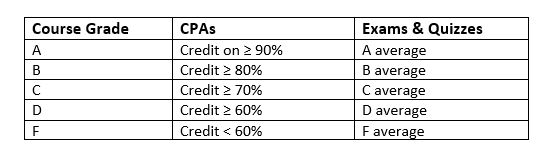
In a definitional grading system the pedagogical assumption is that different categories of work are each important, and the teacher does not want one category to compensate for the other in any way. In the table below there are two distinct categories of work: the CPAs, and the exams and quizzes.
table for class preparation assignments
For a student to get a particular course grade, she must meet or exceed the standard for each category of work. If a student gets an A average on the exams and quizzes but earns credit for only 75 percent of the CPAs, she receives a C for her grade. If a student earns credit for 90 percent or more of the CPAs, but gets a C average on the exams and quizzes, she receives a C for her course grade. The definition of an A student is one who not only does A work on the exams and quizzes, but who also comes to class prepared at least 90 percent of the time.
If you adopt this course design, students will come to class prepared. Therefore, you won’t have to lecture as if the students are seeing the material for the first time. Instead, you can engage the students with active learning strategies that go after higher-level learning and skill development.
Grading the CPAs is easy. By the end of class the students’ CPA answers are dated, having been used and responded to in class. We simply scan the CPAs for whether the student showed a good faith effort.
The level of difficulty of the CPA questions has to be chosen with care. Make the questions too simple and the students will scan the reading for the answers. Make the questions too tough and the students will become frustrated and feel that the course design is unfair. Additionally, if the questions are too difficult, students will come to your office for help before class and you will lose the efficiency of the students working together on the harder aspects of the material in class and your ability to respond to their answers as a whole in class.
Pay attention to what you name the preparation assignments. We specifically chose not to call them homework assignments because students are accustomed to getting credit on homework assignments without coming to class. With our CPAs, students only get credit if they come to class.
Be sure to use the CPAs as the foundation for class discussion. Early in the semester, it is generally a good idea to cover the CPA questions in a linear fashion. But later, there can be magic in the classroom as the practice of preparation allows for the discussion of ideas in a non-linear fashion.
The CPA-definitional grading system design has worked well across different course levels from introductory courses to graduate courses, and across different institutions from large land-grant institutions to private liberal arts colleges. As we and others have learned, if you use this course design, students will come to class prepared and class time will be much more productive, dynamic, and fun for everyone.
A tenet of this course design is that students with specific assignments can acquire the basic understanding of the material themselves before coming to class and that they need help primarily with critically applying and evaluating the material. In addition, so often college students are lectured to and talked at. Using the CPAs allows time and space for informed student voices. In the words of the classic Aretha Franklin song, we think that it shows students R-E-S-P-E-C-T.
View at the original source

Lessons From the Frontier: How to Make Blended Learning Truly Work 02-17

Lessons From the Frontier: How to Make Blended Learning Truly Work


Four years ago, Aspire Public Schools senior leadership decided that we should explore the use of blended learning in our schools to find out if it was “right” for us and asked me to lead the effort. I was not a particularly techie educator, but I did believe that it was time for us to figure out what role technology should play in our instructional model, which I cared deeply about, having coached Aspire teachers for years.

I was what colleagues politely called a “healthy skeptic.” I had spent six years in the classroom as a teacher, and then another 10 years coaching teachers and developing curriculum. Like my colleagues at Aspire, I deeply believed that we needed to teach the individual student--or to use the industry jargon, that “differentiated and individualized instruction” would help our students.

But we had yet to be sold on the power of technology in our instructional program for increasing student achievement. Models hadn’t been proven; software had little research behind it. The enthusiasm of national and family foundations (which have traditionally funded different teaching and learning initiatives) was both a blessing and a curse: They were excited about funding us to try changing the ways in which education could be delivered, yet many were also very interested in blended learning as a cost-cutting device, which in California with its low per pupil funding amount, added an extra burden to this work.

And yet, there was that tantalizing promise: We recognized that as adults, our lives depend heavily on technology. We knew that our students who we sent off to college each year would use technology in everything they did in college. And even though we knew our teaching practices were really good, they were not getting all of our students adequately prepared to succeed in and graduate from college--and that we needed new strategies and tools to increase our students’ achievement. 

Blended learning was unproven, yes. But it just might offer us a way to give students greater access and experience with technology, learning experiences that were truly differentiated to their level with real-time feedback, and give teachers more immediate and individualized student data. On many days, I felt something like a cowgirl out on the cutting edge of the untamed prairie or an astronaut on the distant edge of the universe.

I wasn’t alone, however. At schools scattered across the US, teams of other teachers and instructional design coaches were beginning to work through the same problems. I began connecting with folks from the KIPP Foundation, Summit Public Schools, Rocketship Education, E. L. Haynes Public Charter School, the Alliance College-Ready Public Schools, Cornerstone Charter Schools, Highline Public Schools (Washington), Mastery Schools and FirstLine Schools. 

We started slowly--sharing with each other our software choices and lessons learned. We spent a great deal of time commiserating over the phone. Gradually, we began meeting twice a year to dig more deeply into the work with each other: our models, our teacher training plans, our human capital strategies, our scaling plans. We started to believe that technology could deliver on its promise within our instructional programs.

As our teachers started piloting the work, they began providing powerful examples of how “going blended” was changing the work of teaching for them. “I feel my job has been more purposeful,” shared Nancy Castro, kindergarten teacher at Aspire Titan Academy. “The data that is provided through the software has allowed me to focus more on my guided reading groups and also target my student needs.

 I feel blended learning has allowed me to use my guided reading and math time more effectively. I get to spend a little more time with my guided reading groups, I get to teach my math lessons during computer time, and I get to pull small groups to work with my low students.”

The most fundamental lesson we learned was that blended learning is a model that puts student learning at the center of learning. That makes blended learning a critical step towards whatever the future of teaching and learning in our schools will be. Blended learning sets up teachers and students to continually adapt and iterate in ways that previous school reforms have not.

 It uses technology but keeps a strong emphasis on learning. Realistically, it means not “going blended” because you think it’s a good idea. Rather, you’re going blended because you want to figure out how technology can help you solve a targeted problem: increase student achievement given your context, school culture, and the overall willingness of your teachers to tackle the challenges your students face.

These days, I’m still thinking about how to improve on this work as more Aspire schools adopt the blended learning model. And I’ve pulled together the lessons and observations from our teachers and the dozens of other cowboys and cowgirls who have been trying to tame blended learning into a new book, Go Blended!

 A Handbook for Blending Technology in Schools. Part of Aspire’s mission is to share promising practices with other forward-thinking educators, and this book allows us to share what we’re learning in a much broader way.up to speed? How do school leaders train teachers and identify when teachers and classrooms are ready for blended learning?

And I’m excited that I’ll be working with EdSurge as part of its Education Leader Day sessions in its Summits to share these lessonswith educators across the country.

I hope you’ll take this journey with us, and share back your lessons, so we can learn from you, too.

Sunday, February 8, 2015

Teachers: Have This Conversation Before You Collaborate 02-08


Teachers: Have This Conversation Before You Collaborate


Getting educators to collaborate around instruction is really hard.
When I was coaching teachers, I had a framework for observation similar to many of the teacher evaluation frameworks that are out there today. It contained phrases like “Designs lessons so that timing supports learning”, which seemed fairly clear and objective.
I often saw things in the classroom worth improving, and the teacher and I would debrief them and brainstorm steps for positive change. Imagine my surprise when I would return a few weeks later and find that very little had changed. I would ask why, and teachers would usually say something like “I liked the suggestion, but it just didn’t really fit my style” or “I just wasn’t sure that would fit my classroom.” Usually that would kick off good conversations about teaching and learning. But occasionally, my mis-understanding of the teacher’s ideal classroom could cause real mistrust, and I’d struggle to get traction in supporting that teacher.
In graduate school, I began to research different styles of teaching.  I found that different styles varied in two really big ways: 1. How does the teacher articulate the purpose of education? and 2. What theories does the teacher hold about how students learn?
When you think about the wide spectrum of possible answers to these two questions, a criteria like “designing lessons so that timing supports learning” becomes much less clear cut. After studying multiple styles of teaching, I began to see that I had biases towards certain styles of pacing and timing in the classroom. My timing bias was towards an almost frenetic urgency, with lots of hands up and a lot of “buzz.” That’s because I usually thought about the purpose of education in terms of mastering content–and there sure was a lot of content to get through!
But what if the teacher I was collaborating with had a different notion? What if she believed that the purpose of education is to develop a young person’s sense of agency and self-mastery? She naturally would have a different interpretation of “timing that supports learning.” I found that teachers tend to approach common teaching tasks in a way that aligns with their sense of purpose and their theories about student learning.
I realized that I had done very little deep thinking about the purpose of education. If you had asked me about purpose in my first year of teaching, I would have said something about closing the achievement gap. But to what end? If it was college completion, that would imply one thing about how I do the work. If it was “citizenship”, might that imply something quite different?
Same goes for my theory of learning. Did I think students should first grapple with big, hairy problems or get lots of practice at basic skills? Did I think students learn best when they get choice over what they learn or is it better for them to feel like part of a collective effort? When you start having these kinds of conversations, you realize that most teachers’ conceptions of their jobs are a crazy maze of beliefs. How are educators supposed to collaborate effectively if they don’t know how their colleagues think about this stuff?
So as you are engaging with other educators and find that you just can’t seem to see eye-to-eye around some aspect of instruction, take a step back and see if you might need to have a conversation about your perspectives on education! If you need some conversation starters, consider these:
  1. What do you think is the end-goal of education?
  2. What do you hope your students will be doing 8 years after graduating from high school?
  3. What are your top three pre-requisites for an effective classroom?
  4. Complete this sentence: Students learn best when…
Hopefully this kind of conversation can spur better collaboration on your teams!

Sunday, July 13, 2014

Designing Developmentally Appropriate Writing Assignments 07-13

Designing Developmentally Appropriate Writing Assignments


Often the articles highlighted in The Teaching Professor newsletter are examples of pedagogical scholarship that could beneficially be done in many fields. That is the case with this piece on developing writing assignments, but it also contains content useful to any faculty member who uses writing assignments as a major method of assessing student learning in a course.
The five authors describe the goals and offer illustrations of writing assignments developmentally appropriate in beginning, intermediate, and advanced psychology courses. Their justification makes sense in any discipline. “If the psychology curriculum is developmentally structured to progress from introductory to advanced courses to foster student learning …, it is reasonable to argue that they may benefit from writing assignments that match this gradual increase in complexity.” (p. 88) Most faculty do use assignments that reflect the level of the course but not with the thoughtful planning and care illustrated by the assignments described in this article.
For beginning psychology courses, they recommend “writing assignments that are brief in length [five pages or fewer, they note elsewhere], assigned frequently, and focused on assessing students’ reflections and reactions to class reading and discussions.” (p. 89) In those papers students offer opinions with at least some evidence to support them. They should start using the language of the discipline, but more important is the application of psychological concepts to daily life. Accepted disciplinary style guidelines (in this case APA style) should not be required in these papers. The example discussed at length in the article is an analytical essay students write about an advertisement that involves race, class, gender, or sexuality. In the paper they explore the psychological consequences of the images in the ad.
In intermediate courses, writing should “encourage significant personal engagement with the material, so that students synthesize ideas for a subdiscipline while also trying to express original ideas within its framework of reference.” (p. 89) For psychology courses at this level they recommend assignments that encourage reflection, but now it is reflection focused specifically on a question or issue related to the content area of the course. At this level students should be expected to write using more disciplinary language and theory. They should also be writing with some understanding of methodology. These papers should be between five and 10 pages and correctly formatted in APA style. The example, from an abnormal psychology course, is a 10-page paper on a disorder that interests the student and is taken from a list of possibilities provided in the syllabus. Students work on these papers in groups.
In advanced courses, writing assignments should focus on and continue developing the higher-order thinking skills of analysis and synthesis. Students should be able to offer critiques. The assignments should move students in the direction of being able to produce knowledge as opposed to simply consuming it. The recommended length for these papers is between 15 and 25 pages, and students should (with teacher input) be able to generate their own topics. The most typical examples here are traditional research papers and honors theses.
Of interest to instructors teaching any subject is content in the article that explores and illustrates the development of learning objectives for writing assignments. The authors note that “counter to what most students probably believe, it is not easy to design effective assignments. The development of meaningful and measurable learning objectives is challenging.” (p. 95) And because it is, many instructors avoid doing so, or they design the assignment first and generate learning outcomes after the fact or only when they are asked for them. Starting with the learning objectives—what it is students should know and be able to do—results in better designed assignments and makes grading easier and more objective. The article contains examples of learning objectives that pertain to the intermediate assignment example and samples of grading rubrics used to assess the assignments. They illustrate the value of being able to clearly connect assignments, goals, and grading criteria.
The intermediate assignment example, as noted above, involves students writing collectively in groups of three but with significant parts of the paper prepared individually. As a group they collaboratively write the first two sections of the paper (the introduction and a three-page description of the disorder that is the focus of the paper). The third, fourth, and fifth parts of the paper (their synthesis of information from the textbook and two peer-reviewed journal articles, the conclusion, and their reference page), each student prepares individually. Seventy-five percent of the points on the paper are based on this individual work. The authors believe this enables students to benefit from peer collaboration without experiencing the disadvantages often associated with group grades.
View at the original source