Shyam's Slide Share Presentations

VIRTUAL LIBRARY "KNOWLEDGE - KORRIDOR"

This article/post is from a third party website. The views expressed are that of the author. We at Capacity Building & Development may not necessarily subscribe to it completely. The relevance & applicability of the content is limited to certain geographic zones.It is not universal.

TO VIEW MORE CONTENT ON THIS SUBJECT AND OTHER TOPICS, Please visit KNOWLEDGE-KORRIDOR our Virtual Library

Showing posts with label Religion. Show all posts

Tuesday, January 14, 2014

Why Hanuman smeared himself with vermilion 01-14

View at the original source


Why Hanuman smeared himself with vermilion


The scene

The scene is from an instance when Lord Rama had returned home after killing Ravana. Hanuman was still living with Lord Rama in Ayodhya.
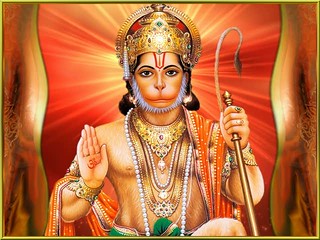

Change is needed

On a particular Tuesday morning Hanuman felt very hungry. “No, these fruits are tasteless. I have been eating these for a longtime now. I need some cooked food for a change”, thought Hanuman and rushed to meet Sita.
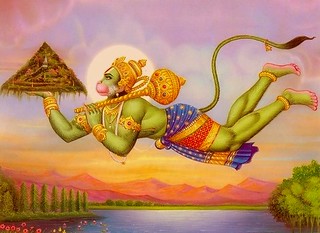

Sita was going somewhere

She was about to leave for morning bath. “Alright, Hanuman, I will be back in a minute. You be here.”, Sita said and went for a bath.
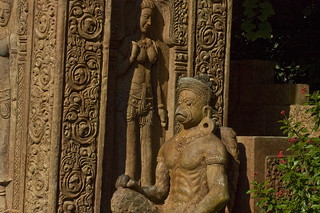

Hanuman is puzzled

After bath, she applied a vermilion line in the parting of her hair as per normal practice. “Mother, why are you applying red vermilion mark.”, Hanuman asked as a puzzled child would do.
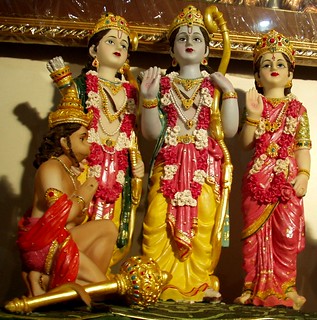

Why vermilion

“This vermilion mark increases the lifespan of the Lord”, remarked Sita as she brought an assortment of sweets for Hanuman.
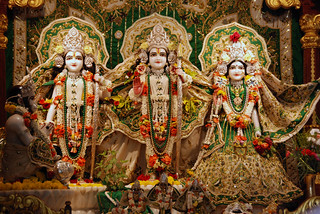

Vermilion it is

Hanuman kept on thinking for a longtime. He had never thought about the life-span of Lord Rama on earth. Neither has he done anything to improve that. After thinking various options he applied oil throughout his body and smeared red vermillion from his feet to head profusely. Layers upon layers of vermilion. Bathed in vermilion. Satisfied, he picked up his mace and proceeded to the court of Rama.
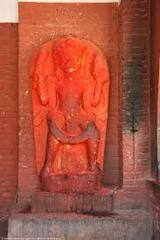

The red Hanuman

On the Ayodhya roads, people were taken aback. Red Hanuman (sindoor-maya hari). This was the sight to behold. As he entered the royal court, there was stunned silence initially. Then everybody laughed aloud. Even Shri Rama smiled.
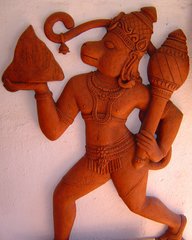

Rama is curious

“Hanuman, Why did you apply vermilion coat on your entire body today?”, Rama queried.
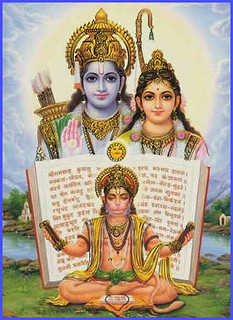

An innocent reply of a devotee
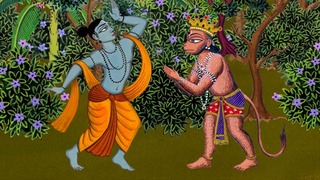
Hanuman folded his hands in utmost devotion and said, “My Lord, Mother Sita puts a small dot of vermilion on her head which increases your life-span. But a small dot can only do so much. Learning about this, I have started to apply full coat of vermilion on my entire body to significantly improve your life-span.”

God is pleased
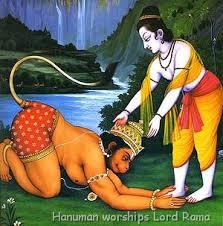


Lord Rama was pleased with the simplicity and deep devotional feeling of Hanuman. He embraced Hanuman, became somewhat red with vermilion and declared, “Today is Tuesday. Whoever applies vermilion and oil on Hanuman on this day will get happiness and all his desires fulfilled.”

Tuesday becomes auspicious


From that day the practice of smearing oil and red vermilion on Hanuman started. You might have seen this in temples everywhere, red Hanuman glowing like a just-risen sun ever keen to increase life-span of his Lord.


Moral of the story

It simply shows how even a small act done out of pure devotion can endear you to God.
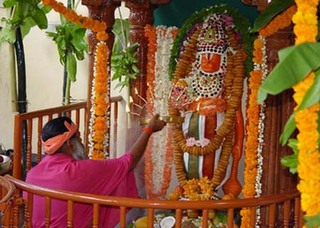

Pomp and show might not work

Don't trouble yourself with wealthy decorations and paraphernalia. God always overlook them. He checks your heart and the feeling behind the action that you do.
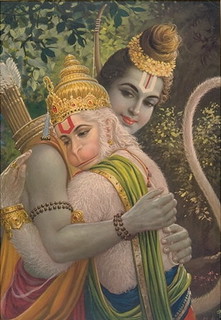

What we should do

So, if we really want to please God, we should do every act with devotion. We might not be even aware what might catch His eyes!


Share your thoughts

Share your thoughts and experiences when simple acts might have scored God's grace for you.



Monday, November 25, 2013

The Majestic Shiva 11-25


Shiva meaning "The Auspicious One"), also known as Parameshwara(the Supreme God), Mahadeva, Mahesh ("Great God") or Bholenath ("Simple Lord"), is a popular Hindu deity and considered as the Supreme God within Shaivism, one of the three most influential denominations in Hinduism. Shiva is regarded as one of the primary forms of God, such as one of the five primary forms of God in the Smarta tradition, and "the Destroyer" or "the Transformer" among the Trimurti, the Hindu Trinity of the primary aspects of the divine. Shiva is also regarded as the patron god of yoga and arts.

Shiva is usually worshiped in the aniconic form of Lingam. Shiva of the highest level is limitless, transcendent, unchanging and formless. However, Shiva also has many benevolent and fearsome forms.[16] In benevolent aspects, he is depicted as an omniscient Yogi who lives an ascetic life on Mount Kailash, as well as a householder with wife Parvati and two sons, Ganesha and Kartikeya or as the Cosmic Dancer. In fierce aspects, he is often depicted slaying demons. The most recognizable iconographical attributes of the god are a third eye on his forehead, a snake around his neck, the crescent moon adorning and the river Ganga flowing from his matted hair, the trishula as his weapon and the damaru as his instrument.

Shiva as we know him today shares features with the Vedic God Rudra.

The Sanskrit word Shiva  comes from Shri Rudram Chamakam of Taittiriya Samhita  of Krishna Yajurveda. In simple English transliteration it is written either as Shiva or Siva. The adjective śiva, is used as an attributive epithet not particularly of Rudra, but of several other Vedic deities.

The other popular names associated with Shiva are Mahadev, Mahesh, Maheshwar, Shankar, Shambhu, Rudra, Har, Trilochan, Devendra (meaning Chief of the Gods) and Trilokinath (meaning Lord of the three realms).

The Sanskrit word śaiva means "relating to the god Shiva", and this term is the Sanskrit name both for one of the principal sects of Hinduism and for a member of that sect. It is used as an adjective to characterize certain beliefs and practices, such as Shaivism. He is the oldest worshipped Lord of India.

OM NAMAH SHIVAYA

Friday, June 7, 2013

Silence Is Unceasing Eloquence 06-07

Silence Is Unceasing Eloquence


Solitude is an attitude. A man who adopts an attitude of detachment towards the external environment is always in solitude. It is possible that despite being involved in all sorts of worldly activity, a person may maintain perfect   equanimity.  That’s solitude. Another may stay on a hilltop, away from the hustle and bustle of city life, yet he may not be able to experience serenity of mind.  Therefore, even though this person is much better placed to experience peace of mind, solitude deludes him.   


Silence is the perennial flow of ‘language’. It is interrupted by speaking; for words obstruct this mute language. It is quite possible that lecturers may keep the audience involved and amused for hours without transforming them. Silence, on the other hand, is permanent and benefits entire humanity in a subtle manner. 

One may therefore conclude that true silence is unceasing eloquence -- it is a state when words cease and powerful thoughts of the sage begin to penetrate the depths of the seeker, bringing about a change in his thought patterns.

Thought moves with tremendous velocity. Those who entertain sublime and pious thoughts help others who are in the vicinity and at a distance also. 

A saint who has overpowered his mind through meditation sends out into the world thoughts of harmony and peace. They travel with lightening speed in all directions and enter the minds of persons and produce in them also similar thoughts of harmony and peace. 

Whereas a worldly man who harbours thoughts of jealousy, revenge and hatred sends out discordant thoughts which are like wireless messages broadcast in ether, and are received by those whose minds respond to such negative vibrations.

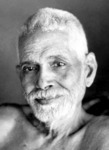
According to the Maharshi, preaching is simple communication of language; it can really be done in silence only. 

A man, who after listening to a religious sermon for an hour, might go away without being even marginally influenced; he has wasted his time.  In comparison, a man who sits in a holy presence and goes away after some time with his outlook on life radically changed, is much better off. Which is better, to preach loudly without effect or to sit silently sending out positive vibrations? 

 Again, how does speech arise?  

From abstract  knowledge  emanates the ego; this, in  turn,  gives rise to thought, and thought gives rise to the spoken word. So it would not be wrong to say that the word is the descendant of the original source.

 If the word can produce effect, consider how much more powerful must be preaching through silence?  

But most people do not understand this simple truth -- the truth of their everyday experience. Rather, they are eager to know what lies beyond, about heaven, hell and reincarnation. 

We may conclude with the following words of Ramana Maharshi: “Those who have discovered great truths have done so in the still depths of the Self. But really there are no others to be helped. For the realised being sees only the Self, just as the goldsmith sees only gold while valuing it in various jewels made of gold. When you identify yourself with the body, name and form are there. 

 But when you transcend body-consciousness, the ‘others’ also disappear. The realised one does not see the world as different from himself”. 


Tuesday, January 3, 2012

If Gods were to propose and the Human beings were to dispose, would human beings dispose of all the gods at the first instant???


If Gods were to propose and the Human beings were to dispose, would human beings dispose of all the gods at the first instant???

If God were to propose and the Human beings were to dispose, would human beings dispose of all the gods at the first instant???

Not a very human thought, I know

But, would that mean a peaceful world for all of us???


.
It could perhaps, if we look at recent history, we will find that most of the wars have been fought in the name gods faiths, religion, and beliefs. Inter and Intra religious differences have resulted in both civil & military wars, in turn resulting in huge loss of innocent human lives.

Every neighborhood in Afghanistan, Iran, Iraq, Pakistan, Palestine, Israel, United States, Japan, and many other countries has a saga to narrate of dear ones killed in the battle. Battles have been fought in the name of god, in the name of peace.

We know that there is serene peace & tranquility in death, but given a choice, we would like to have peace based on principles of mutual understanding and coexistence.

I could have easily quoted country wise figures of the precious lives lost since the world wars, but that is not the focus of this article.

Well, there is a very valid argument that, fear of god, and tenets of the religion often keep people disciplined and help promote harmony within the sects and among the sects. I am also prepared to buy the argument that it is a very small minority that is indulging in misinterpretation of the religion to promote terror activities.

Very small minority, yes correct, but the impact, intensity, and the geographic spread of their activities are totally disproportionate to their numbers. Add to this, the over reaction of the various governments, and their extraordinary generosity in spending funds, military hardware, and the deployment of the troops, are the important factors for destruction all around.

Innocent lives are being lost daily due to both terrorist activities and the action by Government troops. A missile or a bomb fired from an aircraft or ground artillery doesn’t distinguish between an innocent, or a guilty individual, doesn’t know as yet to avoid innocent children & women.

The severe impact of excessive allocation of funds for defence   on the global economy is too well known for enunciation. Fledgling economies of West Asia have been driven to pauper status by these needless wars.
The wars are not between the believers and the non believers. They are between the different groups of believers who call the god by different names and have different ways of worshipping the almighty.

There is nothing wrong with the holy books or the scriptures. They all preach love and brotherhood. Intolerance is in the heart and the minds of the individuals or groups and not in the faiths or religions.

Now coming back to the basic question……

If there were no gods or religions, would there still be wars and destruction???

Well, it may not bring end to all wars and loss of human life, but, yes it would remove a very big reason for it. And even one reason less for war is a less war and more peace.

And that would mean less investment for defence and more for building economies. It would mean more investments for education, agriculture, technology, and infrastructure. That would mean more jobs, more affluence. When everyone is busy building economy and affluence, thought of a war would be the last thing on their mind.

With all these glorious possibilities, the question is …

If the human being has the power to dispose, will he…

Well it may seem an insane thought, but a thought that could lead to a saner world.

People may think I am dreaming,sleep writing, in deep slumber.

May be yes…

In that case, don’t wake me up; the other side is too harsh to bear.

Shyam
google-site-verification: googled8cb12c78271c415.html H_abxalAdC9Cg0xe3NtXHQ6qbrc

Sunday, August 28, 2011

Is Money Everything?? 11-29


Is Money Everything???


Is Money Everything???


I know everyone can contribute on this, I also know that most of you are willing & eager to contribute. In fact I need all the views and perspectives. As for me, I am confused and what you see is loud thinking being shared with my friends and social media community members.
It is not an article, it is just a chain of thoughts passing through my mind presented in the order they have come. My apologies, if you find this monotonous and disjointed. I am not rechecking or organizing it. I want to keep the original order.
I hope you like it. Starting with a Telugu verse.

nidhi cāla sukhamā
rāmuni sannidhi sēva sukhamā
nijamuga palku manasa


निधि चाला सुखमा 

रामुनी सन्निधि सेवा सुखामा

निजमु गा पलुकु मनसा 


 Nidhi: Wealth
Sannidhi: Divine presence
Meaning:
Is [possessing] wealth a greater pleasure
or is service in Rama's presence a greater pleasure?
Answer me truthfully, O Mind!

This is what the great Telugu Saint Tyagaraja said more than 200 years ago 
Tyagaraja composed devotional songs in carnatic music. His compositions are sung and admired by musicians all over the world
After 200 years also the question still remains unanswered……
There are people who feel that divine sannidhi is greatest of all nidhis, a person can acquire during a life time. Sannidhi (Divine presence) is not related to any one religion or faith. It is above religions and faith. Every seeker irrespective of the faith yearns for it.
There are people for whom nidhi is most important acquisition, and in which they find the divine sannidhi.

There are people who pretend to to be working for attaining divine bliss.They have all sorts of weird appearances and clothing. These are all serving saints. Why do they do this.

Totakacharya 8th Century C E saint and the disciple, whom the Adi Shankara loved most and whom he installed as the first Jagatguru of Jyotirmatha pitham near Badrinath, wrote this verse of Bhaja Govindam. In this he explains why people do what they do.

(It is a well known fact that only some of the verses were written by Adi Sankara himself.Rest were written by his disciples)

JATILO- MUNDI LUNCHITA-KESHAH
KAASHAAYAAMBARA- BAHU-KRITA-VESHAH
PASYANNAPI CHA NA PASYATI MOODHA
HIUDARA-NIMITAM BAHU-KRITA-VESHAH

जटिलो मुण्डी लुंचितकेशः     
काषायांबरबहुकृतवेषः । 
पश्यन्नपि च न पश्यति मूढः    
 उदरनिमित्तं बहुकृतवेषः 

The  ascetic with matted locks, the man with the shaven head or one with hair pulled out, or the man parading in the ochre robes    — they all have eyes but yet do not see. All these are but  deceptions for cheating the world, for filling their bellies.  (Renunciation does not lie in external appearance, but in inward thought, attitude and feeling).


What is the real wealth???

This is what Adi Shankara said in His Bhaja Govindam about wealth

müãha jahèni dhanágamatøúïám
kuru sadbuddhim manasi vitøúïám,
yal-labhase nijakarmopáttam
vittam tena vinodaya cittam.(2)


"O fool! leave off the desire for accumulation of wealth; create in the mind, thoughts about Reality, devoid of passion. What you get - i.e. what you have achieved through your past deeds - with that, satisfy your mind."

Adi shankara feels that the real wealth is, the soul that is content and enjoys is existence.
I feel it is not wise to either agree or disagree with either. It is all a case of circumstances, environment, Karma and Dharma.
What if the lure of money was not there?? Would people still work?? One’s need for money is fulfillment of some other need for other. Is earning money also societal??
How much of it is societal, and beyond which point is it greed??
Now what is greed??
What is right and what is wrong???
For a King or emperor expanding his domain is considered a prime duty, even if it involves war and loss of lives.
For a businessman making profits, even if it involves falsehood is the dharma.
 This takes us back again to the question, and what is wrong and what is right??

Samarth Ramdas the Marathi saint poet of Chatrpati Shivaji’s time has this to say
मना सज्जना भक्ती पंथेची जावे
तरी श्री हरी पाविजे तो स्वभावे
जनी- निन्ध्यते सर्वे सोडुनी द्यावे
जनी वन्द्यते सर्व भावे करावे!

Meaning:


Let us follow the path of honesty and devotion. This path will lead us to Shri Hari. Let us shun everything that is condemned and do everything that is commendable with the full devotion of mind.]

Appears reasonable because, what is good and correct, changes with time.

Here is what Narsimh Mehta the Guajarati poet says in his famous song that Mahatma Gandhi liked to sing as bhajan.
वैष्णव जन तो तेने कहिये जे पीड पराई जाणे रे,
पर दु:खे उपकार करे तोये मन अभिमान  आणे रे,
A true Vaishnav (devotee) is one who understands the pain of others.
Now coming to others, who are “others”???
For some, “others” are people outside family, people other than wife, children, and parents..
For some, even parents are others.
For some there are no others. Every human being is a part of their family.
Now how do you define the term selfless??  It is doing something without expecting any returns for self.
How do you define “returns”??? Does it include only materialistic gain??? Is soul satisfaction a return???
Is a feeling of well being, a return???
Is there an act or a deed that doesn’t give any of the above????
In the above context, can there be a selfless act. If there is an act, which doesn’t give satisfaction, physical, mental, spiritual or soul satisfaction,
Then what is selflessness, what is tyaga (sacrifice)? , what is vyragya (renunciation)? 
Aadi Shankara has this to say in Bhaja Govindam
सुरमन्दिर तरु मूल निवासः 
शय्या भूतला मजिनं वासः 
सर्व परिग्रह भोग त्यागः 
कस्य सुखं  करोति विरागः 

A real parityagi (hermit): No one can disturb the peace of mind and vairaagya, if one is willingly taking shelter in some temples, under some trees, sleeping on the naked ground, wearing a
deer skin, and thus renouncing all idea of possession and thirst to enjoy life.


Well,I started with money, and reached parityaga,I will end it here before  my mind goes further astray and roams aimlessly into wilderness.

Thanks for your patience.

If you find this disjointed, you are welcome to put this thing in order. I am open to views and opinion, and yes ready to get educated.
Best wishes,
Shyam
Please also read Shyam's article