Shyam's Slide Share Presentations

VIRTUAL LIBRARY "KNOWLEDGE - KORRIDOR"

This article/post is from a third party website. The views expressed are that of the author. We at Capacity Building & Development may not necessarily subscribe to it completely. The relevance & applicability of the content is limited to certain geographic zones.It is not universal.

TO VIEW MORE CONTENT ON THIS SUBJECT AND OTHER TOPICS, Please visit KNOWLEDGE-KORRIDOR our Virtual Library

Showing posts with label Marketing. Show all posts

Friday, December 9, 2016

How to Build Trust through Ethical Selling 12-10


Ethical behaviour is key to maintaining customer loyalty. In sales, it’s often hard to shift the focus from hitting short-term revenue goals, especially when there can be a great deal of expectation within the business to achieve them. However, taking your customer perspective can save you a lot of trouble and actually make reaching your revenue goals much easier.

Rather than struggling to increase profit no matter what, it’s much more useful to learn what could be undermining success. In sales, it’s often trying too hard to increase profit as and perhaps at the expense of meeting customer needs.

Customers can smell desperation! If your revenue is the only thing in your mind, you are far more likely to start making unethical decisions, such as making exaggerated promises or even trying to persuade people to buy something that they don’t need. Although some may be gullible enough to take the bait the first time – they definitely won’t be back after they realise you’ve abused their trust.
According to Help Scout, typical business hears complaints from only 4% of their dissatisfied customers, and around 90% of them simply abandon the idea of ever buying from you again*. This leaves sales people baffled, wondering why their revenue is suddenly rapidly decreasing.
The chances that your company will sell something to a loyal customer are up to 70%, while those of selling to a new prospect are not higher than 20%*. Evidently, gaining customers’ trust is imperative for a successful business.

So, what is ethical selling?

The first thing to have in mind is that whatever you are selling needs to help your customer. Don’t try to sell your product/service to everyone, but think of that ideal customer that actually needs it.
It’s all about solving their problems. If your product has made your customer’s life easier, in any aspect, they will subconsciously start trusting your brand. They will choose you over their competition, and they will recommend your company to their friends and family. That is why they say that a loyal customer is worth up to 10 times as their first purchase.

Always be clear and never lie to your customers. They are a person, just like you, and they know the difference between an honest proposal and a desperate attempt to dig into their pockets.
Never disappoint your customers or clients. Misrepresenting your product inevitably leads to it not fulfilling their expectations, and then the game is over.

Instead of speaking badly about your competition, concentrate on building your reputation by giving your customers what they need.

Resolve all issues quickly and never ignore customer complaints. There is a great chance that by doing so you’ll not only manage to keep your customer, but they will feel like they are very important to you (as they should be) and subconsciously become attached to your brand.

If your company concentrates on customer needs, instead of your revenue goals, eventually both will be met.

No matter whom you’re selling to: clients or other companies, you should always live up to excellent ethical standards. Ethical practices in sales are crucial for successful trading, regardless of how big the value of your sales or deals is.

View at the original source

Sunday, September 6, 2015

The Difference Between Content Marketing and Inbound Marketing (and Why It Matters) 09-06


The Difference Between Content Marketing and Inbound Marketing (and Why It Matters)


During a 1967 post-fight interview with Muhammad Ali, legendary sports broadcaster Howard Cosell said to the fiery champ, “You’re being extremely truculent.” Without pausing to catch his breath, Ali replied, “Whatever ‘truculent’ means, if that’s good, I’m that.”
I’ve always thought Ali’s response was the coolest quip in sports history. Yet somehow I’d forgotten all about it until a couple years ago, when someone asked me to explain the difference between “content marketing” and “inbound marketing.”  I suggested she let others fret about terminology and instead focus on creating awesome stuff that doesn’t even feel like marketing in the first place. In other words, if it’s good, be that.
Perhaps it's because I have a “content marketing” title at the company that coined the term “inbound marketing," but lately I’ve spent quite a bit of time thinking about the distinction. So as part of our annual State of Inbound survey, we put the question to more than 3,500 marketing and sales professionals.
Specifically, we asked, “Which of the following best describes the relationship between ‘content marketing’ and ‘inbound marketing’?” and provided five options:
  1. They are synonyms.
  2. Content marketing is a subset of inbound marketing.
  3. Inbound marketing is a subset of content marketing.
  4. The two are fundamentally different.
  5. Don’t know.
Before we dive into what the audience said, I’ll share my perspective. I believe content marketing is a subset of inbound marketing, but like the Arc Reactor to Iron Man, there is no inbound without content. Content is inbound’s lifeblood. What I think, of course, doesn’t matter at all. Ultimately, it comes down to what marketers think. And it turns out, we all think a lot alike.
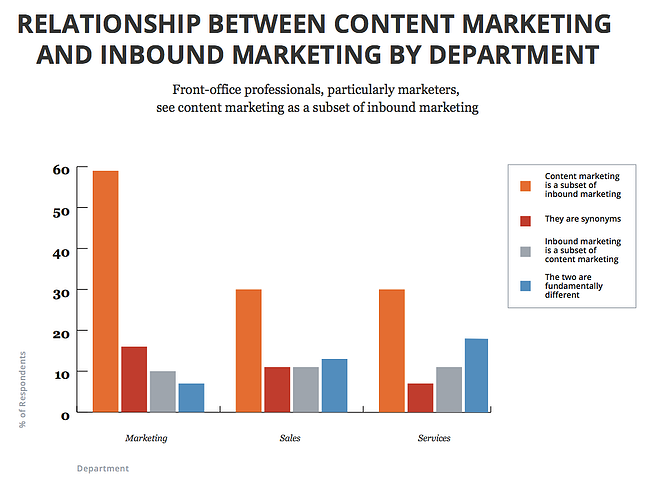
Front-office (marketing, sales, services) professionals generally agree that content marketing is a subset of inbound marketing. Marketers are particularly united in this definition.
Content-vs-Inbound-By-Department
When we first saw the above data, we felt validated, but skeptical. We wondered if sample bias was skewing the results. After all, HubSpot sells inbound marketing software, and nearly half of our survey respondents are our partners or customers -- so perhaps we were sampling an audience that had been preconditioned to favor inbound?
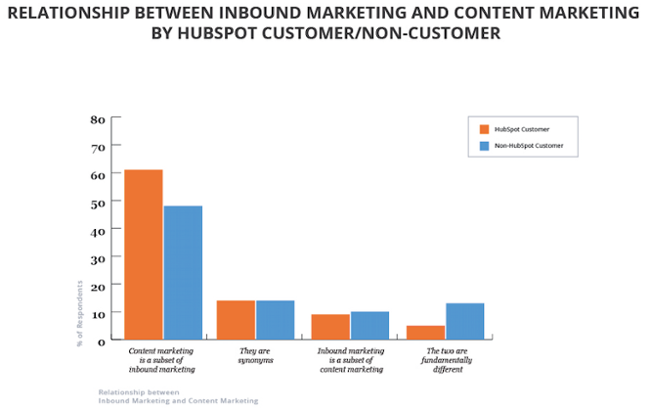
We tested this possibility by comparing responses from HubSpot customers to non-customers. As you can see in the below chart, there’s little variance between the two groups. In fact, nearly half of marketers who don’t use HubSpot believe content is a subset of inbound marketing – that’s five times as many as those who feel inbound is a subset of content marketing.

Just as HubSpot has positioned itself around the inbound marketing concept, other marketing automation vendors have introduced their own terminology. Does one’s choice in marketing platform influence her perception of inbound and content marketing terminology? We sliced the data by marketing automation usage to find out.
Here's what we found: Marketers generally share a common understanding of inbound/content marketing, regardless of what marketing software they run.

Finally, we wanted to ask the same question of a completely different audience. So we promoted a one-question survey on Facebook, targeting North American adults with an interest in either digital marketing, inbound marketing, or content marketing. Though the data is a bit more variable than the responses to the HubSpot State of Inbound survey,respondents were three times as likely to consider content a part of inbound than vice versa. See below.

So what does all this mean, and does it really matter? It does.
Marketers should think in terms of “and” not “or” when it comes to the content/inbound relationship. Success relies on both. Content may help fuel your inbound engine, but there are similarly valuable inbound projects -- like technical SEO, freemium trials, interactive tools -- that may exist outside of the content marketer’s scope. If you aren’t availing yourself of the full spectrum of inbound practices, you are limiting the potential impact you can have as a marketer or marketing leader. In other words, your inbound initiative should be a superset -- inclusive of your content assets, but not limited to them. There are implications for organizational structure, roles and responsibilities, as well as skills procurement. 
Or you can worry about creating the kind of marketing people love, and let the pundits attach terms to your output. That works too. After all, as truculent as Ali was, he’ll always be remembered simply as the greatest.

Saturday, August 23, 2014

Uncovering insights on putting marketing theory into practice 08-24


Google's Tony Fagan

True detectives

Uncovering insights on putting marketing theory into practice

 "We are all detectives, trying to uncover something.”
 

Evoking Sir Arthur Conan Doyle, Donald Lehmann of Columbia Business School shared that reflection at the conclusion of the 2014 Theory + Practice in Marketing conference held at Kellogg. Lehmann’s remarks illustrated how practitioners and academics alike are in constant pursuit of discoveries that have the potential to solve huge problems, such as the challenges posed by big data.

“While data analytics is one of the big ‘it’ ideas of the current day, why does it matter? We all know it’s about gaining a deeper understanding of the customer and how you create more value,” said Dean Sally Blount ’92 as she welcomed top marketing faculty from across the globe to the fourth annual TPM conference.

Speakers who have held top positions at Google, Microsoft and Booz Allen imparted the following ways today’s executives can harness the power of big data — by emulating the wisdom of Sherlock Holmes.

1. Become a professional skeptic

“My education here taught me how to be a professional skeptic as opposed to an armchair skeptic,” said former Booz & Company CEO Shumeet Banerji ’90, as he reflected on obtaining his PhD at Kellogg. “Being a professional skeptic is about asking, ‘Is that true?’ ‘Under what conditions is it true?’ ‘Can you support that claim with evidence?’ Good questions beget good answers. It is about not accepting something is thus because a wise man said so.”

2. Emphasize decision-making over analytic output

Speaking to his time in the corporate world, Banerji said, “While analysts do analytics, nobody listens to them. You have to get line people to use analysis. And the way you get them to do it is by integrating the analytics into decision-making. What matters is decision-making, what doesn’t matter is analytic output.”

3. Don’t buy the quick-fix “anxiety sell” — hire the right people instead


Instead of trying to find flash-in-the-pan big data solutions, Tony Fagan, who leads a quantitative research team at Google, underscored the importance of hiring a Watson-like team with the right combination of skills. “It’s almost a fluency issue. They need a certain intuition with data, they need to know what questions to ask and they need to have some understanding of technology, because that, in my view, is what will affect marketing organizations in the future.”

4. Experiment your way to rapid innovation

As the economics of technology professor at Stanford and the former chief economist at Microsoft, Susan Athey knows a thing or two about how research principles can best apply to modern business, especially in the area of web search and online advertising. “At Microsoft and Google, algorithmic changes [in web search] are proposed frequently and exposed to a subset of users in randomized experiments. Every single thing that changes at Microsoft and Google in search goes through A/B tests. Experimentation allows you to incredibly rapidly innovate. You can have people come up with an idea, put it through an experimentation process, test it and ship it within a week.”

Ideally, all of this tinkering will have a positive impact on key stakeholders. According to Athey, “When you think about changing a [web search] algorithm, it’s going to change the outcome for all constituents. It’s going to change revenue for the platform, it’s going to change advertiser profits and it’s going to change the user experience. You’re constantly monitoring how changes you make affect the welfare of participants.”

Conference conversations revealed the value of academics’ and practitioners’ shared focus on developing an analytical approach to customer centricity — and forging collaboration between the two sectors is truly a case worth cracking. 

Tuesday, June 10, 2014

The Great Divide in Content Marketing - infographic 06-11


The Great Divide in Content Marketing - infographic

"Embraced by brands and marketing professionals around the world, content marketing continues to capture budget and priority in the marketing mix. But there’s a startling contrast in the motivations behind content marketing and the actual results.

Check out this infographic that shows how the actual results of content marketing don’t always line up with what we’re intending or expecting from our efforts – and a few important tips for marketers seeking to close that gap."


Wednesday, November 6, 2013

Three Wrongs Make a Right 11-06

Three Wrongs Make a Right

Today I was eating at a restaurant with my family and it was one we had never tried before. As it turns out, it will be the basis of this week’s blog post. The server does not come to our table for 10 minutes after we were seated. Wrong #1. So, I had to go ask someone who our server was and then he magically appeared. We told him we were ready with our drink and food order if that made it easier for him. (Yes, we were hungry.) Oh yeah, and before I forget, this restaurant has one of those Coke machines that can make tons of variety flavors of drinks. So, we order a few like Cherry Coke Zero and then a couple of iced teas (yes Kelly Mallozzi, and John Foley) sweet tea. OK, back to the story...

So, the server disappears for quite a while and finally comes back and has the drink order entirely wrong. Wrong #2. He went back to fix this once we told him. Third, the manager comes out to ask if we ordered only two food orders (there were four of us there today) instead of four food orders. We said no and she apologized and said the server put in all the food wrong as well. Wrong #3.

The server never told us it was his first day or we might have been more understanding. This was just a lack of good communications on his part. However, the manager did everything right. She rushed to get all the drinks fixed, took care of our table herself, offered us a free appetizer, and then explained all the options with each meal (which we did not get the first time). You see, she took a situation that was quickly getting bad and fixed it. So my experience was not great today, but it would not stop me from going back. Why? She cared and communicated she was sorry and explained the truth as to what was going on.

She was honest, did not make excuses and simply took care of the problem. Is this not something we can all learn from and apply to our business? There are times when it might be appropriate to explain “why” something went wrong to a customer. However, in many cases the best policy is to say we have “dropped the ball” on this and we will do whatever it takes to make the situation right. This is what the manager did for my family at lunch. Little does she know I am blogging about this on an international blog. 

Customers do not like mistakes. However, my most loyal customers were earned based on how I make bad situations “right” for them. Once a customer knows you will go the extra mile and do what is right, you have reached an entirely new level in your relationship. You make them feel important and they know that you will stand behind a problem. Thus, you create more than a loyal customer...you make a raving fan.

So, as the title states...sometimes three wrongs can make a right!

Wharton Professor Eric Bradlow unveils a new metric for marketers to determine customer lifetime value. 11-06


SIX STEPS TO A CLUMPIER CONSUMER

Wharton Professor Eric Bradlow unveils a new metric for marketers to determine customer lifetime value.
152992029
Professor Eric Bradlow, W’88, HOM’00, shares an epiphany from his latest marketing analytics research: how one data point could help marketers better identify their customers with the most promising customer lifetime value (CLV).
It’s called “clumpiness”—a measurement of how binge-y a shopper is. Clumpy shoppers—those that shop in spurts comparable to the behavior of binge drinkers and binge sleepers—are more valuable in the long run than nonclumpy shoppers, according to data collected by Bradlow, who serves as Wharton’s K.P. Chao Professor, vice dean and director of Wharton Doctoral Programs, and co-director of the Wharton Customer Analytics Initiative.
Your options are to watch the full webinar to gain a greater understanding of clumpiness, or read our six takeaways, presented below.
Better yet, you could do both—read this blog and watch the full webinar.
1. Does clumpiness apply to business-to-business customers? “I have no empirical proof,” Bradlow told his remote webinar audience. “I am willing to bet a lot of money that clumpy B2B is worth more in the future,” he said, adding that if any B2B marketers would like to share their data sets, he would be happy to test his hypothesis on them.
2. Bradlow will offer links to the two research papers that explain his new finding, as well as an Excel spreadsheet to demonstrate how to measure the clumpiness of your customers, on his Wharton homepage  .
3. Digital consumers seem to behave more clumpily. In his analysis, 40 to 50 percent of Hulu, YouTube, Amazon and eBay customers are clumpy. Shoppers of traditional products—like toilet paper, for instance—tend not to be clumpy.
Prof. Eric Bradlow
Prof. Eric Bradlow
4. There are two types of clumpy—visit clumpiness and purchase clumpiness. Shoppers who are visit clumpy are not necessarily purchase clumpy and are thus not necessarily more valuable. Purchase- clumpy shoppers tend to have that long-term value.
5. Female shoppers, younger shoppers under 30, loyalty program members and customers with wish lists tend to be clumpier.
6. The traditional framework of CLV and customer segmentation is RFM: recency, frequency and monetary value. This framework is lacking without a fourth attribute: C for clumpiness.

For others—and those Wharton community members who want as much of Bradlow as they can get—please watch the video below of Bradlow’s Wharton Lifelong Learning master class on “mining for gold in marketing.”

View at the original source

Sunday, June 30, 2013

Would Customers Pay for Your Sales Calls? 06-30


Would Customers Pay for Your Sales Calls?
by Scott Edinger  


When I speak to audiences of sales professionals and ask, "How many of you sell value versus price?" everyone raises their hand. But my next question "So how do you do that?" is frequently followed by an uncomfortable silence. Many consider themselves to be value sellers but few are able to articulate what that really means.
In the simple economics 101 definition, value equals benefits minus cost: V=B-C. If you follow the logic of that equation, then, selling value means creating some benefit through the sales process beyond that provided by the product or service itself. My former boss and sales guru Neil Rackhamhas a simple test for this: He asks, "Would your customer write you a check for the sales call?" That is, did your salespeople do something on the call valuable enough for your customers to pay you for?
If they didn't, the only way you can profit from your sales operation is by reducing costs. That's why all my efforts to make sales teams more effective have focused on increasing not just the value of the offering but the value of the sales call itself. To do that I encourage them to move down the continuum from transactional to consultative relationships. Here's how:
Help clients see issues they hadn't considered. 
The best salespeople I've worked with do an extraordinary job of this. And they don't do it simply by lecturing the client about the problems they see. They do it through a process of mutual diagnosis. In these instances, the seller leads a dialogue with the client about her business, offering diagnoses as the conversation progresses.
Help clients examine issues they thought were benign, but aren't.
 When I interview clients about their sales relationships, they frequently tell me that they greatly value the ability of their reps to help them make a case for change. They do that by helping clients see the effect of a problem on the organization. A seller may help a client to see that a morale problem, for instance, which right now is only causing modest employee turnover, is having a tremendously negative impact on recruitment and productivity that will eventually become highly problematic.
 Again, this is not done through lecturing, but rather through the course of conversations in which seller and buyer explore the impact of a given situation together to determine the implications for the business.

Help clients see opportunities they'd missed. 
Sales-training programs rightly focus on finding clients' "pain points." But great salespeople also know there's value in pointing out successes waiting to be exploited. Surely, creating value in the sales process is as much about raising the bar as it is about solving problems.
 In fact, untapped opportunity may be even more important as organizations seek to grow in this perpetually tough economic environment. Jointly discovering such opportunities through the course of back-and-forth conversation makes it less likely that a client will react defensively to something he perhaps should have already known and more likely that he will embrace both the opportunities — and the messenger that helped to uncover them.

Help clients address problems with solutions they hadn't considered. 
Of course, at some point your, products and services have to come into the picture. When they do, the best sellers position them, not as a series of features and benefits, but as solutions that address the expressed needs of the client. 
Positioning products and services as a solution is not a new idea by any stretch, but the key to creating value is to do so in a way that the client has not considered. I bought a new air-conditioning system last year. 
I hadn't considered upgrading the heat pump in my system. But with the help of the representative, I came to realize that the new system wouldn't lower my winter heating bills without one. 
The power of the a-ha moment here can't be understated when the client says, "I hadn't thought about it that way!" Few clients will know everything your offering can do or all its potential applications, so finding a way to uniquely address their expressed need is a powerful thing indeed.
Help clients connect with additional support resources. 
As the old saying goes, "When you sell hammers, every problem looks like a nail." But you can't win 'em all; not every client will actually be a good match with what you're offering right now. Still, that doesn't mean that you can't create additional value for them. 
Perhaps you can provide connections to others in your organization that could help a client think through a complex issue, or make referrals to outsiders who can get her what she truly needs. You'll still get the credit for helping the client — and this can help both of you over time.

At the end of the day, selling is about improving the client's condition with your organization's products and services. The sales professionals who understand how to do that — who help buyers find real value through the selling process using these methods — sell more and command a premium for their offerings.