Shyam's Slide Share Presentations

VIRTUAL LIBRARY "KNOWLEDGE - KORRIDOR"

This article/post is from a third party website. The views expressed are that of the author. We at Capacity Building & Development may not necessarily subscribe to it completely. The relevance & applicability of the content is limited to certain geographic zones.It is not universal.

TO VIEW MORE CONTENT ON THIS SUBJECT AND OTHER TOPICS, Please visit KNOWLEDGE-KORRIDOR our Virtual Library

Showing posts with label Human physiology. Show all posts

Friday, October 20, 2017

How to defend against your own mind 20-10


Image credit: Shyam's Imagination Library


New project to use podcasts, video to illuminate bias, improve decision-making. 

When it comes to some of the most important decisions we make — how much to bid for a house, the right person to hire, or how to plan for the future — there is strong scientific evidence that our brains play tricks on us.


Luckily, Mahzarin Banaji has a solution: Understand how your mind works so that you can learn to outsmart it.

The Richard Clarke Cabot Professor of Social Ethics and chair of the Department of Psychology is launching a new project — dubbed Outsmarting Human Minds — aimed at using short videos and podcasts to expose hidden biases and explore ways to combat them.

“The behavioral sciences give us insights into what gets in the way of reaching our professional goals, of being true to our own deepest values,” Banaji said. “The science is not new, but its message is still one most people have difficulty grasping and understanding.”

Banaji and research fellow Olivia Kang, with funding from PricewaterhouseCoopers (PwC) and a grant from Harvard’s Faculty of Arts and Sciences, developed Outsmarting Human Minds as a way to deliver up-to-date thinking about hidden biases in an engaging way.

“Everyone wants to know what’s happening in their minds, and they want to know what they can do to make better decisions,” Kang said. “The science is out there; the challenge is getting it to the public in a way that captures their interest.”


The impetus for the project came in part from Banaji’s perspective as a senior adviser on faculty development to Edgerley Family Dean of the Faculty of Arts and Sciences Michael D. Smith.

Speaking of that role, Banaji said, “I try to expose what the mind sciences have taught us about how we make decisions. The hope is that the faculty will put this information to use … in decisions about how to imagine the future of their disciplines.”

Banaji has taught on decision-making to any number of organizations, including corporations, nonprofits, and the military. Questions about how to confront hidden biases are common.


“I want to put the science in the hands of people — or rather, in the heads of people — and have them ask: How can I outsmart my own mind? How can I be the person I want to be?”

She emphasized that watching a video or listening to a podcast isn’t enough to address hidden bias.
“Learning brings awareness and understanding. It cannot itself put an end to the errors we make,” she said. “To achieve corrections that will matter to society, we must learn to behave differently.”

Said Kang: “We want to deliver this information to people in a way that doesn’t make them feel that they’re a bad person if they have these biases. The fact is, we all do. This is about acknowledging that hidden biases are a product of how we’re wired and the culture we live in. And then agreeing that we want to do something about it — that we can use this knowledge to improve the decisions we make in life and at work.”

View at the original source

Wednesday, December 30, 2015

Intelligence ‘networks’ discovered in brain for the first time 12-30

Intelligence ‘networks’ discovered in brain for the first time


Scientists from Imperial College London have identified for the first time two clusters of genes linked to human intelligence.

Called M1 and M3, these so-called gene networks appear to influence cognitive function which includes memory, attention, processing speed and reasoning.

Crucially, the scientists have discovered that these two networks which each contain hundreds of genes are likely to be under the control of master regulator switches. The researchers are now keen to identify these switches and explore whether it might be feasible to manipulate them. The research is at a very early stage, but the scientists would ultimately like to investigate whether it is possible to use this knowledge of gene networks to boost cognitive function.

Dr Michael Johnson, lead author of the study from the Department of Medicine at Imperial College London, said: "We know that genetics plays a major role in intelligence but until now haven’t known which genes are relevant. This research highlights some of genes involved in human intelligence, and how they interact with each other.

What’s exciting about this is that the genes we have found are likely to share a common regulation, which means that potentially we can manipulate a whole set of genes whose activity is linked to human intelligence. Our research suggests that it might be possible to work with these genes to modify intelligence, but that is only a theoretical possibility at the moment we have just taken a first step along that road."

In the study, published in the journal Nature Neuroscience, the international team of researchers looked at samples of human brain from patients who had undergone neurosurgery for epilepsy. The investigators analysed thousands of genes expressed in the human brain, and then combined these results with genetic information from healthy people who had undergone IQ tests and from people with neurological disorders such as autism spectrum disorder and intellectual disability.
They conducted various computational analyses and comparisons in order to identify the gene networks influencing healthy human cognitive abilities. Remarkably, they found that some of the same genes that influence human intelligence in healthy people were also the same genes that cause impaired cognitive ability and epilepsy when mutated.

Dr Johnson added: "Traits such intelligence are governed by large groups of genes working together like a football team made up of players in different positions. We used computer analysis to identify the genes in the human brain that work together to influence our cognitive ability to make new memories or sensible decisions when faced with lots of complex information. We found that some of these genes overlap with those that cause severe childhood onset epilepsy or intellectual disability.

"This study shows how we can use large genomic datasets to uncover new pathways for human brain function in both health and disease. Eventually, we hope that this sort of analysis will provide new insights into better treatments for neurodevelopmental diseases such as epilepsy, and ameliorate or treat the cognitive impairments associated with these devastating diseases."

View at the original source

Tuesday, February 10, 2015

Newly Discovered Networks among Different Diseases Reveal Hidden Connections 02-11

Newly Discovered Networks among Different Diseases Reveal Hidden Connections


Enormous databases of medical records have begun to reveal connections among diseases that could provide insights into the biological missteps that make us sick.


Stefan Thurner is a physicist, not a biologist. But not long ago, the Austrian national health insurance clearinghouse asked Thurner and his colleagues at the Medical University of Vienna to examine some data for them. The data, it turned out, were the anonymized medical claims records — every diagnosis made, every treatment given — of most of the nation, which numbers some 8 million people. The question was whether the same standard of care could continue if, as had recently happened in Greece, a third of the funding evaporated. But Thurner thought there were other, deeper questions that the data could answer as well.
In a recent paper in the New Journal of Physics, Thurner and his colleagues Peter Klimek and Anna Chmiel started by looking at the prevalence of 1,055 diseases in the overall population. They ran statistical analyses to uncover the risk of having two diseases together, identifying pairs of diseases for which the percentage of people who had both was higher than would be expected if the diseases were uncorrelated — in other words, a patient who had one disease was more likely than the average person to have the other. They applied statistical corrections to reduce the risk of drawing false connections between very rare and very common diseases, as any errors in diagnosis will get magnified in such an analysis. Finally, the team displayed their results as a network in which the diseases are nodes that connect to one another when they tend to occur together.
The style of analysis has uncovered some unexpected links. In another paper, published on the scientific preprint site arxiv.org, Thurner’s team confirmed a controversial connection between diabetes and Parkinson’s disease, as well as unique patterns in the timing of when diabetics develop high blood pressure. The paper in the New Journal of Physics generated additional connections that they hope to investigate further.
Eventually, Thurner and a growing number of other researchers hope to use these disease networks to generate hypotheses about how diseases operate at the molecular level. “Is this disease caused by a gene?” Thurner said. “Is it caused by a defect in the metabolic network? Is it due to environmental things that affect certain genes? Things like this. This is the aim.”
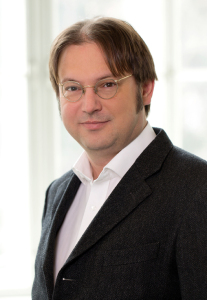
Stefan Thurner analyzed the anonymized medical records of all of Austria.
Medical University of Vienna/Matern
Stefan Thurner analyzed the anonymized medical records of all of Austria.
The work is being driven by the realization that diseases, as defined in medicine, sound like tidy, distinct entities, but are messier in reality. Diseases tend to be defined by their symptoms. But the molecular roots of a disease may have biological effects that go far beyond our current understanding. Certain diseases tend to follow others or have high rates of comorbidity, and though it isn’t clear why, it may be because they arise from related biological flaws.
“The idea is, connections at the cellular level get amplified at the population level, and they emerge as comorbidity,” said Albert-László Barabási, a physicist at Northeastern University who has published several landmark papers in this area, including a 2009 article in PlOS Computational Biology that helped inspire Thurner, as well as a 2011 review of the field in Nature Reviews Genetics. Using a disease network, a researcher might suggest that biologists look for new disease genes shared between diseases one and two, for instance, where there seems to be a strong connection.
Biologists typically look for genetic connections by using genome-wide association studies, which statistically associate genetic markers with disease. But at Harvard Medical School, another research team is attempting to find the same connections by mapping networks of a very different kind: the molecular networks at work in a cell.
Networks of Life
The inside of a cell seethes with activity, as tiny molecules, enormous proteins and strands of DNA wash around each other going about their business. Each actor’s business is some set of other actors — a protein, for instance, might snip pieces off of other proteins, ferry molecules around, or jump-start the manufacturing of DNA. It takes its cues from other actors, which can make it work faster or more slowly or send it off to distant regions where it’s needed.
The functioning of the cell can take on a very different character if even a single member of this molecular social network starts to behave oddly. Before long, the effects ripple outward from the initial flaw, causing problems — disease — on the level of the organism. A disease is in some sense just an expression of the underlying dynamics of this social structure. Thurner hopes his disease networks can eventually help uncover some of these flaws.
And it’s here at the sub-microscopic end of things that Joseph Loscalzo, a professor at Harvard Medical School and a long-time collaborator of Barabási’s, is mapping his own network. He and his team start by gleaning data from numerous databases on which proteins interact with each other and how. Then, using a computer model, they sketch out the social network within an average cell, connecting individual genes and proteins to one another if they happen to interact. Loscalzo’s team has built a diagram with 13,460 protein nodes and 141,296 links. (These interactions probably account for only about 20 to 25 percent of the total, Loscalzo says, but it’s a start.) Then they isolate just the nodes that have been statistically linked to a given disease. They call this set of nodes the disease module.
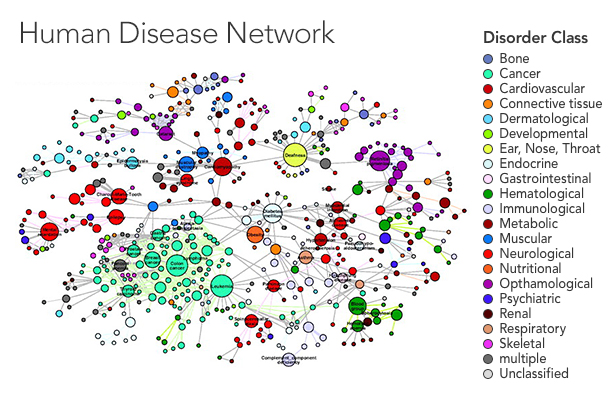
A human disease network maps out connections between diseases — if patients who have one disease tend to also have another, the two disease nodes are connected.
Olena Shmahalo/Quanta Magazine; source: Albert-László Barabási
A human disease network maps out connections between diseases — if patients who have one disease tend to also have another, the two disease nodes are connected.
One disease module they’ve studied is for pulmonary hypertension — high blood pressure in the lungs, which can cause heart failure. They looked at all the molecular pathways that genome-wide association studies suggested were involved. They then studied which pathways grow more active in animal models and in pulmonary hypertension patients under stress. Their disease module revealed that two proteins previously linked to some forms of the disease were part of the same molecular pathway and that they work together to cause errors in cell proliferation, which may be linked to the symptoms of the disease. The researchers published their findings in the journal Pulmonary Circulation.
Another module looks at Type 2 diabetes. Researchers have linked diabetes to about 200 spots on the genome through genome-wide association studies. “The first 18 or so of those are highly significant, but the last 182 or so are just at the margin,” Loscalzo said. But in the disease module, it was clear that some of those 182 genes were highly connected hubs in the social network, a state of affairs that a genome-wide association study alone is not equipped to reveal. “We’ve explored three of those [genes] now, and they highlight pathways that had been peripherally believed to be associated with diabetes but never demonstrated in any careful way,” he said.
Combining Loscalzo’s molecular networks with Thurner and Barabási’s disease networks would help to create a bridge between correlation and mechanism. If comorbid diseases share overlapping molecular networks, researchers could use the networks to understand the biochemical mechanisms behind them. These two kinds of networks, very different in how they are built, are united only by the idea that data can reveal connections that otherwise would pass unnoticed. But together these networks have the potential to open new doors in the study of disease.
“Once you draw a network, you are drawing hypotheses on a piece of paper,” Thurner said. “You are saying, ‘Wow, look, I didn’t know these two things were related. Why could they be? Or is it just that our statistical threshold did not kick it out?’” In network analysis, you first validate your analysis by checking that it recreates connections that people have already identified in whatever system you are studying. After that, Thurner said, “the ones that did not exist before, those are new hypotheses. Then the work really starts.”
It is worth remembering that both techniques are still relatively new. Loscalzo can reel off ways that his results could be flawed — the sprawling incompleteness of the data on protein-protein interactions is a major concern, but so are the methods used to gather the data, which are the best currently possible but far from perfect. And Thurner and his students are still gathering collaborators in biology who can test their hypotheses. After they published their first results from the database a couple of years ago, Thurner said wryly, “we thought we would have a hundred people sitting in our office,” looking to collaborate. So far, the response has been more of a trickle.
“It’s not uncontroversial,” said Andrey Rzhetsky, a professor of genetics at the University of Chicago with a background in mathematical biology who has published on comorbidity networks. “Some people feel very strongly about big data sets — almost to the point of fanatic refusal to accept results from large-scale analysis.” The argument, he explains, is that there are unknown biases in large data sets. In the case of databases like Thurner’s, these biases stem from the different ways doctors enter information into medical records, the way ethnicity is accounted for, and so on. Rzhetsky acknowledges the danger of biases but believes they do not eliminate the usefulness of the data, provided researchers are careful with their interpretations. “I do think it’s the direction for the future, but it’s far from a solved problem,” he said. He was intrigued by the article in the New Journal of Physics. “The model is extremely simple, but the direction is great,” he wrote in an email.
Loscalzo is aware of his colleagues’ scrutiny. “When I give talks about network medicine,” he said, “I’ve gotten three kinds of responses. At one end of the spectrum are generally young people … who say this is a great idea, I hadn’t thought about this before. … At the other end of the spectrum I have people my age or older who say: ‘What are you talking about? I’m a member of the National Academy and that’s all based on reductionist biology, I’m not going to change my strategy.’ Then in the middle you’ve got this broad swath of people who have a healthy skepticism and who want there to be some sort of proof that these notions can give us new insights. And that’s what we’ve been working on.”

Sunday, September 1, 2013

Researchers Grow Human 'Mini Brains' 09-01

Researchers Grow Human 'Mini Brains'


Researchers have used stem cells to grow pea-sized structures that resemble the developing human brain, an advance that offers a way to model brain maladies that are otherwise hard to study.
The human brain is one of the most elaborate natural structures known to science. These new lab-grown "mini brains" are imperfect, and a long way off from matching the real thing.
Still, the structures, which are about four millimeters in diameter, share some of the crucial three-dimensional architecture of a developing human brain. The different brain parts interact in a normal manner, though they aren't necessarily in the proper places.
Enlarge Image
Credit: Madeline A. Lancaster
A cross-section showing development of different brain regions.


image

"It would be like a car with the engine on the roof, the gear box in the trunk and an exhaust pipe that points to the front," said Jürgen Knoblich at the Institute of Molecular Biotechnology of the Austrian Academy of Sciences and leader of the research team. "You can still use such a car to study how an engine works."
The experiment was reported Wednesday in the journal Nature.
The advance is expected to allow researchers to investigate human brain disease in a lab—something that currently is a big challenge. Brain disorders such as Alzheimer's typically are studied in rats, mice and other animals, but these are inadequate proxies mainly because the human brain is much more complex.
By contrast, the new approach should enable scientists to study neurological disorders by examining brain tissue derived from actual patients.
[image]
Jürgen Knoblich created versions of developing brains in the lab.
In the Nature paper, Dr. Knoblich and his colleagues described how they used their technique to study brain tissue created from a patient suffering from microcephaly, a genetic disorder that leads to a smaller brain. His team's research builds on several experiments published by other researchers since 2008, which showed how stem cells could be manipulated to create not just nerve cells, but more elaborate neuron-based structures as well.
At a lab in Austria, Dr. Knoblich did experiments with human embryonic stem cells, which are derived from an embryo. He experimented with stem cells that were obtained by reprogramming mature tissue, such a person's skin cells, into an embryonic-like state. Both types of stem cells are "pluripotent"—they can be changed into all other cell types in the body.
The researchers added chemicals known as growth factors to the stem cells, which created tissues that would go on to form the central nervous system. The tissues were put in a gel-like substance resembling the environment of a developing human embryo.
That mix was then put into a spinning bioreactor, a vessel that helps cells develop and grow. After 20 to 30 days, the neural cells organized themselves into tiny structures, called cerebral organoids.
These structures had defined brain regions, including a dorsal cortex—which makes up the largest part of our brain—and the choroid plexus, where cerebrospinal fluid is produced. The neurons were active and fired.
"That was the big surprise—it was self-organizing," said Dr. Knoblich, who added that his team made hundreds of the "mini brains."
But within the structures, the various bits were in a jumble and the shape and overall spatial organization didn't fully match that of a real brain. Plus, key pieces—such as the cerebellum, an area involved in motor control—were missing.
After the organoids achieved a size of four millimeters in diameter, they stopped growing, probably because they lacked a circulatory system, the researchers said. At that stage, they resembled the developing brain of a nine-week-old human embryo.
"Despite these compelling data, the realization of a 'brain in a dish' remains out of reach," wrote Oliver Brustle of the University of Bonn, in an article that accompanied the study. Dr. Brustle, who wasn't involved in the study, added: Although parts of the organoids' exteriors "clearly bear a resemblance to the developing cerebral cortex, it remains unclear whether they can advance to the complex six-tiered architecture of their natural counterpart."
Nonetheless, even imperfect brain tissue has uses, such as the work by Dr. Knoblich's team to study a patient suffering from microcephaly, the malady that leads to a small brain size and which has been difficult to model in mice.
The researchers first reprogrammed the patient's skin cells into stem cells, then grew those into mini brains. As expected, the mini brains grew to a lesser-than-normal size.
By examining the mini brains in the lab, Dr. Knoblich's team was able to pinpoint some ways in which the disease develops. In such patients, it seems, stem cells get transformed into neurons prematurely—at the expense of a proper buildup of stem cells. That is why the brains of such patients end up being smaller than normal, the scientists theorized.

Monday, June 24, 2013

The link between circadian rhythms and aging 06-24


The link between circadian rhythms and aging


MIT study finds that a gene associated with longevity also regulates the body’s circadian clock.