Shyam's Slide Share Presentations

VIRTUAL LIBRARY "KNOWLEDGE - KORRIDOR"

This article/post is from a third party website. The views expressed are that of the author. We at Capacity Building & Development may not necessarily subscribe to it completely. The relevance & applicability of the content is limited to certain geographic zones.It is not universal.

TO VIEW MORE CONTENT ON THIS SUBJECT AND OTHER TOPICS, Please visit KNOWLEDGE-KORRIDOR our Virtual Library

Sunday, May 26, 2013

Class of 2013 collection of top commencement speeches 05-28


Oprah Winfrey's Commencement speech at Harvard to the Class of 2013
Sir Richard Branson Founder at Virgin Group

Arianna Huffington, President and Editor-in-Chief at The Huffington Post Media Group

Guy Kawasaki, Advisor at Motorola Mobility

Charlene Li, Founder Partner at Altimeter Group

Michael Fertik, CEO at Reputation.com and Owner, Reputation.com

Maria Shriver, Author, Journalist & Activist at Maria Shriver

Michael Skok, General Partner, North Bridge Venture Partners

Wendy Kopp, CEO & Co-Founder, Teach For All / Founder & Chair, Teach For America

Emily Chang, Host of "Bloomberg West"

T. Boone Pickens, Founder, Chairman and CEO at BP Capital and TBP Investments Management

Adam Lashinsky, Sr. Editor at Large, Fortune Magazine

Craig Newmark, Founder at craig connects


Jon Steinberg, President and Chief Operating Officer at BuzzFeed

Class of 2013: You'll Never Again Be so Unburdened; Do Something Bold 05-28

Class of 2013: You'll Never Again Be so Unburdened; Do Something Bold


The best advice I could give any graduate is to spend your time working on whatever you are passionate about in life. If your degree was focused upon one particular area, don't let that stop you moving in another direction. If college hasn't worked out for you, don't let that put you off. Virgin's expansion into so many different areas is borne out of my insatiable curiosity to enjoy new experiences and pursue fresh challenges.

You may decide to take a break and consider your options. I would urge you to travel, take on new experiences and draw upon those when it comes to making the decisions that will shape your future. The amount of business ideas that people pick up from travelling the world is enormous. If you don't want to reinvent the wheel, you may find a business that works in another market that could be adapted for your own. Gap years don't only have to happen before you go to college. Actually, a good option is to travel instead of going to university. You can work and still have a lot of fun along the way: you won't create as much debt, you'll learn an awful lot and may come back with some great ideas. 

Equally, if you spot an opportunity early on and are really excited by it, throw yourself into it with everything you have got. Be ambitious. There probably won't be another time in your life when you have such freedom of opportunity. Grasp it with both hands. If you can't find an opening that fits what you want to do, why not try to create one yourself? We always enter markets where the leaders are not doing a great job, so we can go in and disrupt them by offering better quality services. Until this week I had never had a boss in my entire life. I lasted about five hours before Tony Fernandes sacked me, after throwing a tray of drinks over him while working as a stewardess on a flight! (It was all for a bet to raise money for charity, so I wasn't too upset.)

My own transition from education to a working life was pretty straightforward. I started Student Magazine at school and was spending an increasingly large amount of time working on getting it off the ground. The headmaster gave me an ultimatum: he said if I wanted to carry on with Student, I had to stop being a student. So I left to start my adventures in business. Being dyslexic, I never excelled in the classroom and entrepreneurship wasn't encouraged. I didn't even know what I was doing was called entrepreneurship until somebody told me!

However, education is absolutely crucial to success and to the progress of the world at large. As Nelson Mandela said:
Education is the most powerful weapon to change the world."
But education doesn't take place in stuffy classrooms and university buildings, it can happen everywhere, every day to every person. I was on a panel at a University in Australia recently and it turned out the only one of us onstage who had graduated was the Dean himself!
I have been offered to do graduation speeches over the years and did accept an honorary Doctor of Technology from Loughborough University. It was strange at the time, but now we have Virgin Galactic perhaps it's not so strange! I was chuffed to receive it, having left school at 15. It was a hell of a lot easier than going through university to get it! If you are graduating, congratulations and good luck for your future. Every graduate - scratch that - every person has the chance to reach for the stars in their chosen field.

Saturday, May 25, 2013

Management Tools & Trends 2013 05-27


Management Tools & Trends 2013


By Darrell Rigby and Barbara Bilodeau


alt
The slow and uneven emergence from the global economic downturn has left many executives in a bind. They need to grow their businesses at a time when forces inside and outside their organizations make that task much more difficult. Having pinned their hopes on a relatively swift recovery, many global business leaders are coming to recognize they may have been overly optimistic. With more realistic expectations, executives are taking a more focused approach to the management tools they use to guide their businesses—using fewer tools to pursue revenue and profit growth, but using them more strategically.
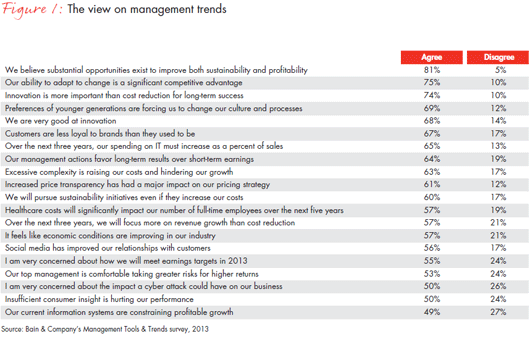
Overall, a majority of the 1,208 global executives interviewed for Bain & Company’s 14th Management Tools & Trends survey see economic conditions improving in their industries. But their confidence level has slipped dramatically since our last survey in 2010, amid a slower recovery than many anticipated—and with some additional new challenges. As a result, 55% of executives we surveyed are concerned about meeting their earnings targets in 2013 (see Figure 1).
The same dynamic is forcing business leaders to reassess the investments they must make to grow revenues, in areas ranging from information technology, hiring, healthcare and taxes, to sustainability, price reductions and product differentiation. Having maximized the benefits of such cost-cutting tools as Downsizing and Outsourcing, many are now scouting for new and creative approaches to cost reduction to help them fund investments or meet earnings targets. Survey results show that the need is felt most acutely by leaders of large companies in North America and Europe.


mgmt-tools-2013-fig-01_embedClick to enlarge

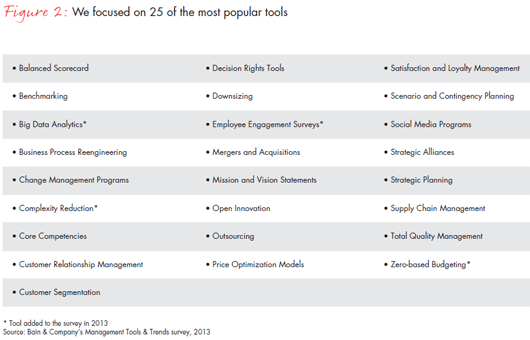
Twenty years ago we launched our first global survey of Management Tools & Trends to track executives’ behaviors and attitudes through a full range of economic cycles (see Figure 2 and below, “A history of Bain’s Management Tools & Trends survey”). The results this year, as in the past, provide instructive insights into what is working and what is not, as well as what is on the minds of executives around the globe. Not surprising, growth is the top priority. The survey responses also reveal some of the major challenges that make growth difficult to achieve—from price transparency (which constrains the ability of companies to notch up prices as demand improves) to healthcare costs that executives say will make it more difficult to boost their ranks.

mgmt-tools-2013-fig-02_embedClick to enlarge

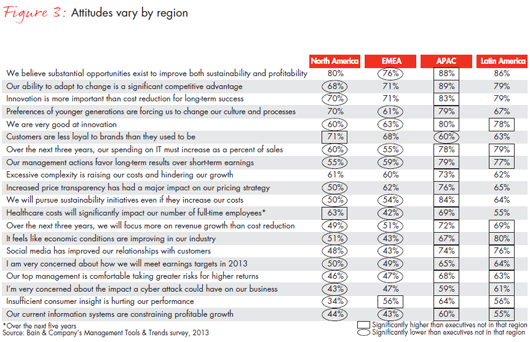
The differences between established and emerging markets became even more pronounced in this year’s survey, with respect to both the outlook of executives and the management tools they use and regard as effective. For example, while executives in all regions have lowered expectations for their industries, only half of North American executives are optimistic about improving economic conditions in their industries—a decline of 20 percentage points since 2010. Only 43% of Europe, the Middle East and Africa (EMEA) executives see their industries improving. By comparison, 80% of Latin American and 67% Asia-Pacific respondents express optimism about the future of their industries—reflecting expectations that the path to revenue growth will be easier in emerging markets than in advanced markets (see Figure 3).

mgmt-tools-2013-fig-03_embedClick to enlarge

A desire for profitable growth and the challenges to it
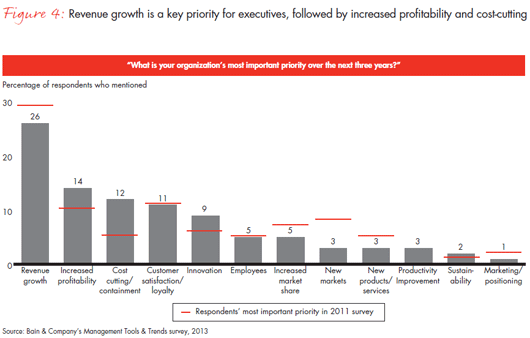
The most urgent priority indicated by all the global executives in the survey was the need to increase the pace of revenue growth and to find additional ways to make that growth profitable. When asked “What is your organization’s most important priority over the next three years?” executives cited revenue growth twice as often as the second most cited priority (see Figure 4). In some regions, executives perceived conditions that could significantly improve growth—for instance, 78% of leaders in Brazil and 83% in Mexico said economic conditions in their industries were improving.

mgmt-tools-2013-fig-04_embedClick to enlarge

Businesses need to recapture growth lost in the downturn and in a recovery that proved weaker than many had hoped. A majority of those surveyed were confident in the capabilities they’ve had in place to help them grow: for example, in their ability to adapt to change, to innovate and to use social media to improve customer relationships.
But leaders said they would need to overcome a range of challenges that vary widely around the globe and have executives of large companies (more than $2 billion in revenues) more worried than their counterparts at midsize or small companies. As the recovery drags on, more executives acknowledge a tough macroeconomic environment, with particularly stiff headwinds in Europe, which will require a disciplined approach for revenue growth. Pricing was a major concern, with some indications that business leaders saw customers becoming less loyal and putting price above other considerations. That concern was greatest in North America.
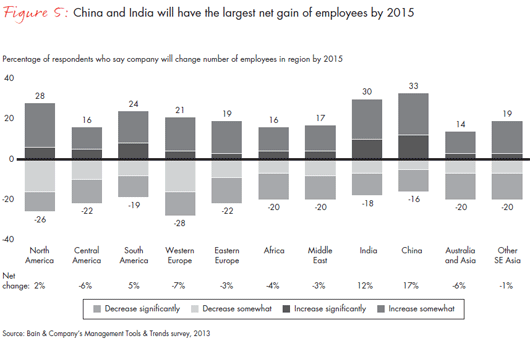
Some of the challenges to growth appear to be beyond their control. Roughly half of all executives feared a cyber attack would greatly impact their business (see below, “A growing concern: Cyber attacks”). Other challenges take the form of mounting costs that limit expansion plans. For example, almost 60% said healthcare costs will significantly affect the number of full-time employees they will be able to retain over the next five years. That issue, in combination with the uncertain economy, may hurt US companies more than companies in other countries. When asked if and how their employee numbers would change by 2015, 28% of companies said they will increase the number of employees they have in North America, but 26% said they will decrease. By comparison, in China 33% plan to increase, while only 16% expect to decrease (see Figure 5).

mgmt-tools-2013-fig-05_embedClick to enlarge

Along with these external factors, business leaders indicated a number of internal and organizational challenges to revenue growth. Half of the respondents believed current information technology systems constrain profitable growth. And 6 out of every 10 respondents said that the complexity creeping into their organization raises costs and hinders growth.
Customers’ ability to easily compare prices online surfaced as a tricky new challenge for executives as they pursue revenue growth—61% said price transparency had a major impact on their pricing strategy. Price transparency affects revenues in two ways: Companies have less flexibility to boost prices and customers are more easily lured to lower-priced competitors. Among executives surveyed, 67% said they believed their customers had become less loyal to their brand.
That loyalty issue may help explain why larger companies were more worried about the future than smaller companies. Despite their resources and influence, executives at larger companies were more likely than their counterparts at midsize or smaller companies to say customers were less loyal to their brands. Seven out of 10 executives at larger companies perceived customers to be less loyal. Smaller start-ups see an advantage in customers’ wavering loyalty because it allows them to steal share and grow from larger, more established companies.
Companies of all sizes need to rely on new and future employees to help them grow. The Millennial generation has entered the workforce and is making its presence felt, with new demands that executives must take seriously. Sixty-nine percent of respondents said their youngest employees are pressuring them to change their culture and processes.
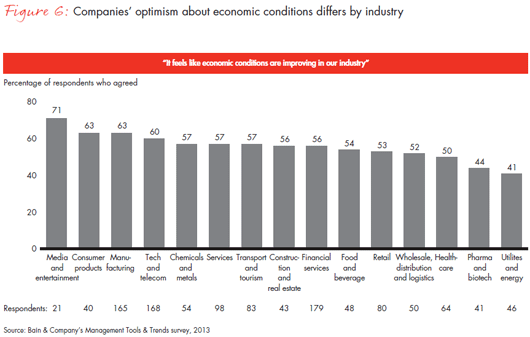
These challenges to growth are being felt more intensely in some industries than in others. When asked about the prospects for improved conditions in their industry, leaders in media and entertainment, consumer products and manufacturing companies were most optimistic; those in healthcare, pharmaceuticals and biotech, and utilities and energy were least optimistic (see Figure 6).

mgmt-tools-2013-fig-06_embedClick to enlarge

The growing need to invest
One message came through loud and clear: Executives knew the investments they needed to make to boost revenues, but they had delayed making them while companies waited out the downturn.
Across industries and regions, business leaders indicated that they were narrowing their focus on the most critical areas for investment. In recent years, Customer Relationship Management emerged as an important investment priority. Now it may be more critical than ever, as executives see signs of diminished customer loyalty. Armed with new evidence proving the link between motivated employees and customer loyalty, business leaders are prioritizing investments in employee engagement. They told us they are compensating for long-delayed investments to upgrade information technology and to tackle complexity in their organizations. Companies are responding vigorously to growing demands for sustainability, even at the price of increased costs.
Customer loyalty has gained recognition as a key factor for success. At a time when record numbers of companies are investing more in ways of tracking and improving customer loyalty, two-thirds of our respondents indicated that customers are becoming less loyal to any one brand. For many, that creates pressure to reduce prices or to invest in greater innovation and differentiation to strengthen their devotion. More than any other industry, consumer products executives reported that they had experienced a reduction in brand loyalty.
Clearly, companies see the need to continue sharpening their focus on customers, as they had already begun to do before the downturn. Half of the executives—up slightly from 2010—believed that insufficient consumer knowledge hurt their performance. Gaining a deeper understanding allows companies to foster loyalty. Our research also supports this intensified customer focus. Customer Relationship Management tied as the most widely used and most satisfying tool.
Customer Relationship Management (CRM) started gaining popularity as a tool in the mid to late 1990s and we first added it to our survey in 2000. At that time, it ranked 15th on our list and was used by 35% of our respondents. Relatively few executives found it satisfactory: It ranked 22nd of our 25 tools in satisfaction. At that time, companies had a choice: They could abandon their efforts, making CRM little more than a fad, or focus on making their existing investment pay off.
Based on our subsequent surveys, they chose the latter. CRM’s ranking steadily rose both in usage and satisfaction. By 2002, CRM tied for 5th in usage and 13th in satisfaction. In 2004 it rose to 2nd in usage and tied for 9th in satisfaction. By 2006, the tool remained 2nd in usage and moved to 4th in satisfaction. Today it is tied for 1st in both usage and satisfaction. One of the lessons companies have learned is that, over time, improvement in both technology and user sophistication have increased performance.
While companies are investing in improving their relationships with customers, they are discovering an equal need to invest in their employees. As already mentioned, executives are feeling pressure from their youngest employees to change their processes and culture. That concern is highest in Asia, where 79% of surveyed executives reported experiencing such pressure. Disengaged employees result in high employee turnover and in the need to invest in hiring, training, compensation and benefits.
That may be one explanation for the popularity of Employee Engagement surveys, a tool that was new to our list this year and tied with Strategic Planning and Customer Relationship Management as the most used tool. Employee Engagement surveys help companies build a more engaged workforce. But we also see evidence that the solutions aren’t easy to come by: Employee Engagement surveys ranked 22nd among all 25 management tools in satisfaction.
Based on Bain & Company research in the area of employee engagement, companies are finding that a loyal workforce does more than reduce the costs of churn; it also delivers more loyal customers. “Employees’ positive behavior and attitude are among the most powerful factors that earn a company the enthusiastic advocacy of its customers,” says Rob Markey, who leads Bain’s Global Customer Strategy and Marketing practice. Our consumer surveys show that the overall experience of dealing with a company often matters much more to customers than price or brand. In industries with a big service component, such as home insurance and retail banking, it may matter even more than product features alone. (For more on the topic of employee engagement, see the Bain Brief “The chemistry of enthusiasm.”)
Companies are also looking at other areas where they can overcome impediments to growth. As we mentioned, nearly half of the executives surveyed said their IT systems are hampering growth—65% told us their IT spending as a percentage of sales must increase over the next three years. The majority—63%—also saw excessive complexity as a challenge, highlighting the need to invest in improvements designed to streamline complexity in its many forms, including products, organization and processes.
Meanwhile, more companies see investments in environmental sustainability as supportive of future growth. Six in 10 companies said they will invest in sustainability initiatives even if it raises their costs—an increase of about 16 percentage points since we first asked the question in 2008. Many companies started their sustainability initiatives with win-win efforts that can save money while also demonstrating an environmental awareness to customers who increasingly look for such a commitment. More and more hotels, for example, are asking their guests if they would like their linens cleaned every day. The real test will come when customers push companies to expand sustainability efforts beyond those that save money to those that cost money.
Finding new ways to cut costs
Given this daunting list of investment priorities, it is no surprise that so many executives told us they need to trim costs. Among respondents, the number who mentioned cost-cutting as a priority more than doubled in 2012. Cutting costs will allow them to make investments and help reach earnings targets, which 55% of our respondents are concerned they won’t meet this year.
But business leaders need creative approaches to reducing budgets. In too many cases, cost-cutting initiatives put in place during the downturn either fell short or crept back in. A previous Bain survey looked at the experiences of nearly 300 companies that relied on a variety of cost-cutting initiatives during 2008 and 2009. Fully 40% of the executives surveyed, who sought to reduce costs by at least 10%, acknowledged their failure to achieve their goal. Among those seeking cost reductions of 20% or more, nearly 60% acknowledged failure.
The evidence of such ill-fated cost-cutting efforts can be seen in companies’ experiences with three tools that were popular during the recent downturn: Downsizing, Outsourcing and Business Process Reengineering. These tools took a heavy toll on corporate cultures and often hurt, rather than improved, stock performance. That is a pattern consistent with previous downturns. For example, Bain research during 2000–2001 revealed that companies with few or no layoffs delivered significantly better stock performance than those with large numbers of layoffs. In our recent survey, Downsizing scored low in user satisfaction in every region.
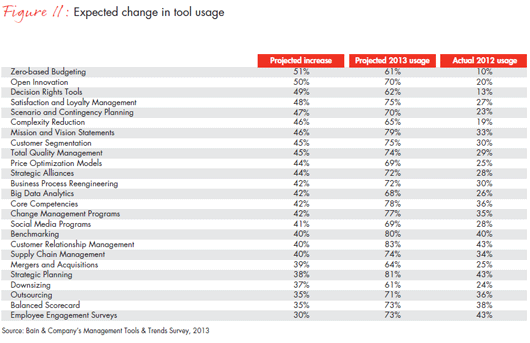
What alternate cost-cutting tools will they adopt? Zero- Based Budgeting, the broad-reaching cost transformation effort that takes a starting-from-scratch approach to resource planning, topped the list of tools that business leaders expect to use more of in the future. Another cost-cutting tool that will gain popularity, according to our survey is Complexity Reduction, which helps companies simplify their strategy, organization, products, processes and IT. Both of these tools scored higher in satisfaction than Downsizing and Outsourcing.
The big picture: Tool use and satisfaction
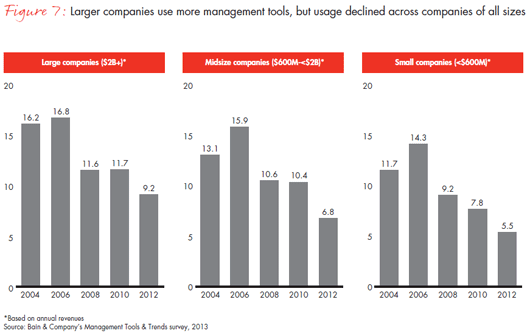
Since 2006, the number of tools used has declined (see Figure 7). That’s good news. While it reflects, in part, the mix of tools we include and people we survey, there is also an important underlying message: Given the challenges to growth and the competing demands for investments, companies now take a more thoughtful and strategic approach to tools instead of jumping on the latest tool fad. That is something Bain has long recommended to clients. Among the key lessons we’ve learned over the past 20 years is that executives need to champion an enduring strategy, find the right tools and then adapt the tools to the companies—not vice versa.

mgmt-tools-2013-fig-07_embedClick to enlarge

Asia-Pacific and North America used the highest number of the 25 tools we surveyed—8.5 and 8.4, respectively—similar to their use in 2010. Among Latin American and EMEA companies, there was a substantial decline. In fact, Latin American companies used only 5.3 tools, on average; smaller Latin American companies used 4 tools, on average. With so few tools, during a period of unpredictability, it becomes critical to zero in on the ones that will deliver the greatest benefit.
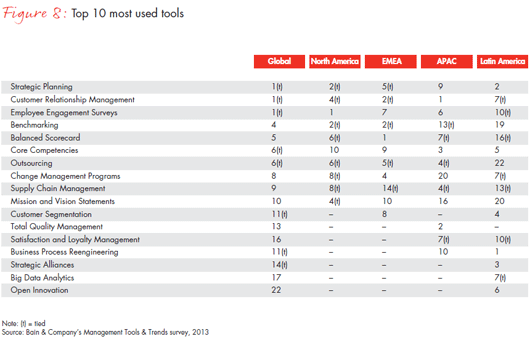
The five tools used most often were Strategic Planning, Customer Relationship Management, Employee Engagement Surveys, Benchmarking and Balanced Scorecards(see Figure 8). The variations by region reflect differences in business objectives and economic realities. For example, executives in North America and EMEA faced the harshest economic headwinds. But the tools they favored to grow in their sluggish economies reflected distinctly different management priorities. In North America, the most widely used tool was Employee Engagement Surveys, designed to improve employee morale and, by extension, productivity, retention and customer loyalty. In EMEA, Balanced Scorecards—a tool that helps companies measure and improve managers’ performance—topped the list.

mgmt-tools-2013-fig-08_embedClick to enlarge

The Asia-Pacific region enjoys stronger economic growth. Executives there relied on Customer Relationship Management more than on any other tool, demonstrating their interest in increasing customer value as a way of capturing more growth opportunity. By contrast, executives in Latin America favored Business Process Reengineering, hoping to make the most of a relatively robust economy by improving productivity, cycle time and quality. The tool was not nearly as popular elsewhere in the world, where it didn’t even make the global top 10 list.
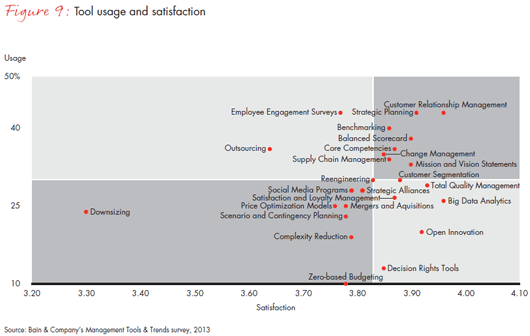
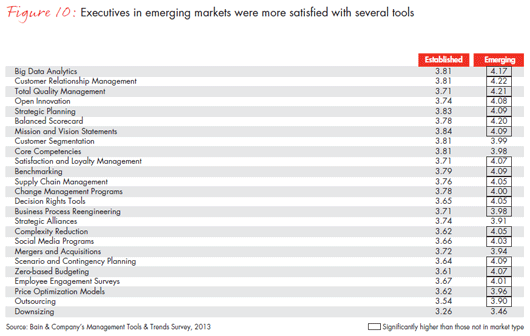
In general, respondents in emerging markets were more satisfied with almost all of the tools(see Figures 9 and 10). In all regions, we’ve consistently found that when tools are used as part of a major effort, they achieve better satisfaction scores than limited efforts. In some cases, the differences are enormous. Mergers & Acquisitions tied as the fifth-highest-rated tool when used as part of a major effort, but tied for 21st when used on a limited basis. Perhaps some tools should not be used on a limited basis at all.

mgmt-tools-2013-fig-09_embedClick to enlarge

mgmt-tools-2013-fig-10_embedClick to enlarge

It is critical for companies to understand that not every tool is right for every situation. For example, Big Data Analytics was below average in usage but above average in satisfaction. Based on our experience with tracking tool use, when satisfaction is high but usage is low, usage tends to grow. When usage is high and satisfaction is low, usage tends to drop in line, unless the tool improves—as was the case with Customer Relationship Management.
As the world continues its uneven recovery from the global downturn, executives in different regions are planning for the future with a variety of strategic tools. In North America and EMEA, where companies are having the toughest time growing, Open Innovation and Satisfaction and Loyalty Management rank among the top tools they expect to increase usage of in 2013 (see Figure 11 for a global ranking of expected change in tool usage). In Asia-Pacific and Latin America, Zero- Based Budgeting—a cost cutting tool—showed the greatest expected increase in usage. And more than anywhere else in the world, executives in Latin America told us they will be increasingly turning to Outsourcing and Downsizing in 2013.

mgmt-tools-2013-fig-11_embedClick to enlarge

Whether they choose tried-and-true tools like Strategic Planning, or relatively new tools like Open Innovation, executives can improve the odds of maximizing their return on investment by acting prudently. That means using the right tool in the right way at the right time, relying on the research and talking to other tool users. When pursuing revenue growth in an uncertain economy, it never pays to buy into hyperbole and simplistic solutions.
Darrell Rigby, a partner with Bain & Company and leader of Bain’s Global Retail and Global Innovation practices, has conducted Bain’s Management Tools & Trends survey since 1993. Barbara Bilodeau is director of Bain’s Customer Insights Group.

A history of Bain’s Management Tools & Trends survey
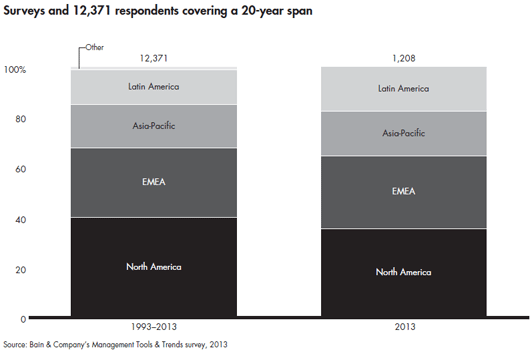
Since 1993, Bain & Company has surveyed executives around the world about the management tools they use and how effectively those tools have performed. We focus on 25 tools and refine the list each year. The tools included in our survey must be topical and measurable, and they need to be relevant to senior management. By tracking the tools that companies use, the circumstances under which they use them and the degree of managers’ satisfaction with the results, we’ve been able to help companies make better choices in selecting, implementing and integrating the most effective tools for improving their performance.
With this Bain & Company 14th Management Tools & Trends survey, we have now compiled a database of more than 12,000 respondents, which enables us to systematically track the effectiveness of management tools over any given time period. As part of our survey, we also ask executives for their opinions on a range of important business issues. As a result, we are able to track and report on changing management priorities.

mgmt-tools-2013-survbeys-12371-embedClick to enlarge


A growing concern: Cyber attacks
Half of all executives surveyed are very concerned about a potentially crippling impact of a cyber attack on their business. The most concerned are executives in Latin America (61%) and Asia (59%); the least concerned are those in North America (43%) and EMEA (47%). “For many organizations, security is evolving into a game that is becoming more difficult to win, with executives finding themselves facing formidable opponents with more sophisticated technology and skills,” says Rudy Puryear, who leads Bain’s Global IT practice. While many executives are confident in their organizations’ security capabilities, he says that most, in fact, don’t meet the leadership criteria for security management.
What makes a cyber security leader? Bain has found that leadership is determined by having a secure strategy, a chief security offi cer and by constantly reviewing and evaluating the effectiveness of security measures. Among the critical elements: The security strategy should be developed from a business perspective, rather than an IT point of view, and security behaviors need to be embedded in the organizational culture.

Taking the measure of your innovation performance 05-27


Taking the measure of your innovation performance


alt
Innovation is one of the most popular acts in business, but one of the hardest to pull off. Bain & Company recently surveyed nearly 450 executives around the world at enterprises with more than $100 million in revenue, and two-thirds said their companies made innovation one of their top three priorities. Yet fewer than one-quarter believed that their companies were effective innovators. Even fewer, just one in five, said they were strong at “breakthrough” innovation.
We did find companies that are great at innovation, and we don’t mean just iconic innovators such as Apple, Amazon.com and Samsung. Virtually all the top quartile of innovators in our survey agree with the following statements:

• We consistently meet or exceed our innovation goals
• We have a winning, repeatable model for innovation that we apply consistently in different regions and categories
• We currently have projects that will meet or exceed our financial targets for innovation
• We are prepared for major market disruptions through innovation
Many executive teams still treat innovation as a black box, the serendipitous achievement of a few gifted individuals. But our survey found that innovation leaders consistently outperformed laggards on five manageable capability areas (see below, "The innovator’s edge"). The disparity suggests that innovators rely on a systematic approach, not just on finding people who happen to be innovative.
Innovation capabilities and the BothBrain® ingredient
What are the five capabilities? The first is a clear, specific innovation strategy, which includes setting goals and determining investment priorities in a way that captures both hearts and minds. The second is an organization with a culture that nurtures innovation—an organization supported by the right people, processes and organizational structure. Third, this organization should have effective idea generation and development processes to create attractive new offerings, both by generating a broad and diverse set of ideas and, especially, by converting these ideas into profitable business concepts. Fourth, a company has to manage a diverse innovation portfolio that has the right size, shape and speed—a portfolio aligned with its strategy. Fifth, a company has to be effective at scaling new business ideas, supporting them with the appropriate level and type of resources. It also has to create feedback loops to learn how best to reinforce, redirect or (when necessary) kill new ideas.
These capabilities are necessary for sustained innovation, but nearly all successful innovation relies on one essential ingredient that permeates all five. We refer to it as a “BothBrain” approach, and it underlies many of the systems and procedures that successful innovators adopt to manage innovation.
BothBrain derives from the recognition that innovation requires both the creation of brilliant new ideas and the ability to successfully commercialize them. Some may interpret these skills as “right brain” thinking (typically imaginative, intuitive, whimsical) and “left brain” thinking (rational, logical, linear). Most of us are more adept at one set of skills or the other. People who are equally adept at both kinds of thinking, like Leonardo da Vinci, are extremely rare, making up less than 3% of the population.
Many companies tend to separate creative activities from commercial ones. They expect the creatives to come up with new ideas, and then they ask the commercial types to analyze those ideas (and, often, to shoot them down). But it’s far more productive for companies to build integrated teams that bring together people with both orientations and skill sets. These teams can then work together from idea conception all the way to testing and scaling an innovation. We call the approach BothBrain because it engages both kinds of thinking at every stage.
Consider, for example, how a BothBrain orientation affects each of the five capabilities:
  • Creating an innovation strategy isn’t simply about building appealing products and developing spreadsheets to make a business case. It’s about generating passion and excitement—capturing the hearts as well as the minds of your customers and the people in your organization.
  • An organization’s talent management processes and innovation decisions need to reflect the importance of both kinds of thinking. Otherwise it won’t be able to create the kind of culture that fosters innovation.
  • Idea generation and development almost always involves gathering data about customer needs and preferences. But analytic people can stare at this data all day long without coming up with new ideas. A creative person, by contrast, may draw on the same data to find an imaginative new intersection between customer needs, a company’s distinctive capabilities and the vulnerabilities of competitors.
  • A successful portfolio of innovations always needs to include a balance between incremental and radical innovations. To create that balance, companies have to give their creative people more leeway on radical innovations, and not allow analysts with spreadsheets to shoot the ideas down prematurely. Most successful products evolve substantially from idea conception to commercial success. Creatives and commercials have to work through the twists and turns together, not just give up whenever they hit a bump in the road.
  • When a company thinks about how to scale an idea, it needs art and intuition as well as science to determine whether it should stay the course, pivot or kill an offering.
Properly applied, BothBrain engages and affects all the elements that make up an innovation system.
The success factors
The five capability areas are quite broad. But the survey responses and our analysis help focus on the specific factors behind a company’s success or failure in each area (see Figure 1). A handful of examples will illustrate how these factors contribute to each capability.

taking-the-measure-of-your-innovation-fig-01_embedClick to enlarge
Strategy: Set compelling, credible objectives and investment priorities
  • Clear, specific innovation goals and models covering both incremental and breakthrough innovations
  • Strategic alignment on objectives, investment priorities and risk management
Novartis, the healthcare products company, has a well-defined and differentiated innovation strategy that reflects a BothBrain-style “hearts and minds” approach. “It means that every time we choose a new disease focus, we don’t ask ourselves, ‘What is the NPV’ but rather ‘Is there a patient in need? Can we change the practice of medicine?’,” says Mark Fishman, president of the Novartis Institutes for BioMedical Research. To offset the risk of investing in rare diseases, Novartis aims to identify multiple uses for a discovery. For example, Novartis scientists suspected that Afinitor, a drug originally approved for certain types of cancers and rare tumors, could treat other types of cancers as well, and so began parallel testing. The company recently gained approval for the drug as a treatment for the most common form of advanced breast cancer—a major breakthrough for the many women who suffer from the disease.
Organization: Build an innovative organization and a collaborative culture
  • BothBrain talent: well-managed partnerships among creative people and business executives, both inside and outside the organization
  • Structure, roles and decision processes that foster innovation
  • A culture that values, supports and rewards innovation
Pixar is one model of an organization that encourages innovation. The company’s development department brings together small “incubation teams” to help directors develop their ideas. Daily reviews of work in progress and post-mortems at the completion of a film foster creative thinking. Structure is important, however: While everyone is encouraged to give feedback, the ultimate decisions about a film rest with the director. Setting the tone for the culture is the BothBrain partnership of John Lasseter and Ed Catmull. Lasseter—animator, film director, storyteller and chief creative officer—is the creative spirit behind Pixar. Catmull—computer scientist and president—provides technical and managerial expertise.
Idea generation and development: Create profitable new offerings
  • Regular development of new ideas in every aspect of the customer experience
  • Thorough idea screening and development: prioritization and nurturing ideas into business concepts
  • Prototyping and testing
Kraft Foods is an example of a company that is rewriting its innovation playbook to improve profitability. It brainstorms new uses for iconic products, such as Philadelphia Cooking Creme and Velveeta Cheesy Skillets, and it has invested in new products such as MiO, a zero-calorie beverage. Overall, the company is focusing on bigger bets than in the past. To ensure focus, Kraft Foods has added rigor to its development process, setting consistent hurdles for projects and tying its decisions more tightly than ever to the economics of each product. In 2011, it generated $600 million in sales from a relatively small handful of innovations. 
Portfolio management: Improve the size, shape and speed of the innovation portfolio
  • Effective management and monitoring of the project portfolio, including establishing hurdles, assessing speed of execution and terminating projects when appropriate
  • Effective management of individual projects, learning from past efforts
Diageo, the global alcoholic beverages company, has worked hard to improve its portfolio of innovations. “We have built the leading innovation capability in the industry,” declared CEO Paul Walsh in 2011. “Six years ago, we implemented a new approach to innovation, which now accounts for over 50% of our growth in developed markets and is a consistent growth driver for Diageo. We have launched 200 new products in the last two years and have a pipeline of another 200 new products.” For example, the company created an autonomous innovation-oriented team within its niche and specialist brand unit. According to a report by Raymond James analysts, the team “is harnessing the entrepreneurial flair needed to succeed in premium new products” and has already launched a variety of successful premium beverages. 
Scaling: Strengthen testing, learning and scaling skills
  • Allocation of resources to launches based on the opportunity’s potential
  • Feedback loops and adaptation, including course correction when necessary, and post-launch efforts to support projects
Unilever has been highly successful in its approach to scaling innovations. By focusing resources on priority brands and bigger initiatives, the company’s projects launched in 2012 represented a tenfold increase over projects launched a few years ago. Unilever’s average value per project has increased 75% over the past few years, whereas time to market has decreased between 25% and 50%. The company is quick to adapt new products when required. For example, an initiative in the company’s Hindustan Unilever unit encourages employees to buy new products at steep discounts and then provide quick feedback, thus acting as in-house beta testers.
Are some success factors more important than others?
In seeking to learn more about these factors, we wondered whether some of them might turn out to be the keys to the innovation kingdom—the most essential skills for would-be innovators to acquire. Some did turn out to be more important than others as starting points, as we will see in a moment. In general, however, every element of the five capabilities is necessary. Top-quartile companies outperformed others on every measure. Bottom-quartile companies underperformed others on every measure (see Figure 2).

taking-the-measure-of-your-innovation-fig-02_embedClick to enlarge
This analysis underscores an important point. Almost every company comes up with a good idea once in a while; otherwise most companies would never get started in the first place. The real question is what it takes to generate good ideas on a sustainable, repeatable basis. The most successful companies make innovation a core management process. Success comes from focusing the organization on goals, adhering to solid practices in moving toward those goals and making decisions quickly and effectively. Using the Bain Innovation Assessment—a tool we applied in this research—a company hoping to improve its innovation capacity can assess where it is strong or weak in each of these areas. It can then launch targeted investments to increase its skills and develop the necessary capabilities.
Starting points
What should you attack first? A company’s starting points, of course, will depend on what it learns from the assessment. But when we applied two statistical analyses (logistic regression and Chi-square Automatic Interaction Detection, or CHAID) to our survey data, we found two areas likely to be critical:
  • Innovation goals and strategies. The statistics show that this is the most important factor in determining top performance. A half-point improvement on the four-point scale of responses increases a company’s probability of being a top performer by almost half, from 25% to 37%. Of the companies that score themselves low on this dimension, only 3% are top performers.
  • Portfolio management. This factor is almost as important, but with a twist: Good portfolio management makes a significant difference only among companies that already perform well on innovation goals and strategies. Of those companies that score well on innovation goals and strategies but score poorly on portfolio management, only one-quarter are top performers. Among companies that score well on both measures, almost three-quarters are top performers.
These factors turn out to be better starting points than idea generation, for instance, or scaling and launch strategies. The fundamentals have to come first. Without specific innovation goals, a company is unlikely to get anything accomplished. Without good portfolio and project management, even the best ideas are likely to languish. Innovation is like a building: It needs all the requisite elements and it has to be built on a solid foundation.
Why did idea generation not emerge as a major determinant of top innovation performance? It’s probably because ideas are only the seeds of innovation. Put good ideas in a bad company and they die. That’s why so many acquisitions of innovative companies fail: new ideas get buried in the acquirer’s bureaucracy and the creative people who came on board get frustrated and leave. Only when a company nurtures its ideas and builds a system around them do they lead to innovation. However, our analysis does show that good idea generation can help some companies that are otherwise failing with setting innovation goals and strategies.
Among companies that score low on innovation goals and strategies (less than 2.25), 37% are average performers overall. Some of the companies in this group, however, score high on idea generation (greater than 2.75), and a full 66% of these become average per-formers. Thus, some companies that are managing innovation poorly have been lucky enough to somehow find or acquire good ideas, and those ideas have helped them perform better than they would have otherwise.
Our survey also examined companies’ relative success with "incremental" innovation vs. "breakthrough" innovation. Companies clearly struggle more with breakthrough innovation: Overall, only 18% of respondents assess their companies as "very effective" vs. 38% for incremental innovation. Top performers are much more likely to be effective with breakthrough innovation (44%), while almost no low performers are very effective with it (1%).
From a practical point of view, successful innovation appears to come from focusing the organization on goals, adhering to solid management practices in moving toward those goals and making decisions quickly and effectively. Innovation is a complex process that must be managed like any other complex process. It must mobilize key factors essential to achieving success: leadership, management, process alignment and repeatability. This is not a purely linear, logical, left-brain-generated process. Companies that cultivate both aspects of human brain functioning—both left- and right-brain thinking—to inform their innovation initiatives are likely to outstrip their competitors in creating great new products, processes and services.
Eric Almquist, a partner with Bain & Company in Boston, leads the Global Consumer Insights team. Mitchell Leiman, a Bain partner based in Boston, leads the firm’s Innovation practice in the Americas. Darrell Rigby, also a Bain partner based in Boston, is the head of Bain’s global practices in Innovation and Retail. Alex Roth is a partner based in London and leads the firm’s Innovation practice in EMEA.

What innovation takes: Ten voices from the survey
The following are verbatim comments, edited for length, from 10 respondents to Bain’s recent Innovation Assessment Survey of Nearly 450 executives around the world.
  • “Innovation cannot be successful if it does not come from the top to the bottom. In other words, the CEO must be completely convinced that innovation is the best strategy to achieve success. Innovation has to be part of the company’s culture to be part of the company’s achievements.”
  • “Innovation is driven bottom up. If it’s a top-down approach, more often than not it doesn’t succeed. The other important factor is absolute commitment from the top management, that is, the key stakeholders in the company.”
  • “Our organization is improving in our approach to innovation due to the introduction of new senior managers who understand the requirements of using innovation successfully across the organization.”
  • “I would consider innovation from an end-to-end perspective. ‘Creating’ (a product or service) is as important as ‘realization’ of it in the marketplace. Only after realization can the creation be considered successful or not.”
  • “A philosophy of ‘fail fast’ is absolutely critical to innovation and success in general. You have to validate your assumptions with the target audience as quickly as possible and make course corrections as needed. The more iterations you are able to get in a specified time, the better your chances of getting close to the goal.”
  • “Success at innovation means not being afraid to make big mistakes.”
  • “The market does not reward risk taking. Therefore, many companies rely upon outside sources, such as universities and star t-up companies (innovative acquisition vs. organic innovation) for innovation.”
  • “We just have to set targets and be willing to tolerate mistakes (both time and money wasted).”
  • “Innovation requires true long-term commitment and focus to bring disruptions to the industry.”
  • “For innovation to be optimized, the entire value chain must play a role and agree upon a direction.”

The innovator’s edge
Successful innovation delivers business results (see figure). According to our sur vey of executives around the globe:
  • Companies in the top quartile grew significantly faster than others—an average annual growth rate of 13%, compared with 5% for other companies. Compounded over five years, the top performers will grow 84%, compared with 28% for lower performers, a threefold difference.
  • Top-quartile companies are also winning the war for talent. We measured this through employee Net Promoter® scores (eNPS), a widely used indicator of employee loyalty and enthusiasm. Top performers’ eNPS is 23, compared with a low of negative 56 for others in our survey. That’s a striking difference by eNPS standards.
  • Top-quartile companies are better at making and executing decisions, as measured by Bain’ s proprietary assessment of corporate decision effectiveness. (The measure includes the quality, speed and yield of decisions, along with the effort involved.) Greater decision-making skills produce better strategy, better selection of projects and better alignment among organizational units
taking-the-measure-of-your-innovation-innovations-top-performers_embed