Shyam's Slide Share Presentations

VIRTUAL LIBRARY "KNOWLEDGE - KORRIDOR"

This article/post is from a third party website. The views expressed are that of the author. We at Capacity Building & Development may not necessarily subscribe to it completely. The relevance & applicability of the content is limited to certain geographic zones.It is not universal.

TO VIEW MORE CONTENT ON THIS SUBJECT AND OTHER TOPICS, Please visit KNOWLEDGE-KORRIDOR our Virtual Library

Monday, April 29, 2013

Expanding Pre-K Education: How Philanthropy Could Do the Job Better than Obama 04-29


Expanding Pre-K Education: How Philanthropy Could Do the Job Better than Obama


WOODBOURNE, NY - SEPTEMBER 20:  A child looks ...
WOODBOURNE, NY - SEPTEMBER 20: A child looks out from class at the federally-funded Head Start school on September 20, 2012 in Woodbourne, New York. (Image credit: Getty Images via @daylife)
President Obama’s proposal in his State of the Union address for a major new program to provide universal pre-kindergarten education has been well-received, as well it might be in light of research by the University of Chicago’sJames Heckman and others that disadvantaged students not prepared for kindergarten may be permanently left behind. What criticism there’s been has focused on the program’s financing—$750 billion in new spending, based on an increase in federal cigarette taxes which, in light of the declining number of smokers, will likely lead to decreasing help from Washington for local school districts which find themselves mandated to provide a major new program.
Not discussed, however, is a central assumption behind the Obama proposal—an assumption implicit in all new social programs, at least since the 1960s: that we should look to government—and, moreover, to the federal government—to formulate and fund new programs for the disadvantaged. It’s an assumption that’s become basic to our politics. The fact is, however, that the results have not been encouraging—particularly as they relate to early childhood education. Rigorous studies of the existing federal program for disadvantaged young children, Head Start, on which we already spend $8 billion annually, have shown it to have sharply limited benefits. Is a major new government program the only way to approach our social problems? We should not dismiss the possibility that a combination of private philanthropy and strong local organizations might be a different and better approach.
There are significant precedents in American history for private action as the means of addressing public problems—including the problem of assisting disadvantaged children.
In the early twentieth century, for instance, the settlement house movement, dedicated to acculturating that era’s wave of immigrants and helping them advance economically, arose from one key seed: Jane Addams’ foundation of Hull House in Chicago. By 1897 there were 74—and by 1911 there were 413 spread across 33 states, offering English classes, fresh air summer camps for immigrant children, pasteurized milk for poor families and much more. The movement’s combination of a welcoming hand to the newcomers and belief in the essential goodness of the country’s common culture, is,  it’s worth noting,  one we could still use today, as I’ve written for The Public Interest.)
In the pre-New Deal world, it spread widely without government funding or mandates.  It was a private movement, locally-based but tied through national associations, supported by  local fundraising and volunteers—and spearheaded by civic leaders. By the time immigration ebbed in the 1920s, the movement had long since proved its worth—if only through such contributions as recruiting Benny Goodman for the boys’ band at Hull House, where he received the clarinet lessons which made him a premier jazz musician—and which he credited with keeping him away from the gangs of Chicago’s Maxwell Street.
There’s a similar story—a good idea spreading through private means and local champions—to be told about a previous pre-kindergarten movement. The Montessori movement was  built on the idea that structured play leads to cognitive development. Although its story goes back to the movement’s namesake, Italian educator Maria Montessori and her work with poor children in Rome circa 1907, it took off in the U.S. in the early 1960s, thanks to the Johnny Appleseed-like efforts of one Connecticut woman, Nancy Rambusch. She both  founded the first U.S. Montessori school in Greenwich and sparked local efforts around the country that have led to the establishment of thousands of Montessori-style pre-schools (some linked to K-12 schools, as well), and an American Montessori Society to accredit those it judges to meet its teacher training standards.   It’s no longer  a model for low-income children—typical tuitions  from $8-12,000 (some scholarships offered)—but it does offer evidence that ideas which win the trust of the public can spread without government support. In the case of Montessori schools, they have, moreover, stood the test of time. Indeed, as one AMS official points out, the schools pass a key test of effectiveness: parents are willing to pay to enroll their children in them.
Is there really a lesson in all this for pre-K education for those children at risk of being left behind before they even start? Could actual on-the-ground, privately-supported programs spread, without a program of federal grants—in the case of expanded  pre-K, to local school systems across the country?
There are reasons to think that the precedents of the settlement house and Montessori movements are still relevant. For one thing, private philanthropic assets,  despite the weak economy, has been growing. Of particular note is the growth of donor-advised funds, in essence crowd-sourced foundations, administered by such financial giants as Vanguard and Fidelity, to which individuals contribute a minimum of $10,000. The Chronicle of Philanthropy reports (below)  that such funds, as of 2011, managed $24 billion in assets—an actual  increase since the onset of the financial crisis.
DAF Section Feauture 062712

Decisions about how their funds are disbursed are often made by one of the more than 600 local community foundations which have taken root across the U.S. In other words, there is a network of local foundations, supported by individual philanthropy, which could make pre-K education for the disadvantaged a priority.
Anyone who has experience with the complexity of government categorical grants knows that a philanthropically-led effort—one which identifies the population most in need, finds local talent to staff new schools (or expand existing ones) and then, through a locally-based board of directors, holds programs and their leadership accountable—could be more flexible and more effective. Some programs would gain a reputation for success—which has proved so elusive over the past 40 years of government-led efforts—and would then influence others. A national association—like the one which unified the settlement house movement and that today ties the accredited Montessori schools—would be a vehicle through which experience about what works best would be spread. Ineffective programs might actually close the doors—something that almost never happens to government-funded programs. Word of success might, what’s more, influence the field, including existing private day care programs and even families themselves—as a new norm was established for the potential achievement of low-income children.  Indeed, in the long run, improved norms of private behavior—rather than expensive programs with “clients”—may be the only way that something close to “universal” reach is actually realized.
A private approach to pre-K  might also be less expensive. The President has proposed to spend $75 billion a year over the next ten years to mount a near-universal pre-K program.  Charitable giving of all forms totals only about $300 billion a year. But government spending also comes with costs; in the case of the White House proposal, a requirement that teachers have the same sort of credentials as current public school teachers—implying union wage scales. (Notably, the American Montessori Society accepts community college degrees for accrediting teachers—but requires that they master classroom methods.) That leaves out a place for volunteers—who might well be drawn to help in such a cause. Moreover, in an effort to build political support, the White House has dangled the possibility of funding for middle-income families—which would increase costs yet more.  A privately-led initiative might, instead,   identify—and focus its resources—only on those most in need.
Such an approach is not fanciful. In recent years, national networks have actually developed to support locally-based programs addressing a variety of social problems. Village to Village helps establish programs to enable  the elderly “age in place,” rather than going to nursing homes.   Volunteers in Medicine provides free,  basic health care for the uninsured.  Both are active now in more than 90 cities. No one philanthropic source could fund a pre-K movement. Private foundations, as well as donor-advised funds,  could play a role, however. Perhaps, under the right conditions, government could help—so long as it did not dictate the terms. Charter schools—flexible in their staffing and methods, and which already have shown they can combine public and private funding sources effectively (see, for instance, the KIPP Schools network) might be good models.
The larger point here is this. Government funding is not something to be opposed  in principle—but the years since the War on Poverty have made clear that social programs that require individual, hands-on attention are not something government does well. There is a temptation to look to public funding for them—because it seems to offer a way to achieve universal reach. But reach and grasp are different things—and government has not shown it can combine “scale” with positive results. (See the track record not just for Head Start but for community mental health programs, foster care, job training and so many other social programs).
Imagine a coalition of major community foundations coming forward, along with the major foundations with an established interest in disadvantaged children and education (Gates, Broad, Annie E. Casey) to support a national pre-K movement. It might not require us to depend on taxing an activity we wish would actually decrease (smoking)—and it might actually work.

Stanford researchers identify troubling patterns of teacher assignments within schools 04-29


Stanford researchers identify troubling patterns of teacher assignments within schools


A study of a major urban school district reveals how high-achieving students tend to get the most experienced teachers, leaving other students in classes with less experienced teachers.
Gualtiero Boffi / ShutterstockMath teacher at chalk board
Teachers with more seniority within a school may be able to influence the assignment process in order to secure their preferred classes, such as those with higher-achieving students, the researchers found.
Even within the same school, lower-achieving students often are taught by less-experienced teachers, as well as by teachers who received their degrees from less-competitive colleges, according to a new study by researchers from the Stanford Graduate School of Education and the World Bank. The study, using data from one of the nation's largest school districts, also shows that student class assignments vary within schools by a teacher's gender and race.
In a paper published in this month's issue of Sociology of Education, the researchers present the results of a comprehensive analysis of teacher assignments in the nation's fourth-largest school district, Miami-Dade County Public Schools. Their findings identify trends that may contribute to teacher turnover and achievement gaps nationwide.
Previous research indicates that high-quality teachers can significantly improve education outcomes for students.  However, not all students have equal access to the best teachers.
"It is well-known that teachers systematically sort across schools, disadvantaging low-income, minority and low-achieving students," said Demetra Kalogrides, a research associate at the Graduate School of Education's Center for Education Policy Analysis and one of the study's three authors. "Our findings are novel because they address the assignment of teachers to classes within schools. We cannot assume that teacher sorting stops at the school doors."
The authors note that more research needs to be done to see whether such patterns exist within schools across the country.
The assignment of teachers to students is the result of a complex process, involving school leaders, teachers and parents. While principals are constrained by teachers' qualifications – not all high school teachers, for instance, can teach physics – they also may use their authority to reward certain teachers with the more desirable assignments or to appease teachers who are instrumental to school operations.
Teachers with more power, due to experience or other factors, may be able to choose their preferred classes. Parents, particularly those with more resources, also may try to intervene in the process to ensure that their children are taught by certain teachers.
"We wanted to understand which teachers are teaching which students," said Susanna Loeb, a Stanford professor of education and an author of the study.  "In particular, are low-achieving students more likely to be assigned to certain teachers, and if so, why?" Loeb is the director of the Center for Education Policy Analysis.
Using extensive data from Miami-Dade, the authors compared the average achievement of teachers' students in the year before the students were assigned to them.  They discovered that certain teachers – those with less experience, those from less-competitive colleges, female teachers, and black and Hispanic teachers – are more likely to work with lower-achieving students than are other teachers in the same school.
They found these patterns at both the elementary and middle/high school levels.
According to the researchers, teachers who have been at a school for a long time may be able to influence the assignment process in order to secure their preferred classes – for instance, classes with higher-achieving students.  The study found that teachers with 10 or more years of experience, as well as teachers who have held leadership positions, are assigned higher-achieving students, on average.
Assigning lower-achieving students to inexperienced teachers could have significant repercussions. According to the researchers, it could increase turnover among new teachers, since novice teachers are more likely to quit when assigned more low-achieving students.
In addition, it could exacerbate within-school achievement gaps – for example, the black-white gap. Since they are lower-achieving on average, minority and poor students are often assigned to less-experienced teachers than white and non-poor students. Less-experienced teachers tend to be less effective, so this pattern is likely to reinforce the relationships between race and achievement and poverty and achievement, the researchers said.
The study also found that lower-achieving students are taught by the teachers who graduated from less-competitive colleges, based on test scores for admission and acceptance rates.  This trend is particularly evident at the middle school and high school levels, possibly due to the more varied demands of middle and high school courses.  Teachers from more competitive colleges may have deeper subject knowledge than their colleagues from less-competitive colleges, leading principals to assign them to more advanced courses, the researchers said.
The researchers noted that assignment patterns vary across schools. Experienced teachers appear to have more power over the assignment process when there are more of them in a school; senior teachers are assigned even higher-achieving students when there is a larger contingent of experienced teachers in the school.
At the same time, schools under more accountability pressure are less likely to assign higher-achieving students to more-experienced teachers than schools that are not under accountability pressure.
Finally, according to the findings, class assignments vary depending on a teacher's gender and race. Since female teachers are more likely to teach special education than male teachers, on average they work with lower achieving students than their male colleagues. Also, black and Hispanic teachers, when compared with white teachers in the same schools, work with more minority and poor students, who tend to be lower-achieving.
Unlike sorting based on experience, the authors said that teacher-student matching based on race could improve student achievement because previous research suggests that minority students may learn more when taught by minority teachers.   
"Our analyses are a first step in describing within-school class assignments, an important, yet often overlooked, form of teacher sorting," said Kalogrides.
The other co-author is Tara Béteille of the World Bank.  The research was supported by a grant from the Institute of Education Sciences.
Rachel O'Brien is a research associate and writer at the Center for Education Policy Analysis.

These Modular Houses From MIT Have The Solar Power Built Into The Walls 04-29


These Modular Houses From MIT Have The Solar Power Built Into The Walls

The Soft House is designed to produce its own energy just from its walls, without having to retrofit panels once it’s constructed.
We shouldn’t approach resiliency as something you add on to a home once it’s already built--by slapping a solar panel on the roof, for example. Instead, we should integrate it into a home before it’s even built. That’s the idea behind the Soft House, a home developed by MIT architecture professor Sheila Kennedy and her team. Earlier this year, the Soft House took first place in the International Building Exhibition design competition. As a result, it may eventually become a model for homes around the world.


The Soft House embodies what Kennedy calls "soft architecture"--a theory that looks at energy infrastructure as a set of building materials instead of something separate from architecture. In practical terms, that means the house has an energy harvesting facade with built-in photovoltaic cells. A press release explains :
Just as a sunflower moves with the sun, the façade moves to capture the maximum amount of clean energy to power the housing units. At the same time, it casts shade in the summer and allows light to penetrate deep into the homes during the winter--saving the household energy year round. As it changes position, the responsive façade creates different shade patterns and views that become part of the architecture.


According to the Soft House website, the home can generate 16,000 watt-hours of electricity, or over half the daily energy needs of a typical U.S. home. There is, of course, plenty of room to upgrade the Soft House design as technology gets better.
The floor plan of the home is completely flexible. Want three bedrooms instead of two? The plumbing cores let you do that. Want a workshop in the garage? Also easily done.
The Soft House is currently on display in a model community in Wilhelmsburg Island, Germany. All the homes and workspaces there are being monitored--and eventually, occupants will join in.

This Is What Facebook’s Green Roof Will Look Like 04-29


This Is What Facebook’s Green Roof Will Look Like

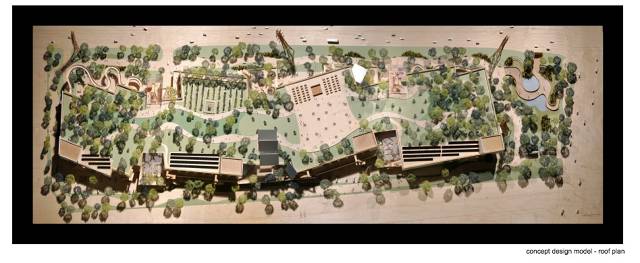
The company is building a giant addition to their headquarters, and a giant park to go along with it. That park just happens to be on the roof.

Like so many tech companies flush with cash, Facebook is expanding its headquarters in grand fashion--in this case, to a second campus that connects to the main one in Menlo Park, California. Architect Frank Gehry is designing the building (Warning: That PDF takes a long time to load), which Facebook describes as "a large, one room building that somewhat resembles a warehouse." But we’re not so much interested in the interior of this particular building than what’s on top of it: a giant green roof that spans most of the 433,555 square foot structure.
It’s less a green roof than an entire park. It will include oak trees, a walking trail, furniture to lounge on--and like Google’s planned green roof, it will have kiosks and cafes, according to Greenbiz.
The roof will also be flush with flora and fauna. Facebook writes: "We’re planting a ton of trees on the grounds and more on the rooftop garden that spans the entire building." Beyond the oak trees, we can’t say exactly what Facebook is planting, but we do know this: Menlo Park ordinances require 80% of the plantings to be either native or xeriscape, meaning they need little or no water.
For the sake of everyone working in the warehouse space below, let’s hope that the roof also has fast Wi-Fi and some decent workspaces. After all, ample sun is one of the more attractive features of Silicon Valley life.

Saturday, April 27, 2013

10 Ways To Create High Converting Headlines 04-28


10 Ways To Create High Converting Headlines

How to Take Your Company to the Next Level 04-28


How to Take Your Company to the Next Level


By strategically sizing up the competition, you can help take your business to the head of the pack.


Rubberball/Mike Kemp


"I want to take my company to the next level."

I hear these words from CEOs all the time as they talk about their goals and dreams for their companies. When I push for the details, the conversation tends to get a little murky. It's usually just a recap of how the company has been performing recently. The conversation always ends with a statement of aspiration, "I just know we are ready to really grow."

Certainly, set your goals for the stars. Along the way, however, you need to pass the runner in front of you before you overtake the record-setter at the front of the pack. If you have ever raced, you know the importance of focusing on the racer right in front of you as you look for your opportunity to pass.

What to do:

1. Study the pack

Pick out the market leader. Now pick out the one-to-three competitors who are at the next level ahead of you. Take your ego out of the conversation as much as possible and put your analyst hat on. What separates the pack into their current positions? These layers in the market are often set by what the market values. The question should be, what criteria are being valued by the customers you want and the market-share you want to take? If you can determine those elements, you can plan your company's stepping-stones for growth.

2. Emulate, eliminate, differentiate and overtake

You've done your homework on your competitors. Now look at your company. In the comparison between you and them, what are the characteristics that are making them successful? This is no time for emotional self-indulgence. Focus on what is worthy of emulation, what should be eliminated from your costs and offerings, what truly differentiates them from you, and what it will take to overtake them.

3. Build your race strategy one competitor at a time

There are lots of things to learn from the market leaders. I believe in learning from the best practices of the best players. However, the company who is ahead of you is your focus in the short-term. Market performers have a tendency to cluster around similar components of success. Figure out those cluster formulas.

A word of caution: This set of strategies is about getting your company to the next level, but it is not a plateau. As a CEO, building a strategy exclusively around replicating the successful traits of your competitors will lead to a flattening growth curve. You need to combine the winning characteristics of your competitors with your own unique game-changing strategies. By defining what the next level is, then identifying how to get there, you can give your team a real plan.

View at the original source

The IT Conversation We Should Be Having 04-28


The IT Conversation We Should Be Having

It has been a while since I was a parent of teenagers, but I remember when the question, "Have you had the conversation yet?" made me break out in cold sweats. The Conversation is also a 1974 filmby Francis Ford Coppola whose themes include the role of technology in society and being so focused on what you are doing that you forget why you are doing it and become oblivious to what is happening around you. Both examples fit the conversation that should be going on in the C-suite, but isn't, because it makes people nervous, and because people lose visibility and perspective of what is changing around them as they focus on their goals. It is a conversation about the increasing importance of information technology and the role it must assume in every enterprise, regardless of size, industry or geography.
Over the last two years, we have been engaged in primary research with The Harvard Business Review, The Economist, CEB (formerly known as the Corporate Executive Board), Intel, and TNS Global in an attempt to paint a picture of how the role of the CIO and the IT department is changing. We also engaged with CIOs across the globe in discussions about what they were experiencing and what changes were surprising or bewildering them.
A simple summary of the work suggests that CEOs believe that CIOs are not in sync with the new issues CEOs are facing, CIOs do not understand where the business needs to go, and CIOs do not have a strategy, in terms of opportunities to be pursued or challenges to be addressed in support of the business.
Key findings from our research:

  • Almost half of CEOs feel IT should be a commodity service purchased as needed

  • Almost half of CEOs rate their CIOs negatively in terms of understanding the business and understanding how to apply IT in new ways to the business

  • 57% of the executives expect their IT function to change significantly over the next three years, and 12% predict a "complete overhaul" of IT

  • Only a quarter of executives felt their CIO was performing above his or her peers

Our observations:

  • CEOs are demanding more visible value from their CIOs, in terms of generating revenue, gaining new customers, and increasing customer satisfaction.

  • Increasingly, the CIO and IT must be seen less as developing and deploying technology, and more as a source of innovation and transformation that delivers business value, leveraging technology instead of directly delivering it.


  • The CIO must be responsible and accountable if technology enables, facilitates or accelerates competition that the C-suite didn't see coming, or allows the enterprise to miss opportunities because the C-suite did not understand the possibilities technology offered.

  • CIOs today must adapt or risk being marginalized.

Why this is happening:
As we worked with the data, while we saw what was happening it became clear we were missing the "why" it was happening. Why is this dissonance between the CIO and the C-suite happening? It could be the rapid pace of technological change, but historically that only facilitates or accelerates change already desired or underway? The more we looked for an answer, the more we realized we were at an impasse. Then we realized that what we were seeing were not changes in IT, but secondary effects from changes going on in business.
In order to understand the future of enterprise IT, the evolving future of business itself must be considered.
Trends that are affecting fundamental concepts of business, and in turn IT:

  • The basic ideas of capitalism--return on investment (ROI) and return on assets (ROA)--are being challenged by the historical stalwarts of capitalism (Harvard, Drucker Society, Forbes, the London School of Economics and many more). Many of these ideas shun ownership for rent on those elements of the enterprise not tied directly to value creation, suggesting a rethink in how IT is delivered.

  • As we transform from industrial work more easily and efficiently done by robots to creative and knowledge work leveraging humans, we are balancing the values of scale and efficiency (industrial work) with the need for agility and efficacy (creative and knowledge work). This means that transactional systems that ensured security, encouraged conformance and drove operational goals of predictability and productivity lose value to new systems of collaboration, transparency and agility.

  • The nature of economics is transforming as complexity science and behavioral science provide valuable insights about how value is created, markets work and buyers think. The nature of value which is momentarily created and quickly perished in turn drives the new economics as it diverges from classical ideas of value chains. As a consequence, the boundaries between customers, suppliers, partners, staff, contractors, channels and even competitors begin to diminish and even disappear, creating a whole new user community for enterprise IT systems.

  • All of these ideas are drastically changing how we organize to accomplish the necessary work, and in turn how we manage those organizational structures and resources. This suggests more unique, highly focused niched application systems with integration of information and systems across organizational and agent boundaries - no IT system is an island.

How this affects the CIO and enterprise IT:
All of this is changing the role of the CIO before our very eyes. Not only are there new systems, business and delivery models, types of information, technologies, etc., but whole new roles for IT in the enterprise's ecosystem. These new business insights, tied to the emergence of new technologies, are creating an opportunity for IT to lead business transformational efforts, creating new business models, initiating new business processes and making the enterprise agile in this challenging economic environment.
Leveraging that change requires starting with a conversation that CIOs, CEOs and the rest other members of the C-suite should be having, but aren't. Here's a start to that conversation.
In future pieces, I will explore the dramatic business changes and challenges that are affecting the C-suite and the role of the CIO; look at how innovation, as the only way to create long-term profit, provides a solution to these challenges; and outline the new conversation that CIOs should be having in the C-suite.
--
Many organizations are approaching the tipping point being described in this series of blogs. Stepping into the role of strategic visionary and business driver requires CIOs to have a completely new conversation with their C-suite colleagues. To begin the conversation, Dell, HBR, and CIO magazine are sponsoring a Harvard Business Review panel discussion, "Change the Conversation, Change the Game," through a webinar, broadcasting live from The CIO Leadership event in Boca Raton, Florida May 5-7, 2013.