Best content from the best source handpicked by Shyam. The source include The Harvard University, MIT, Mckinsey & Co, Wharton, Stanford,and other top educational institutions. domains include Cybersecurity, Machine learning, Deep Learning, Bigdata, Education, Information Technology, Management, others.
Shyam's Slide Share Presentations
VIRTUAL LIBRARY "KNOWLEDGE - KORRIDOR"
This article/post is from a third party website. The views expressed are that of the author. We at Capacity Building & Development may not necessarily subscribe to it completely. The relevance & applicability of the content is limited to certain geographic zones.It is not universal.
TO VIEW MORE CONTENT ON THIS SUBJECT AND OTHER TOPICS, Please visit KNOWLEDGE-KORRIDOR our Virtual Library
Showing posts with label Schools. Show all posts
Wednesday, February 11, 2015
Sunday, June 1, 2014
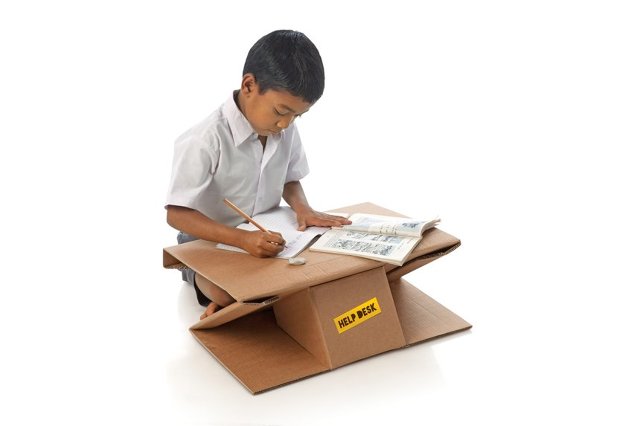
A Brilliantly Simple Design Transforms Old Boxes Into School Desks And Bags 06-0
A Brilliantly Simple Design Transforms Old Boxes Into School Desks And Bags
Most schools in rural India can’t afford basic supplies like desks, and most of the students attending them can’t afford backpacks. The Bombay-based nonprofit Aarambh worked with designers to come up with an ingenious solution to both problems: Their simple stencil transforms old cardboard boxes into a convertible desk and school bag.
“In the villages of India life is very difficult for children,” says Shobha Murthy, the nonprofit's founder. “They walk miles to reach the nearest school. The concept of carrying school bags, wearing shoes or a school uniform are distant dreams because most families are landless laborers who barely earn $1 for 10 hours of work. Kids have to carry their books in their arms, and it was an urgent need to find them a way to carry their books.”
They needed desks just as much--students usually sit on the floor hunched over books for hours--but the organization couldn't afford to make two different products. The result,Help Desk, folds quickly from one thing to the other; at the end of the day, a few simple moves turn the desk back into a bag to carry books home. The design ended up costing only about 20 cents to make since it's made from used cardboard.
"Looking back, I think the solution was right in front of our eyes," says Sanuree Gomes, an art director from an agency called DDB Mudra, which came up with the design. "We wanted a material that was not only strong, but flexible and economical. We had just received a shipment at our office, and we had boxes lying all around us."

The designers prototyped a few different variations to test with the students, looking for a solution that would be ergonomically correct as a desk and also easy to build. So far, the final design has been given to 10,000 students at 600 schools.
The students are fans. "The children love the bags and take good care of them," says Murthy. "They are very lightweight and sit easily on the back."
The desk-bags don't last forever, especially since cardboard doesn't stand up well to the rain. But the team is working on developing a low-cost material that can be coated on the surface to help it repel water. Right now, they only last about six months to a year. But anytime they need to be replaced, it's simple to make again.
Tuesday, August 13, 2013
How Making Robots Captivates Kids' Imaginations 08-14
How Making Robots Captivates Kids' Imaginations
Building robots inspires such passion in high school seniors Violet and Kjersti that they've begun mentoring younger robotics teams to teach STEM skills -- and save their school's robotics program.
How Making Robots Captivates Kids' Imaginations (Transcript)
Violet: I think school would be a lot more engaging if we were asked to solve complex problems. Building a robot and seeing it run and seeing it complete tasks is definitely more satisfying than any schoolwork I've ever done. Getting an A on the test, that's cool, but seeing something I have built with my own hands move is way more satisfying.
So I'll try connecting a one-ten-nine. I'll put a jumper underneath.
Man: Yeah, just don't overlap them, right? Start with three.
Woodie: I think a reasonable way to think about robotics is birthing a machine that can be over there and do something that you either taught it to do, or that you're commanding it to do now. But something that you created that's apart from you that does your bidding.
Violet: So do you guys know how to test a motor with a battery?
Girl: Not really.
Violet: Okay, here.
So I grew up in a really geeky family. My dad is one of those super geeks. He always showed me sci-fi movies and so he's the one who kinda showed me into what robots are.
Kjersti: You could do it like that, or you could do it to the top here, so that way the hub would be on the outside.
It was something completely new for me. It was something that I'd never heard about before, especially heard about kids being able to do. And it was really hard, which was something that was exciting for me, a challenge.
Woodie: One of the things that makes robotics an ideal thing for young people to do is that that child obeying the parent's command is a real thrill. When you first see someone build something and they get it together and then they wiggle the joystick. "Wow, it works, it works!"
Violet: I think the fact that I'm kind of a stubborn person contributed to me being a good robotics engineer. When I see a problem, I wanna find a solution, I wanna figure it out. And if I run into a few failures on the way, I'm not gonna let that stand in my way. I'm gonna keep trying at it and keep going until I've found a solution.
Kjersti: Just feel over all of the little cables back here to make sure that none of them are loose or sticking out a little bit. Drive train, make sure that none of the chains are off, 'cause that's a problem that we've encountered.
Some of the ways that we've gotten better at building robotics are just in very simple mechanical ways, like being really good at constructing simple things and knowing which screws to use in which situation, so that things don't fall apart later on when you're using your robot. And then other things are very elegant designs. You have to see the problem in front of you and go through a bunch of different designs before you get to the one that looks the best and functions the best.
Violet: So one of the main parts of the game for this year is, you have to lift these rings up to different pegs and put them on the pegs. We use pulleys that are controlled by a winch. The lift comes up.
We use rectangular tubing here, along with your average drawer slides.
The way this robot moves around is the drive train right here,
There's a chain connecting each of the motor to the wheels,
We have two motors for each side,
We have an IR, infrared seeker,
This is what we call the brick,
And actually, brick is where all our programming goes, and it has wires going up to all the sensors.
The brick talks to the motors and tells them to run essentially.
I think that that's pretty much our robot.
Violet: I would like you guys to do, in this extra meeting time that we have, is try to see how many challenges you can complete.
After last year, I started just looking back, thinking back to all the effort I had put into robotics and all the time I spent doing it. And I realized how much I had changed, how much I had grown more confident in myself.
Okay, so for how about right now, you start from over here? And drive up and try to balance on the bridge.
I wanted to give that to other people, so that's why I started mentoring robotics students, trying to get people to understand why this is such a great thing.
Kjersti: The first thing I said to myself when I decided I was gonna be a teacher was that I wasn't gonna give them any answers, and I wasn't gonna build the robot for them.
Girl: Because one to six was not fast enough, right?
Kjersti: Yes.
I try to be better at guiding them towards an answer using their thought processes instead of my thought processes.
Check the sensor cables, so just go over these guys. Just pretty much make sure everything is plugged in and then--
I'm teaching them things, but more than that, I'm giving them a real problem to solve and I feel like I'm really giving them the skills to accomplish this certain problem.
Man: All set?
Announcer: Looks like we have the checking now, all the teams are set for match number six, here in Daly City.
Woman: Controllers please.
Woodie: There is a lot of failure in robotics work, but it's not total failure and you don't feel like a fool. When you're going through the loops, designing something, the first time you try it, it probably didn't work and what that teaches you is how to do the next loop to get better and better.
Announcer: You have less than one minute left. Four-four-seven-five in danger of tipping over.
Kjersti: Learning the art of failing is sort of a key aspect of robotics because if you don’t know how to recover from the failure, then you're not gonna be able to build a robot that encompasses all those failures and turns it into something beautiful that works really well at what it does.
Announcer: Six-zero-zero-one is moving very fast, flipping to block.
Woodie: If you follow textbooks only, you think there's a set of problems at the end of the chapter that have unique answers. That's very, very unlike real life. So learning about how to fail and bounce back is a fundamentally important thing to know about life. And learning that the people that come back and try again are the ones that are gonna get ahead.
Announcer: And that's a match, great match everybody.
All:
Violet: I think that robotics would be really good for those kids who just think school's a waste of time. I know a lotta kids who are really smart, but get bad grades 'cause they just don't see the point, and with something like robots, it's so captivating and exciting and addicting, obviously, that I think it would engage people a lot more and make people more willing to put more effort into their schoolwork.
Sunday, March 3, 2013
The Challenges and Glories of Home Schooling 03-04
The Challenges and Glories of Home Schooling
Home school families are an unusual and determined bunch. They are accordingly, unusually challenged and rewarded. The challenges are many, including issues of finance, governmental restrictions, time, method of study and what to study (curriculum), each of which we'll discuss below.
In the end, the reward home school families receive is revived control over the educational fate of their children. Home schooling restores control over the potential future of the student into the hands of those who care most about him or her.
Financial Concerns And Governmental Restrictions
One of the more obvious sets of challenges is financial. Forced to pay taxes that contribute to schools they do not use, home school families must also bear the expense of home school education. Families sending children to private schools face similar double expense, though home schoolers rarely pay as much as private school education requires. After all, home schoolers don't have an entire school to support, with administrators and janitors and what have you. The home school family has only the students in their house to support. However, the need to employ tutors can offset what may be otherwise inexpensive.
Thinking in long term solutions, one needed political movement would refund our educational tax dollars if we chose not to avail ourselves of traditional schools...a choice being made by thousands of new families every month, as the over 50% national drop out rate in the United States attests to. Confronting members of Congress with a united front might bring some attention to this inequity. And please note that there are millions of home schoolers in America alone! We can be a force and we can insist on our rights. I imagine similar movements may benefit many other nations. Money spent to support schools which home school families have no intention of using could be far better spent on terrific home school experiences under the control of the parent and student. After all, who knows your student and their needs better than you and your student?
Governments have proven almost universally awful at deciding how to best spend your money. However, they are far worse at establishing workable educational "standards" which produce good results with your money. The flood of illiteracy our schools have set loose on the world is hard to ignore or miss, but in the United States, the schools cannot seem to reverse the problem. No one seems to be worse at this business of education than government. Yet they insist they have the right to continue to take your educational dollars. Well, if the military made bombs that blew up in their own faces, would we keep funding them? If Fire Departments started fires, would we fund them or lock them up? Yet, we continue to fund public education as it leads a huge number of our children into educational oblivion. And if you don't think this will blow up in our civilization's face, please think again about the cost of supporting an undereducated generation or two. Numbers don't lie. Home school students almost universally outperform public school students in those dreadful "standardized" tests. And the majority of public school students in America...quit. They are certainly "undereducated", as they are not educated.
The control of educational dollars should have always rested in families who are, in the end, responsible for their children and their education. Surrendering this financial control has placed our children and their future in the hands of government. This is a mistake we should rectify.
Sadly, the problem goes far deeper than money. Government often acts, as the California State Legislature recently did, to limit home school rights, a move our governor is deeply opposed to, bless him.
Where does this bizarre governmental need to restrict home school come from? Is it really born of a concern over the home school child's welfare, when all the government's own tests clearly show that these children are educationally, culturally, and emotionally superior to their public school friends? Hmmm. After all, government does need to protect their considerable investment in public schooling. They can't admit that they have been failing our children after all these decades and all that expense, can they? This is a classic case of "throwing good money after bad", as well as placing the "wolf in charge of the hen house."
Education is a deeply personal and intimate thing. Governmental testing and educational "standards" can only depersonalize and make more inhuman a failed system and its products --our children. This has, in fact, been the result of governmental testing since it began. How can a government's standards or tests ever take into account your child's interests, creativity, strengths and needs? They cannot and they do not. They never will. These tests are another thing that need to go, and soon, if our civilization is to recover from this educational debacle.
Time
Another challenge facing home school families is one of time. It's easy and "time efficient" to turn Junior over to the local school for daytime care and some semblance of education. It's hard to take on those responsibilities yourself if you're a working parent or worse, a working single parent. One answer that has worked for many people is to form small home school "conglomerates", groups of parents who each agree to assist in specific ways and to share in the administration of as many as, say, 10 home school children in a group. I've done this personally, with great success, for over two years at a time.
By the way, as a system this only works well when taking full advantage of home schooling's strengths. These include the fact that each student is allowed to study his own studies at his own pace, and is not forced into a "classroom mold" where every student, quick, average or challenged, must be at the same place in their studies as is done in classrooms around the world. The fact that a student does not need to "keep up", or "get ahead", or be forced into a mold of any kind is one of the great potential strengths of home school.
On the issue of time commitment, it also helps to have the full agreement of your children to home school. Home schooling is a deeply responsible activity. In fact, the home school parent and student are saying that they will take full responsibility for the student's education. The home school parent is also taking responsibility for the child's safety, something too many schools have failed miserably at, and to great sorrow.
Home schooling is an act requiring a high degree of trust. The student trusts you to make certain he'll receive a full and effective education. But the parent must also trust the student to honestly and completely do the work which the parent has so laboriously scouted and vetted.
As a student matures, you have the right to expect him or her to carry a larger percentage of the load of their educational effort. But the student has the right to expect the parent or teacher to continuously support and challenge him, and failing this, the student has the right to express dissatisfaction. After all, we're asking the student to make a considerable investment of time and energy. It is in the student's behalf, true, but that is true only if the student is provided methods and study materials and an environment that improve him! Failing this, home school is just school again.
Keeping in this sort of agreement between the student and you (and a tutor, etc) will eventually turn over the bulk of the work to the student, preventing home school from becoming so time-intensive for the parent or tutor as to be unworkable. I've home schooled my son for over six years, and I have seen this to be so with him, and with other home school families.
Your point of view is important, too. You can consider this work, or drudgery; or quality time with your child. You pick.
Method Of Study And Curriculum
Taking education out of the hands of schools is one thing. Replacing schools with a real educational opportunity is another, and there awaits the rocks that many home school families founder on. After all, the parent thinks, what do I know? Don't the schools specialize in education?
No, actually, schools seem to specialize in being paid. When I worked for the Los Angeles Unified School District, I had a perfectly wonderful 17 year old student who was admirable in every respect, only he could neither read nor write. He signed his name with an "X". I had him in an English Elective course, and insisted he be held back and helped. I was told that in no uncertain terms, he would receive a passing grade (in a course all about reading) because if I failed him, the school would not be paid.
How can you, the parent, do a worse job than this for your child? You can't and you won't.
So, what can you offer a home school student? You can do as many parents do and piece together study materials from various sources. Many publishers offer "curriculum", and in nearly any area you'd care to study. But I believe a home school curricula should accomplish far more than the run-of-the-mill materials generally offered, often in poor imitation of the curricula offered in schools!
First, an agreement must be made with the student to study so many hours a week. This minimum is often established by law. But make the student understand that there will be no home work, as all his work IS homework. So the 3-5 hours or so of school done per day is it, and the student will have far more free and discretionary time than he did in school. This is based on honest, diligent study.
A workable home school curriculum would be contiguous, one course leading organically and logically into the next so that the student always knew his grasp of the subject was expanding. It would not leap arbitrarily back and forth through subjects, but semester by semester would penetrate steadily and deeper into the materials and subject, allowing the student to use what he increasingly knows and understands, and apply his growing awareness to new information.
A good curriculum would ask the student to challenge the information it taught. This would be done constantly, to assure that the student was not accepting info by rote, or because he's "supposed to", or to prepare to spit answers out for a test. We want students who learn to evaluate information on their own, and successfully. We want students who accept information because they've tested it and found it to be true. This is an invaluable life skill.
The information and the materials would be challenging, at a level considered "too difficult" for the age range doing it, but set up in such a way that they could successfully study it. You probably know that education has been severely "dumbed down"? There was a time, decades ago, when 10 year olds learned to read and speak not only English, but also Latin. Considering this sad reality, a good curriculum would provide a learning experience in excess of todays accepted range of experience for each age group.
In a good curriculum, the student would not merely read information, but ways would be found to have the student "experience" information for the sake of clarity and the student's own evaluation of the info. Such a curriculum would place a premium on creativity, both within the curricula and the student. It would also place the student in charge of his own thoughts and understandings.
A good curriculum for home school parents would be laid out so as to be easily used by student and tutor. Tests, answer guides and complete lesson plans would all be "tutor proof", so long as the step-by-step plan was followed. This would allow a tutor who knows little about a subject to continue to assist the student as a facilitator, as the course would be doing the actual teaching. (This works equally well in a classroom or group, by the way, so long as each student studies at their own pace.)
A good home school curriculum would fully replace school and what schools do with studies structured for the student to truly succeed, year after year. It would act like a river of study and learning that the student travels from the start to the finish of his or her educational journey. It would not force the parent or tutor to endlessly cobble together bits and pieces from a hundred sources, but would instead provide a comprehensive and coordinated set of studies, ready for use.
In the end, home school is a lot of work, and can be a frightening road to start down. But your child is the best reason to home school, and perhaps the most important result of home schooling is control over your child's fate restored into your hands, and your child's.
Who should have control over your child's future? The state, which does not and will never know your child's name, or you?
View at the original source
Schools – Fortresses of Uncreativity 03-04
Schools – Fortresses of Uncreativity
A teacher whose name we shall not mention (Natalie Munroe) writes a vicious blog, calling her students all sorts of vile names. A high school fires its staff in Rhode Island. Then, that fair state fires an entire school district.
Teachers unions are openly attacked by the governor of Wisconsin, and only teachers and their fellow unions and union supporters raise their voice in protest. Detroit announces plans to close half of its 142 public schools by 2014. High Schools across the country knock on the door of a 40% dropout rate, and many school districts in large cities have blithely waltzed through the door with well over 50% dropout rates. U.S. School children score quite poorly in standardized tests compared to students from many other nations. Functional literacy is on a severe decline. Over a quarter of the people polled on the 4th of July last year did not know that America had won its freedom from England!
What’s going on, here? Let me use one non-word in answer – uncreativity.
Okay, since I’m making the word up, I’ll need to define it. Let’s say for now that “uncreativity” is the systematic attempt to limit, negate or destroy any creative energy, idea or function. That will be our working definition, though we’re not making a bid for the dictionaries – not yet. (By the way, for those of you upset with me for using a “non-word”, stop indulging in uncreativity. You’re better than that.)
Schools are focal points for uncreativity. So are large corporations and governments. Even though (and because) each is gifted with tremendous resources and longevity, they try very hard to solve their problems with “business as usual”. After all, what was done earlier placed them in the rich position they’re in, one of power and longevity.
Why should they change?
Politicians may dress their “solutions” to today’s issues in new jingoisms and jargon. Governments and corporations may glibly talk about their “five year plans”. Schools may proclaim the advent of “new math” and “no child left behind” – but it’s all the same old stuff, approaches that worked (or appeared to work) long ago, but today are brutal failures. I give you as evidence the remarkable failure of classrooms, testing, grading, grouping by age and grade level, homework, and the entire panoply of rotted and hoary tools the world of education insists on continuing to use despite their obvious and abysmal failure.
Can’t they do better? Can’t they create something new, a new approach that will better benefit our children? Why do these massive institutions share this unhappy trait, a reliance on and rigid adherence to some imagined glorious past? One must assume that, somewhere in their ranks, these great organizations each have at least a few creative people providing innovative solutions to current problems. So one must then also assume that the innovators are being shouted down, shut down, silenced, fired and buried.
Why would this be so?
First, large organizations tend to be backwards-looking and conservative in nature. They tend to wish to “conserve” their position and assets. They call this “consolidation”.
The principle asset of government is control, and they are doing an all-too good job of consolidating it. The principle asset of any corporation is its reputation with the public, hence billions are spent on promotion and marketing. These assets – control and reputation – lead to wherewithal, to pay day, to money. How much money did the media say Egyptian President Mubarek fled with, stolen from his people when he finally stepped down? $75,000,000,000! Now that’s successful government! Success of a sort, anyway. Not as successful as United States’ schools, whose “take” is far grander in the long term, but impressive, nonetheless.
The principle asset of any school is its student head count. Attendance leads to money and control. The more students a school has, the bigger its pay day. This is true of both public and private schools. Why are teachers instructed to take roll call first thing each class period? To make certain that each child has arrived safely? That is the public face placed on roll call. But the truth is a little less student-oriented. The money that a school makes is determined by the number of students who show up. How’s that for simplicity! Schools, like governments and corporations, are businesses.
As to control, obviously if the school can force your student to show up in a certain place at a certain time every weekday, voila! All the homework they pile on is a further effort to control, to enforce, to guarantee the school’s income line. This is every bit as true of private as of public schools. Hence, teachers and teacher unions lobby politicians and the law to enforce mandatory schooling and attendance. After all, if a child had the right to not attend a school he found dangerous, or oppressive to his own unique interests, and dominant of his time, his attention and energies – how many children would attend? Without the fearsome support of the truant officer, how much money would schools really make? As an adult, would you subject yourself to the nonsense most schools put children through if you had the option of walking away? Of course you would not, and neither would your child.
Schools are huge. School districts are crazy-huge. A school district might invest tens of millions of dollars in a given math curricula based on the recommendation of elected officials (often not “educators”), called a “school board”. When that math curricula completely fails the children in the school district, is it changed out for something more effective? Are you kidding?! Given the investment made, not to mention the added cost of teacher training to implement the failed curricula, the likelihood of a school district being able to afford such a change is damned unlikely.
The money and time have been spent and there’s nothing left to change direction, a concept in economics called “opportunity cost”. The real cost? Your kids are stuck with what has been done before and failed before. A wonderful example of the doom contained in consolidation.
The same thing applies to the methods of schooling that have been employed for over 100 years. Example: Eliminate grading? (The administrator frowns unhappily.) But how CAN we? It’s “built in”, has been forever. (There’s a lie.) We can’t do without it; it’s how we assess progress. (No it’s not, it’s how teachers stigmatize and control students and their parents, nothing more and nothing less. The same thing is true of all tests as they are currently delivered.)
Besides, your kid can’t get into a college without that all-important grade point average (GPA) controlled entirely by…um, the school. Right?! (Wrong. Many colleges are now admitting solely on the basis of tests they issue. This is a growing trend. And almost anyone can get into a good college after attending Jr. College for two years. That’s if college is one’s goal.) So grades and testing STAY! Don’t bug us!
Eliminate classrooms? (The administrator is now sweating and wondering why you’re still talking.) Impossible! How else should we group the vast number of children we are responsible for? How else can we control that number? (How else can we take roll?) Now be off with you! I have more important matters to deal with, like planning next year‘s sabbatical.
And what of the few teachers possessed with the courage to point out that the system has failed. Not many do protest, nor will they. They would risk their rather significant pay check, tenure, and other perks very few people in America have today. After all, who is really hurt by a teacher’s silence? (Are you groaning or laughing?) No one knows better than the teacher today how miserably failed the system is, how poorly serviced the students are. So what would a teacher’s cry in the wilderness do to this unstoppable thousand foot tidal wave of failure except to make waves and ostracize the complaining teacher? Better to stay still, stay quiet, shut up, go along.
New ideas are expensive and time-consuming. In large organizations, new ideas are often seen as dangerous, a threat to the desired status-quo. Schools are the poster child for status-quo. They are not going to change, despite increasingly dire results. Schools will not change so long as the money keeps pouring in. So they simply must continue to consolidate, and make a policy of uncreating any new approach or idea that might alter that status quo.
Schools aren’t going to change, not for the better. To most school boards and administrators, not to mention teachers, creativity is the enemy.
Subscribe to:
Posts (Atom)