Shyam's Slide Share Presentations

VIRTUAL LIBRARY "KNOWLEDGE - KORRIDOR"

This article/post is from a third party website. The views expressed are that of the author. We at Capacity Building & Development may not necessarily subscribe to it completely. The relevance & applicability of the content is limited to certain geographic zones.It is not universal.

TO VIEW MORE CONTENT ON THIS SUBJECT AND OTHER TOPICS, Please visit KNOWLEDGE-KORRIDOR our Virtual Library

Showing posts with label NASA. Show all posts

Wednesday, March 29, 2017

ADATS Could Assist X-planes With Large, Super-Fast Data Transmission 03-29


A network and communication architecture that can more efficiently move data from research aircraft, while using half the bandwidth of traditional methods, could eventually also enable data collection of precise measurements needed for testing the next generation of X-planes.


Called the Advanced Data Acquisition and Telemetry System, or ADATS, researchers at NASA Armstrong Flight Research Center in California integrated the new systems into a NASA King Air recently for a series of three flights following extensive ground testing. The new system can move 40 megabits per second, which is the equivalent of streaming eight high-definition movies from an online service each second, said Otto Schnarr, principal investigator.


Researchers aren’t looking to make binge watching easier – they are interested in the system’s speed in moving large amounts of data up to four times faster than previous network-based telemetry efforts and up to 10 times faster than current systems Armstrong researchers are using, Schnarr explained.

All of this capability is gained without new architecture and using the advanced modulation technique to save spectral bandwidth, time and research dollars, said electrical engineer Matthew Waldersen. In addition, the system allows people to participate in the flight test from wherever a secure network is available. As many as 3.3 million sensor measurements per second can be acquired, or a focused data set can be targeted to free up bandwidth for other tasks, like streaming high-definition video simultaneously, he added.


ADATS aims to advance flight test data acquisition and telemetry systems using an Ethernet via telemetry subsystem that wirelessly transmits test data and an advanced data acquisition system that allows remote researchers to command experiments and receive data collection during flight.

“The main components are a ground station, a transceiver on the airplane and the instrumentation systems that tie everything together,” said Tom Horn, ADATS project manager. “The tests explored what this system does and how it behaves. We wanted to make sure we understood the nuances and determine if additional testing is required for researchers to feel comfortable using it.”

The flights capped a three-year effort to fill in existing gaps in the technology, such as range, instrumentation and system design challenges. ADATS team members have made well-received presentations at the center that led to additional brainstorming session on potential uses for the technology.


“People were not having trouble coming up with how they could put it to use,” Waldersen explained. “Having more data allows researchers to do what they do better. Everyone at the sessions agreed the technology is worth pursuing. You know a project is a success when you take questions from engineers like, ‘have you considered using it for this case, or could we do this with it?’”

Building up the capability is the next step.


“In any electronics project there is a hardware and a software component,” Waldersen said. “We have completed a lot of work with the hardware component to see what it can do and now it’s a matter of the software aspect and how it integrates with ground operations, which projects will put it to use immediately and what other systems can we build around it to fully utilize the capability.”


Maturing the technology could be useful for upcoming X-plane testing. For example, measurements of airflow data measurement along the entire face of a fan engine could be efficiently researched, Horn explained. Another advantage is unlike traditional data collection that can experience loss of data, or “dropouts,” ADATS can eliminate the loss with this data collection method. However, delays can still occur and researchers are looking into understanding the ramifications of that for safety.

In addition, the system also could have implications for uninhabited air vehicles and systems for uplinks and bandwidth management. For example, aircraft like the Ikhana or Global Hawk could gain efficiencies. ADATS also could work in combination with an Ethernet-based fiber optic sensing system to streamline data collection.


The ADATS effort can be traced back to The Hi-Rate Wireless Airborne Network Demonstration (HIWAND) in 2005, which also flew on the King Air. It demonstrated in flight a network-enhanced telemetry system that enabled connectivity between air and ground, including airborne Internet access. The capability was focused on allowing scientists and others to downlink scientific data and uplink critical information to airborne sensors more efficiently.


NASA’s Flight Demonstrations and Capabilities project, which is part of the Integrated Aviation Systems program, is funding the current effort.

View at the original source

Saturday, March 11, 2017

New NASA Radar Technique Finds Lost Lunar Spacecraft 03-11


DSS-14 is NASA's 70-meter (230-foot) antenna located at the Goldstone Deep Space Communications Complex in California. It is known as the “Mars Antenna” as it was first to receive signals from the first spacecraft to closely observe Mars, Mariner 4, on March 18, 1966.
Credits: NASA/JPL-Caltech


Finding derelict spacecraft and space debris in Earth’s orbit can be a technological challenge. Detecting these objects in orbit around Earth’s moon is even more difficult. Optical telescopes are unable to search for small objects hidden in the bright glare of the moon.

However, a new technological application of interplanetary radar pioneered by scientists at NASA’s Jet Propulsion Laboratory in Pasadena, California, has successfully located spacecraft orbiting the moon -- one active, and one dormant. This new technique could assist planners of future moon missions.


“We have been able to detect NASA’s Lunar Reconnaissance Orbiter [LRO] and the Indian Space Research Organization’s Chandrayaan-1 spacecraft in lunar orbit with ground-based radar,” said Marina Brozović, a radar scientist at JPL and principal investigator for the test project. “Finding LRO was relatively easy, as we were working with the mission’s navigators and had precise orbit data where it was located. Finding India’s Chandrayaan-1 required a bit more detective work because the last contact with the spacecraft was in August of 2009.”


Add to the mix that the Chandrayaan-1 spacecraft is very small, a cube about five feet (1.5 meters) on each side -- about half the size of a smart car. Although the interplanetary radar has been used to observe small asteroids several million miles from Earth, researchers were not certain that an object of this smaller size as far away as the moon could be detected, even with the world’s most powerful radars. Chandrayaan-1 proved the perfect target for demonstrating the capability of this technique.


This computer generated image depicts the Chandrayaan-1’s location at time it was detected by the Goldstone Solar System radar on July 2, 2016. In the graphic the 120-mile (200-kilometer) wide purple circle represents the width of the Goldstone radar beam at lunar distance. The radar beam was pointed 103 miles (165 kilometers) off the lunar surface. The white box in the upper-right corner of the animation depicts the strength of echo. As the spacecraft entered and exited the radar beam (purple circle), the echo from the spacecraft alternated between being very strong and very weak, as the radar beam scattered from the flat metal surfaces. Once the spacecraft flew outside the beam, the echo was gone.
Credits: NASA/JPL-Caltech

While they all use microwaves, not all radar transmitters are created equal. The average police radar gun has an operational range of about one mile, while air traffic control radar goes to about 60 miles. To find a spacecraft 237,000 miles (380,000 kilometers) away, JPL’s team used NASA's 70-meter (230-foot) antenna at NASA's Goldstone Deep Space Communications Complex in California to send out a powerful beam of microwaves directed toward the moon. Then the radar echoes bounced back from lunar orbit were received by the 100-meter (330-foot) Green Bank Telescope in West Virginia.


Finding a derelict spacecraft at lunar distance that has not been tracked for years is tricky because the moon is riddled with mascons (regions with higher-than-average gravitational pull) that can dramatically affect a spacecraft’s orbit over time, and even cause it to have crashed into the moon. JPL’s orbital calculations indicated that Chandrayaan-1 is still circling some 124 miles (200 kilometers) above the lunar surface, but it was generally considered “lost.”


However, with Chandrayaan-1, the radar team utilized the fact that this spacecraft is in polar orbit around the moon, so it would always cross above the lunar poles on each orbit. So, on July 2, 2016, the team pointed Goldstone and Green Bank at a location about 100 miles (160 kilometers) above the moon’s north pole and waited to see if the lost spacecraft crossed the radar beam. Chandrayaan-1 was predicted to complete one orbit around the moon every two hours and 8 minutes.  Something that had a radar signature of a small spacecraft did cross the beam twice during four hours of observations, and the timings between detections matched the time it would take Chandrayaan-1 to complete one orbit and return to the same position above the moon’s pole.


Radar imagery acquired of the Chandrayaan-1 spacecraft as it flew over the moon’s south pole on July 3, 2016. The imagery was acquired using NASA's 70-meter (230-foot) antenna at the Goldstone Deep Space Communications Complex in California. This is one of four detections of Chandrayaan-1 from that day.
Credits: NASA/JPL-Caltech


The team used data from the return signal to estimate its velocity and the distance to the target.  This information was then used to update the orbital predictions for Chandrayaan-1.


“It turns out that we needed to shift the location of Chandrayaan-1 by about 180 degrees, or half a cycle from the old orbital estimates from 2009,” said Ryan Park, the manager of JPL’s Solar System Dynamics group, who delivered the new orbit back to the radar team.  “But otherwise, Chandrayaan-1’s orbit still had the shape and alignment that we expected.”

Radar echoes from the spacecraft were obtained seven more times over three months and are in perfect agreement with the new orbital predictions. Some of the follow-up observations were done with the Arecibo Observatory in Puerto Rico, which has the most powerful astronomical radar system on Earth. Arecibo is operated by the National Science Foundation with funding from NASA’s Planetary Defense Coordination Office for the radar capability.


Hunting down LRO and rediscovering Chandrayaan-1 have provided the start for a unique new capability. Working together, the large radar antennas at Goldstone, Arecibo and Green Bank demonstrated that they can detect and track even small spacecraft in lunar orbit. Ground-based radars could possibly play a part in future robotic and human missions to the moon, both for a collisional hazard assessment tool and as a safety mechanism for spacecraft that encounter navigation or communication issues.


JPL manages and operates NASA's Deep Space Network, including the Goldstone Solar System Radar, and hosts the Center for Near-Earth Object Studies for NASA's Near-Earth Object Observations Program, an element of the Planetary Defense Coordination Office within the agency's Science Mission Directorate.

Friday, July 1, 2016

Juno Space craft from Inside 07-02


Juno: Inside the Spacecraft

image

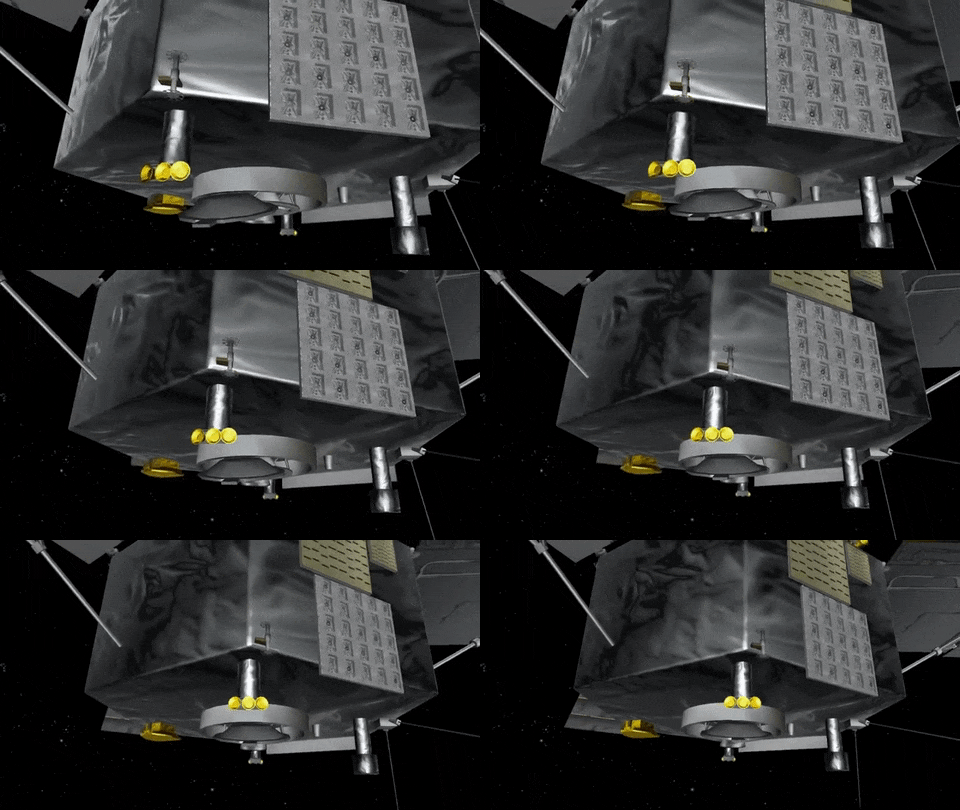
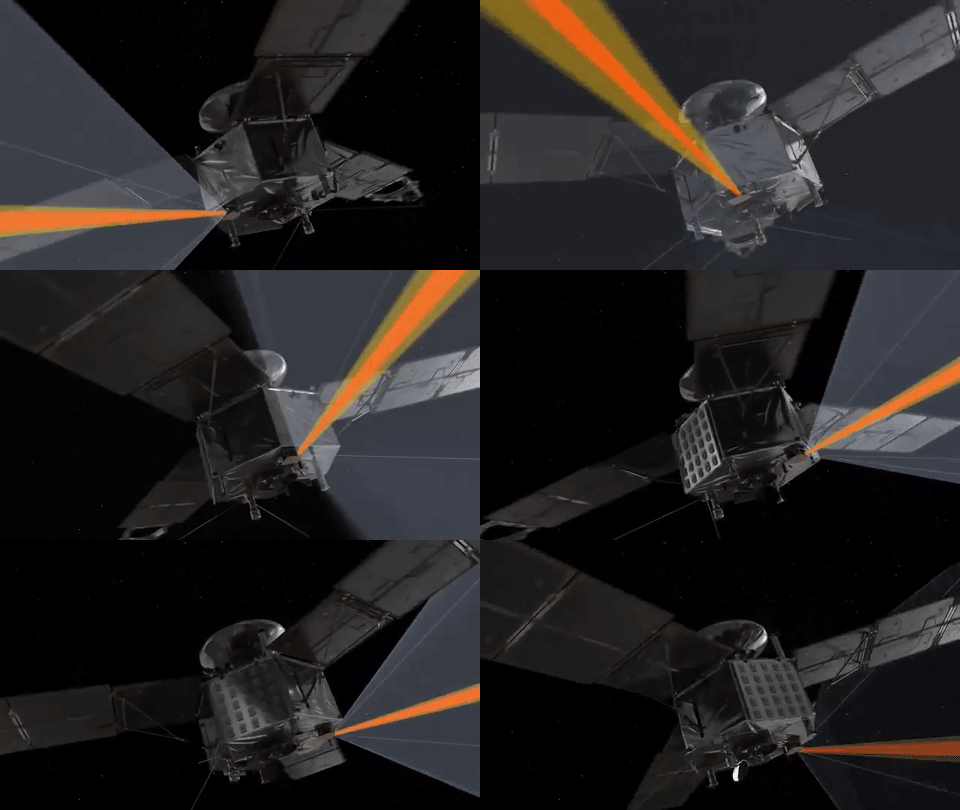
Our Juno spacecraft was carefully designed to meet the tough challenges in flying a mission to Jupiter: weak sunlight, extreme temperatures and deadly radiation. Lets take a closer look at Juno:

It Rotates!
image
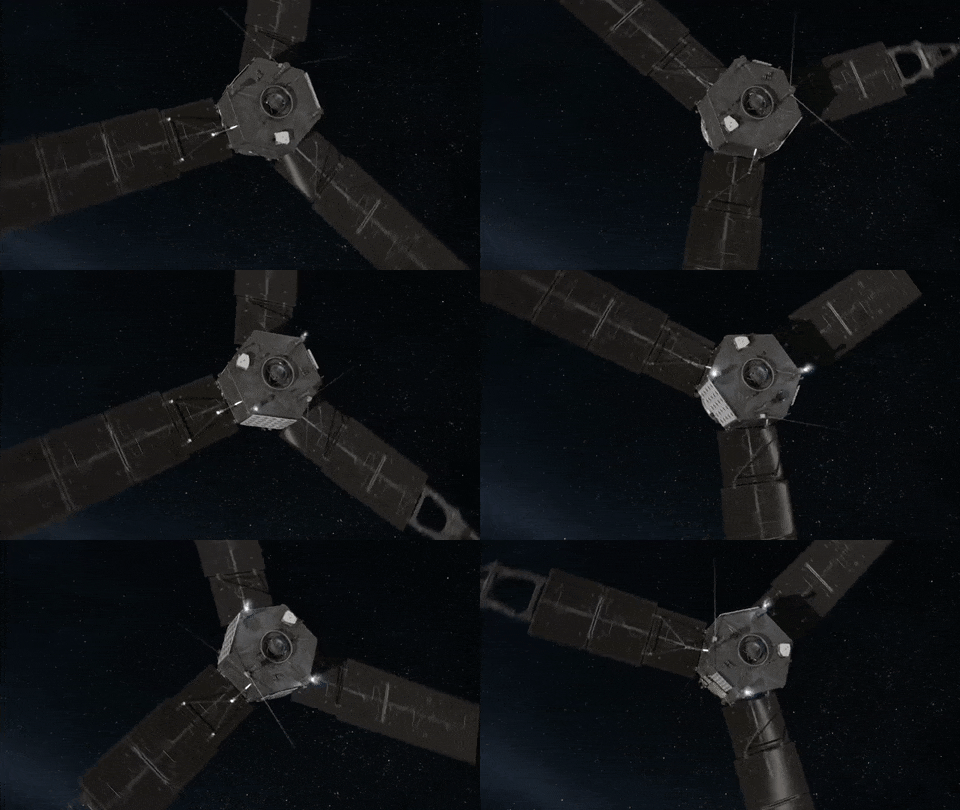
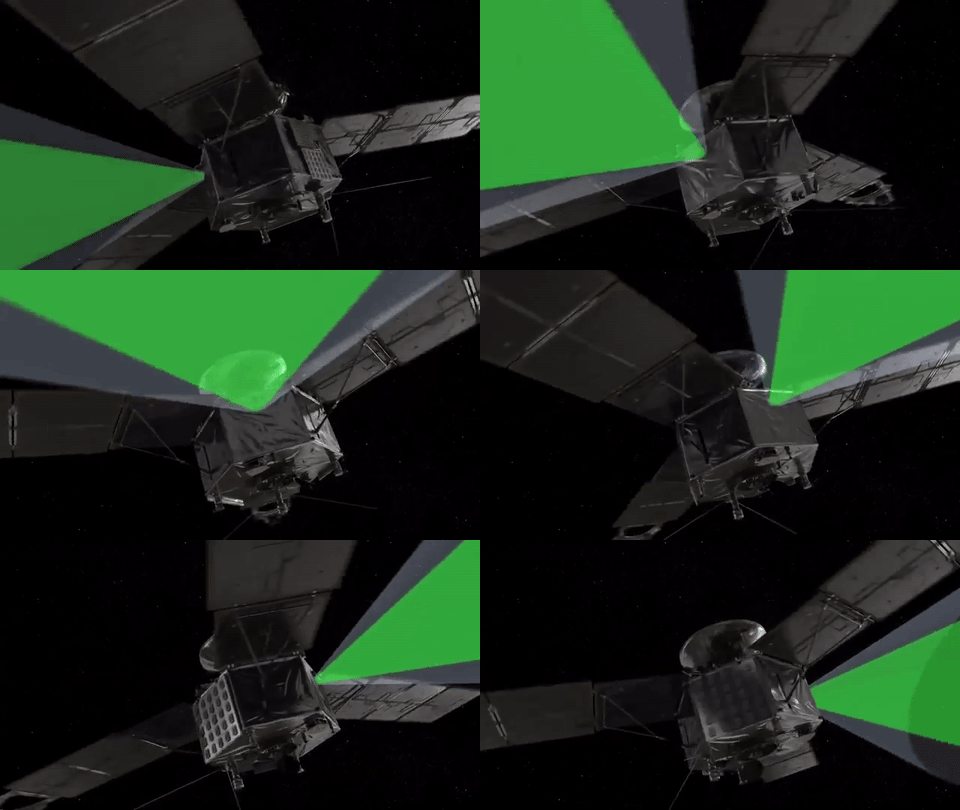
Roughly the size of an NBA basketball court, Juno is a spinning spacecraft. Cartwheeling through space makes the spacecraft’s pointing extremely stable and easy to control. While in orbit at Jupiter, the spinning spacecraft sweeps the fields of view of its instruments through space once for each rotation. At three rotations per minute, the instruments’ fields of view sweep across Jupiter about 400 times in the two hours it takes to fly from pole to pole.
It Uses the Power of the Sun
image
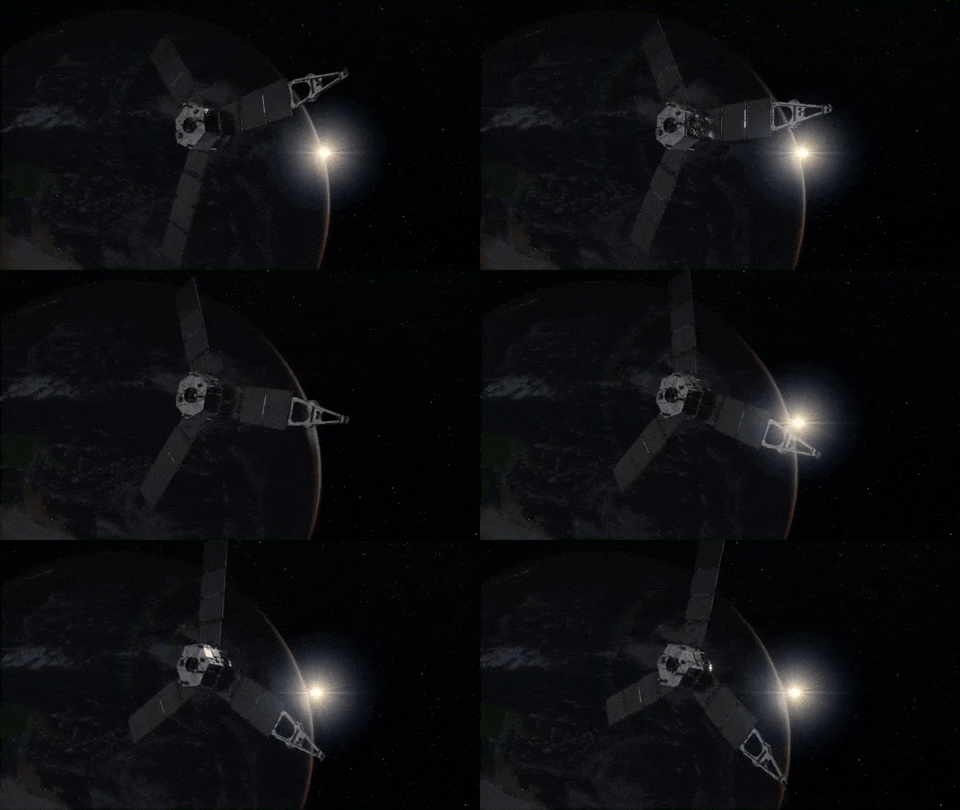
Jupiter’s orbit is five times farther from the sun than Earth’s, so the giant planet receives 25 times less sunlight than Earth. Juno will be the first solar-powered spacecraft we’ve designed to operate at such a great distance from the sun. Because of this, the surface area of the solar panels required to generate adequate power is quite large.
image
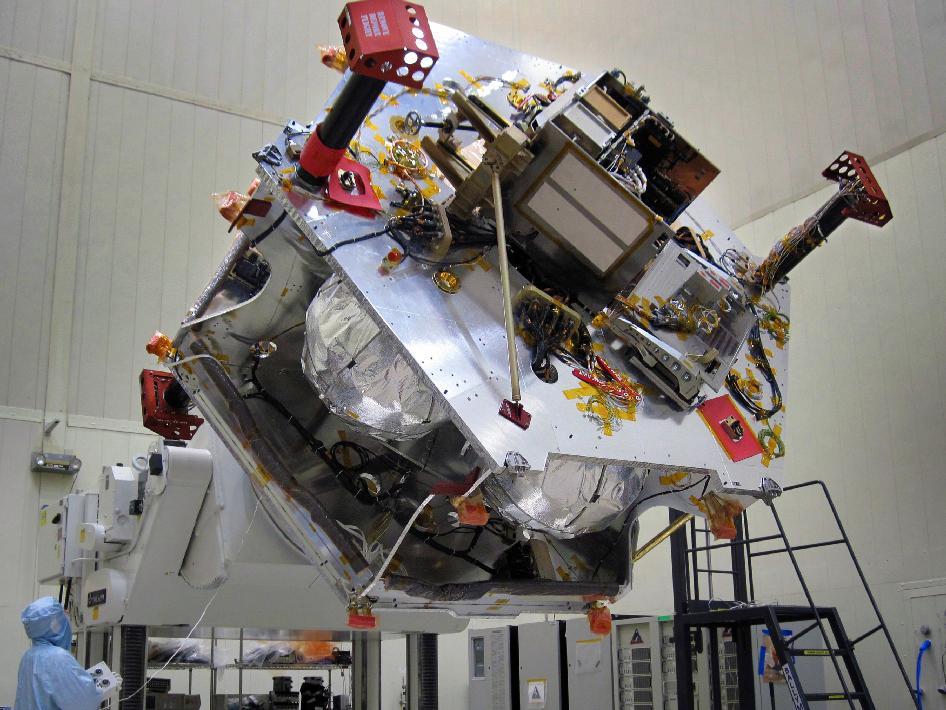
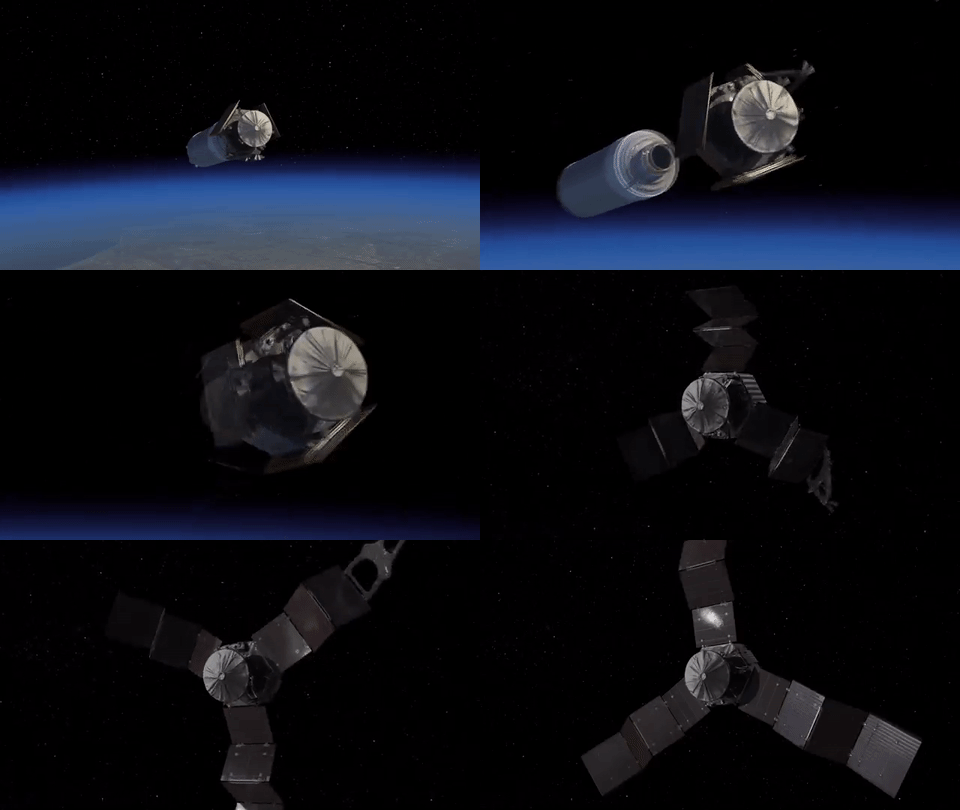
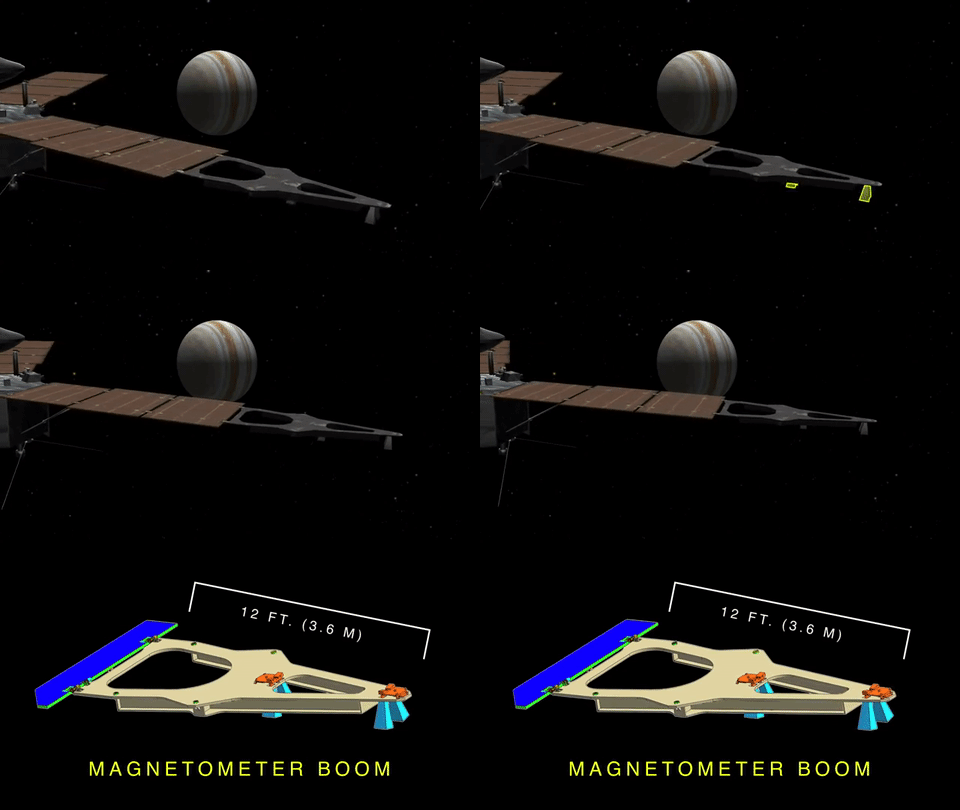
Three solar panels extend outward from Juno’s hexagonal body, giving the overall spacecraft a span of about 66 feet. Juno benefits from advances in solar cell design with modern cells that are 50% more efficient and radiation tolerant than silicon cells available for space missions 20 years ago. Luckily, the mission’s power needs are modest, with science instruments requiring full power for only about six out of each 11-day orbit.
It Has a Protective Radiation Vault

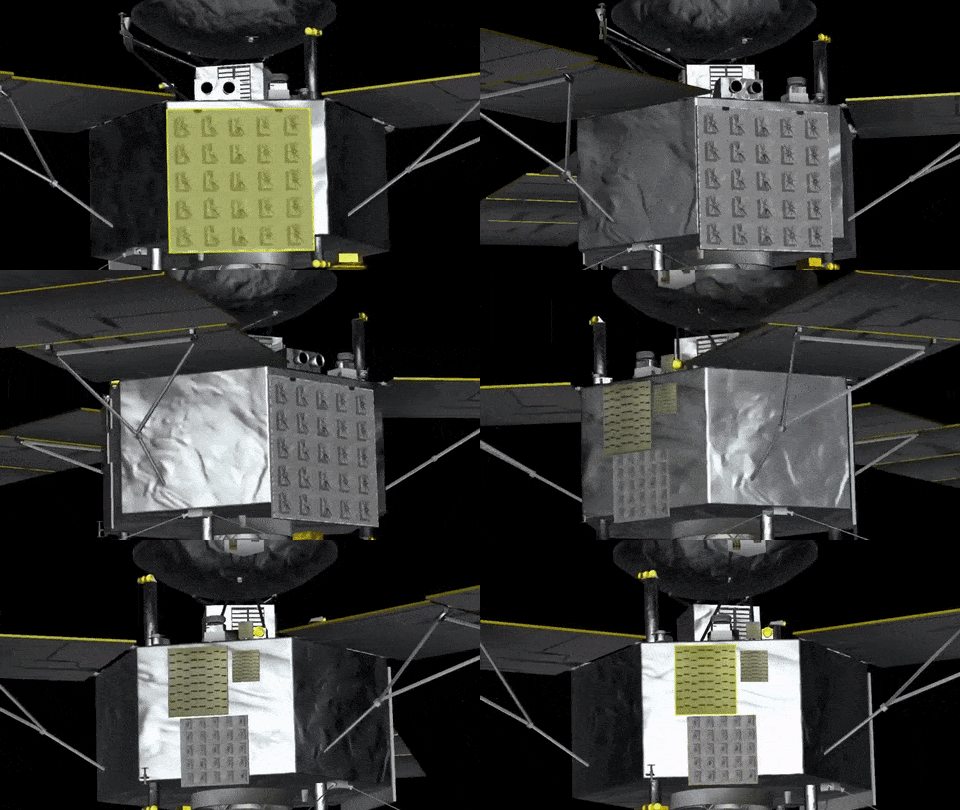
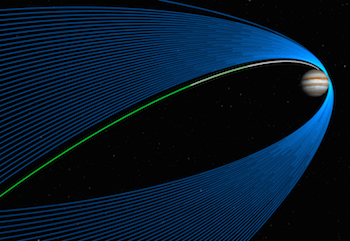
Juno will avoid Jupiter’s highest radiation regions by approaching over the north, dropping to an altitude below the planet’s radiation belts, and then exiting over the south. To protect sensitive spacecraft electronics, Juno will carry the first radiation shielded electronics vault, a critical feature for enabling sustained exploration in such a heavy radiation environment.

Juno Science Payload:

Gravity Science and Magnetometers Will study Jupiter’s deep structure by mapping the planet’s gravity field and magnetic field.
image
Microwave Radiometer – Will probe Jupiter’s deep atmosphere and measure how much water (and hence oxygen) is there.
image
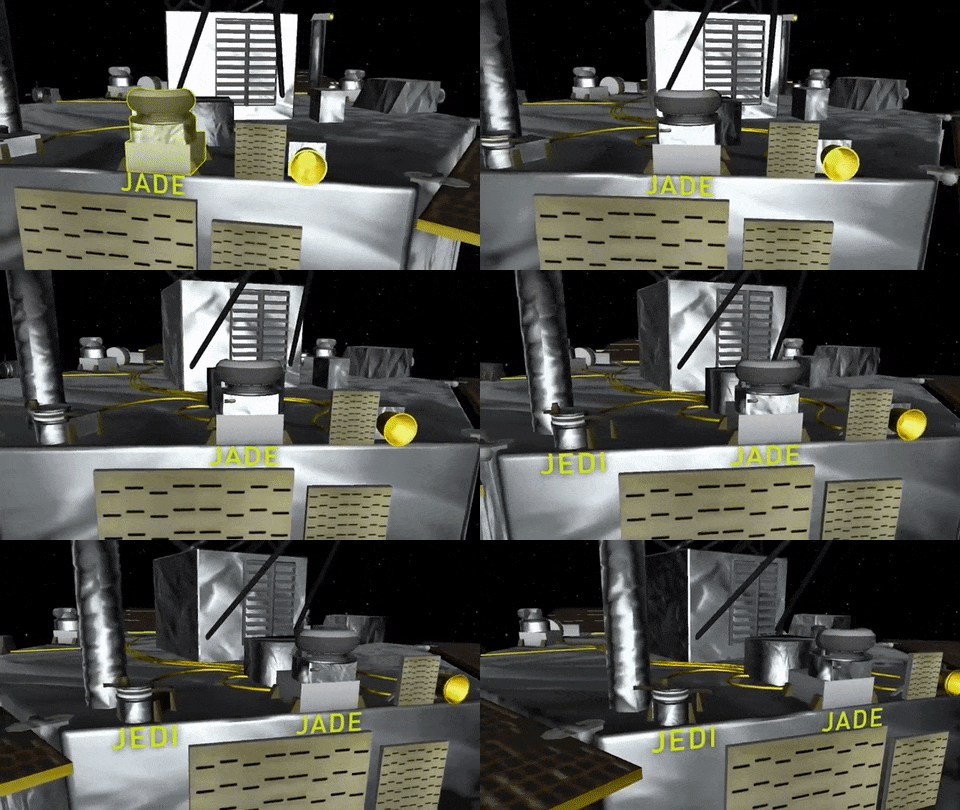
JEDI, JADE and Waves – These instruments will work to sample electric fields, plasma waves and particles around Jupiter to determine how the magnetic field is connected to the atmosphere, and especially the auroras (northern and southern lights).
JADE and JEDI
image
Waves
image
UVS and JIRAM – Using ultraviolet and infrared cameras, these instruments will take images of the atmosphere and auroras, including chemical fingerprints of the gases present.
UVS
image
JIRAM
image
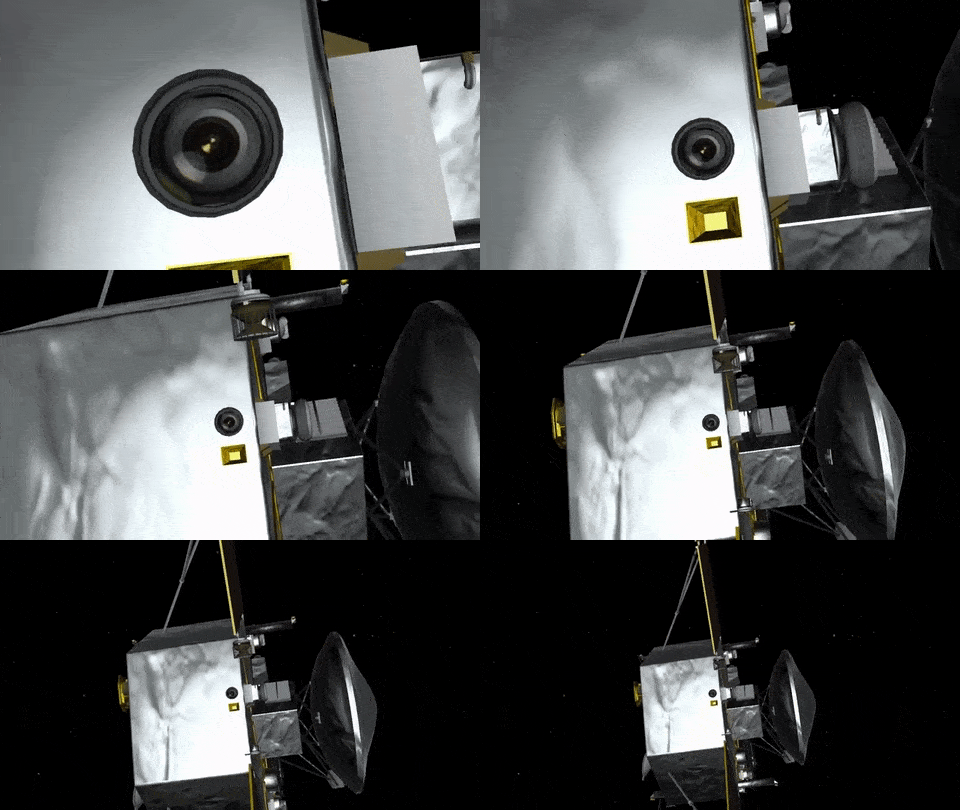
JunoCam – Take spectacular close-up, color images.
image


Solar System: Things to Know This Week


image


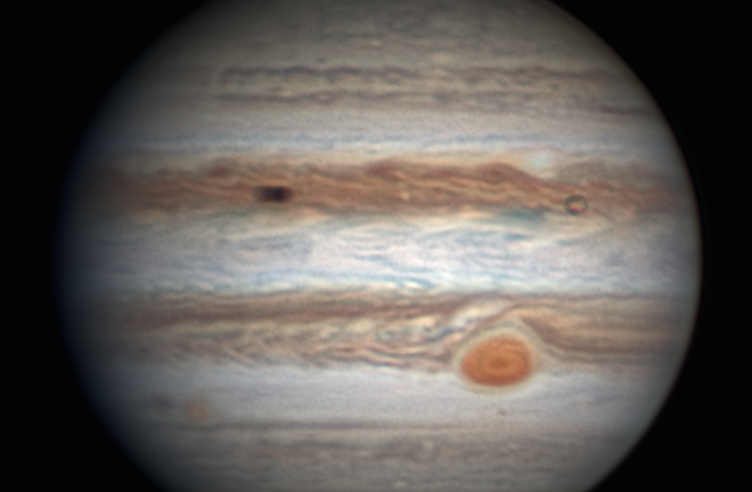
For the first time in almost a decade, we’re going back to Jupiter. Our Juno spacecraft arrives at the king of planets on the fourth of July. From a unique polar orbit, Juno will repeatedly dive between the planet and its intense belts of charged particle radiation. Juno’s primary goal is to improve our understanding of Jupiter’s formation and evolution, which will help us understand the history of our own solar system and provide new insight into how other planetary systems form.
In anticipation, here are a few things you need to know about the Juno mission and the mysterious world it will explore:

1. This is the Big One

image
The most massive planet in our solar system, with dozens of moons and an enormous magnetic field, Jupiter rules over a kind of miniature solar system.

2. Origin Story


Why study Jupiter in the first place? How does the planet fit into the solar system as a whole? What is it hiding? How will Juno unlock its secrets? A series of brief videos tells the stories of Jupiter and Juno. Watch them HERE.
3. Eyes on Juno
If you really want a hands-on understanding of Juno’s flight through the Jupiter system, there’s no better tool than the “Eyes on Juno” online simulation. It uses data from the mission to let you realistically see and interact with the spacecraft and its trajectory—in 3D and across both time and space.
4. You’re on JunoCam!
image
Did you know that you don’t have to work for NASA to contribute to the Juno mission? Amateur astronomers and space enthusiasts everywhere are invited to help with JunoCam, the mission’s color camera. You can upload your own images of Jupiter, comment on others’ images, and vote on which pictures JunoCam will take when it reaches the Jovian system.
5. Ride Along
image
It’s easy to follow events from the Juno mission as they unfold. Here are several ways to follow along online:


Friday, June 24, 2016

Team from India to Participate In NASA Competition 06-26


A team of 13 Indian engineering students, including four girls, will participate in NASA's prestigious global competition to build and design remotely operated vehicles from scratch.

The team named 'Screwdrivers' from Mukesh Patel School of Technology Management, Mumbai, will compete against 40 other teams from countries like China, Scotland, Russia, USA, Canada, Ireland, Mexico, Norway, Denmark, Egypt, Turkey, and Poland in NASA's 15th annual international Remotely Operated Vehicle (ROV) competition in Houston from Thursday.


This competition is being organised by MATE (Marine Advanced Technology Education) and Screwdrivers is the only team from India and competing against 40 other teams from countries like China, Scotland, Russia, USA, Canada, Ireland, Mexico, Norway, Denmark, Egypt, Turkey, and Poland.


Competing for a coveted prize as part of NASA's MATE international ROV competition, the team guided by Prof Sawankumar Naik, is all set to represent India at the NASA Johnson Space Canter's Neutral Buoyancy Lab from June 23 to 25.


"Although it is their third visit to the space centre, but this time, with over 40 participating teams from across the globe, the stakes are higher than ever," he told.


Students are expected to build and design their own remotely operated vehicles from scratch.


Chief Technical Officer, Vijayender Joshi said, "The tasks change each year but are always based on ocean engineering.

This year, NASA is going to start a mission to Jupiter's moon, Europa, since the moon also has water, the students would have to create a model, which will not only work underwater but also survive in space.


"The design is completely revamped from the model that went last year, we're told. And with various changes in design, the cost has come up to an approximately $1,000. Made over a span of five months, the robot, which the team calls 'spyder', has two parts - one that can stay above water and another that can go under it," he adds.


Team Screwdrivers has previously been felicitated by late President late APJ Abdul Kalam, Ace Nuclear Scientist Dr Anil Kakodkar, record holding astronaut Sunita Williams and Chief Minister of Maharashtra Devendra Fadnavis for innovative design and cost-effective implementation.


Saturday, November 21, 2015

A Day on Pluto, a Day on Charon 11-21


A Day on Pluto, a Day on Charon

On approach in July 2015, the cameras on NASA’s New Horizons spacecraft captured Pluto rotating over the course of a full “Pluto day.” The best available images of each side of Pluto taken during approach have been combined to create this view of a full rotation.


Credits: NASA/JHUAPL/SwRI

Pluto’s day is 6.4 Earth days long. The images were taken by the Long Range Reconnaissance Imager (LORRI) and the Ralph/Multispectral Visible Imaging Camera as the distance between New Horizons and Pluto decreased from 5 million miles (8 million kilometers) on July 7 to 400,000 miles (about 645,000 kilometers) on July 13. 

The more distant images contribute to the view at the 3 o’clock position, with the top of the heart-shaped, informally named Tombaugh Regio slipping out of view, giving way to the side of Pluto that was facing away from New Horizons during closest approach on July 14.  The side New Horizons saw in most detail – what the mission team calls the “encounter hemisphere” – is at the 6 o’clock position.

These images and others like them reveal many details about Pluto, including the differences between the encounter hemisphere and the so-called “far side” hemisphere seen only at lower resolution. Dimples in the bottom (south) edge of Pluto’s disk are artifacts of the way the images were combined to create these composites.


On approach to the Pluto system in July 2015, the cameras on NASA’s New Horizons spacecraft captured images of the largest of Pluto’s five moons, Charon, rotating over the course of a full day. The best currently available images of each side of Charon taken during approach have been combined to create this view of a full rotation of the moon.


Credits: NASA/JHUAPL/SwRI

Charon – like Pluto – rotates once every 6.4 Earth days. The photos were taken by the Long Range Reconnaissance Imager (LORRI) and the Ralph/Multispectral Visible Imaging Camera from July 7-13, as New Horizons closed in over a range of 6.4 million miles (10.2 million kilometers). The more distant images contribute to the view at the 9 o’clock position, with few of the signature surface features visible, such as the cratered uplands, canyons, or rolling plains of the informally named Vulcan Planum. The side New Horizons saw in most detail, during closest approach on July 14, 2015, is at the 12 o’clock position.

These images and others like them reveal many details about Charon, including how similar looking the encounter hemisphere is to the so-called “far side” hemisphere seen only at low resolution – which is the opposite of the situation at Pluto. Dimples in the bottom (south) edge of Charon’s disk are artifacts of the way the New Horizons images were combined to create these composites.

View at the original source
Tuesday, March 31, 2015

NASA's Curiosity Rover Finds Biologically Useful Nitrogen on Mars 03-31

NASA's Curiosity Rover Finds Biologically Useful Nitrogen on Mars


A team using the Sample Analysis at Mars (SAM) instrument suite aboard NASA's Curiosity rover has made the first detection of nitrogen on the surface of Mars from release during heating of Martian sediments. The nitrogen was detected in the form of nitric oxide, and could be released from the breakdown of nitrates during heating. Nitrates are a class of molecules that contain nitrogen in a form that can be used by living organisms. The discovery adds to the evidence that ancient Mars was habitable for life.
Nitrogen is essential for all known forms of life, since it is used in the building blocks of larger molecules like DNA and RNA, which encode the genetic instructions for life, and proteins, which are used to build structures like hair and nails, and to speed up or regulate chemical reactions.
However, on Earth and Mars, atmospheric nitrogen is locked up as nitrogen gas (N2) – two atoms of nitrogen bound together so strongly that they do not react easily with other molecules. The nitrogen atoms have to be separated or "fixed" so they can participate in the chemical reactions needed for life. On Earth, certain organisms are capable of fixing atmospheric nitrogen and this process is critical for metabolic activity. However, smaller amounts of nitrogen are also fixed by energetic events like lightning strikes.
Nitrate (NO3) – a nitrogen atom bound to three oxygen atoms – is a source of fixed nitrogen. A nitrate molecule can join with various other atoms and molecules; this class of molecules is known as nitrates.
There is no evidence to suggest that the fixed nitrogen molecules found by the team were created by life. The surface of Mars is inhospitable for known forms of life. Instead, the team thinks the nitrates are ancient, and likely came from non-biological processes like meteorite impacts and lightning in Mars' distant past.
Features resembling dry riverbeds and the discovery of minerals that only form in the presence of liquid water suggest that Mars was more hospitable in the remote past. The Curiosity team has found evidence that other ingredients needed for life, such as liquid water and organic matter, were present on Mars at the Curiosity site in Gale Crater billions of years ago.
"Finding a biochemically accessible form of nitrogen is more support for the ancient Martian environment at Gale Crater being habitable," said Jennifer Stern of NASA's Goddard Space Flight Center in Greenbelt, Maryland. Stern is lead author of a paper on this research published online in the Proceedings of the National Academy of Science March 23.
The team found evidence for nitrates in scooped samples of windblown sand and dust at the "Rocknest" site, and in samples drilled from mudstone at the "John Klein" and "Cumberland" drill sites in Yellowknife Bay. Since the Rocknest sample is a combination of dust blown in from distant regions on Mars and more locally sourced materials, the nitrates are likely to be widespread across Mars, according to Stern. The results support the equivalent of up to 1,100 parts per million nitrates in the Martian soil from the drill sites. The team thinks the mudstone at Yellowknife Bay formed from sediment deposited at the bottom of a lake. Previously the rover team described the evidence for an ancient, habitable environment there: fresh water, key chemical elements required by life, such as carbon, and potential energy sources to drive metabolism in simple organisms.
The samples were first heated to release molecules bound to the Martian soil, then portions of the gases released were diverted to the SAM instruments for analysis. Various nitrogen-bearing compounds were identified with two instruments: a mass spectrometer, which uses electric fields to identify molecules by their signature masses, and a gas chromatograph, which separates molecules based on the time they take to travel through a small glass capillary tube -- certain molecules interact with the sides of the tube more readily and thus travel more slowly.
Along with other nitrogen compounds, the instruments detected nitric oxide (NO -- one atom of nitrogen bound to an oxygen atom) in samples from all three sites. Since nitrate is a nitrogen atom bound to three oxygen atoms, the team thinks most of the NO likely came from nitrate which decomposed as the samples were heated for analysis. Certain compounds in the SAM instrument can also release nitrogen as samples are heated; however, the amount of NO found is more than twice what could be produced by SAM in the most extreme and unrealistic scenario, according to Stern. This leads the team to think that nitrates really are present on Mars, and the abundance estimates reported have been adjusted to reflect this potential additional source.
"Scientists have long thought that nitrates would be produced on Mars from the energy released in meteorite impacts, and the amounts we found agree well with estimates from this process," said Stern.
The SAM instrument suite was built at NASA Goddard with significant elements provided by industry, university, and national and international NASA partners. NASA's Mars Science Laboratory Project is using Curiosity to assess ancient habitable environments and major changes in Martian environmental conditions. NASA's Jet Propulsion Laboratory in Pasadena, California, a division of Caltech, built the rover and manages the project for NASA's Science Mission Directorate in Washington. The NASA Mars Exploration Program and Goddard Space Flight Center provided support for the development and operation of SAM. SAM-Gas Chromatograph was supported by funds from the French Space Agency (CNES). Data from these SAM experiments are archived in the  Planetary Data System (pds.nasa.gov).

Thursday, February 5, 2015

NASA Spacecraft Returns New Images of Pluto En Route to Historic Encounter 02-06

NASA Spacecraft Returns New Images of Pluto En Route to Historic Encounter


The image of Pluto and its moon Charon, taken by NASA’s New Horizons spacecraft, was magnified four times to make the objects more visible. Over the next several months, the apparent sizes of Pluto and Charon, as well as the separation between them, will continue to expand in the images.
Image Credit: 
NASA/JHU APL/SwRI
NASA’s New Horizons spacecraft returned its first new images of Pluto on Wednesday, as the probe closes in on the dwarf planet. Although still just a dot along with its largest moon, Charon, the images come on the 109th birthday of Clyde Tombaugh, who discovered the distant icy world in 1930.
My dad would be thrilled with New Horizons,” said Clyde Tombaugh’s daughter Annette Tombaugh, of Las Cruces, New Mexico. “To actually see the planet that he had discovered, and find out more about it -- to get to see the moons of Pluto-- he would have been astounded. I'm sure it would have meant so much to him if he were still alive today.”
New Horizons was more than 126 million miles (nearly 203 million kilometers) away from Pluto when it began taking images. The new images, taken with New Horizons’ telescopic Long-Range Reconnaissance Imager (LORRI) on Jan. 25 and Jan. 27, are the first acquired during the spacecraft’s 2015 approach to the Pluto system, which culminates with a close flyby of Pluto and its moons on July 14.
“This is our birthday tribute to Professor Tombaugh and the Tombaugh family, in honor of his discovery and life achievements -- which truly became a harbinger of 21st century planetary astronomy,” said Alan Stern, New Horizons principal investigator at the Southwest Research Institute (SwRI) in Boulder, Colorado. “These images of Pluto, clearly brighter and closer than those New Horizons took last July from twice as far away, represent our first steps at turning the pinpoint of light Clyde saw in the telescopes at Lowell Observatory 85 years ago, into a planet before the eyes of the world this summer.”
Over the next few months, LORRI will take hundreds of pictures of Pluto, against a starry backdrop, to refine the team’s estimates of New Horizons’ distance to Pluto. As in these first images, the Pluto system will resemble little more than bright dots in the camera’s view until late spring. However, mission navigators can still use such images to design course-correcting engine maneuvers to direct the spacecraft for a more precise approach. The first such maneuver based on these optical navigation images, or OpNavs, is scheduled for March 10.
“Pluto is finally becoming more than just a pinpoint of light,” said Hal Weaver, New Horizons project scientist at the Johns Hopkins University Applied Physics Laboratory in Laurel, Maryland.  “LORRI has now resolved Pluto, and the dwarf planet will continue to grow larger and larger in the images as New Horizons spacecraft hurtles toward its targets. The new LORRI images also demonstrate that the camera’s performance is unchanged since it was launched more than nine years ago.”
Closing in on Pluto at about 31,000 mph, New Horizons already has covered more than 3 billion miles since it launched on Jan. 19, 2006. Its journey has taken it past each planet’s orbit, from Mars to Neptune, in record time, and it is now in the first stage of an encounter with Pluto that includes long-distance imaging as well as dust, energetic particle and solar wind measurements to characterize the space environment near Pluto.
“The U.S. has led the exploration of the planets and continues to do so with New Horizons,” said Curt Niebur, New Horizons program scientist at NASA Headquarters in Washington. “This mission will obtain images to map Pluto and its moons better than has ever been achieved by any previous planetary mission.”
APL manages the New Horizons mission for NASA’s Science Mission Directorate in Washington. Alan Stern, of SwRI, is the principal investigator and leads the mission. SwRI leads the science team, payload operations and encounter science planning. New Horizons is part of the New Frontiers Program, managed by NASA's Marshall Space Flight Center in Huntsville, Alabama. APL designed, built and operates the spacecraft.

Monday, January 5, 2015

Cool NASA animation beautifully details every step of Orion's first launch 01-06

Cool NASA animation beautifully details every step of Orion's first launch


Orion atop Delta 4 Heavy Booster. Credit: NASA/Kim Shiflett

It's not Science Fiction! It's Not Star Trek!

No. It's a really, really big NASA Mission! It's Orion!
In fact, it's the biggest and most important development in US Human Spaceflight since the end of the Space Shuttle Program in 2011.
Orion is launching soon on its first flight, the pathfinding Exploration Flight Test-1 (EFT-1) mission and sets NASA on the path to send humans to Mars in the 2030s.
Watch this cool NASA animation beautifully detailing every key step of Orion's First Launch!
Orion is designed to take humans farther than they've ever gone before. Even farther into deep space than NASA's Apollo moon landing which ended more than four decades ago!
We are T-MINUS 4 Days and Counting to the inaugural blastoff of Orion as of today, Sunday, November 30, 2014.
To learn even more about the 8 major events and goals happening during Orion's EFT-1 mission be sure to check out my recent story with NASA's fabulous new set of infographics – here.


Every aspect of the final processing steps now in progress by engineers and technicians from NASA, rocket provider United Launch Alliance, and Orion prime contractor Lockheed Martin is proceeding smoothly and marching towards launch.
Orion will lift off on a United Launch Alliance Delta IV Heavy rocket on its inaugural test flight to space on the uncrewed Exploration Flight Test-1 (EFT-1) mission at 7:05 a.m. EST on December 4, 2014, from Space Launch Complex 37 (SLC-37) at Cape Canaveral Air Force Station in Florida.


Orion’s move to Launch Complex-37. Credit: Mike Killian
The two-orbit, four and a half hour Orion EFT-1 flight around Earth will lift the Orion spacecraft and its attached second stage to an orbital altitude of 3,600 miles, about 15 times higher than the International Space Station (ISS) – and farther than any human spacecraft has journeyed in 40 years.
EFT-1 will test the rocket, second stage, jettison mechanisms as well as avionics, attitude control, computers and electronic systems inside the Orion spacecraft.


Here’s how Orion EFT-1 Launch will look! Delta 4 Heavy rocket and super secret US spy satellite roars off Pad 37 on June 29, 2012, from Cape Canaveral, Florida. NASA’s Orion EFT-1 capsule will blastoff atop a similar Delta 4 Heavy Booster in December 2014. Credit: Ken Kremer
Then the spacecraft will carry out a high speed re-entry through the atmosphere at speeds approaching 20,000 mph and scorching temperatures near 4,000 degrees Fahrenheit to test the heat shield, before splashing down for a parachute assisted landing in the Pacific Ocean.
Orion is NASA's next generation human rated vehicle that will carry America's astronauts beyond Earth on voyages venturing farther into deep space than ever before – beyond the Moon to Asteroids, Mars, and other destinations in our Solar System.

After Orion launch, big steps lie ahead for Mars trip, NASA says 01-06

After Orion launch, big steps lie ahead for Mars trip, NASA says


Valles Marineris, Mars. Credit: NASA

If creating the new Orion space capsule or developing a new deep-space rocket are complex and critical breakthroughs, NASA's remaining challenges to send humans to Mars are no less daunting, officials said Tuesday.

NASA's next-generation capsule, Orion, is ready for its maiden launch Thursday at 7:05 a.m. from Cape Canaveral Air Force Station. Space agency officials call it the first step for a human journey to Mars.
"It is truly a beautiful planet. It has fabulous vistas. It has a number of resources that we are finding out about, and we are planning to move toward human exploration of Mars," Jim Green, NASA's Planetary Science Division director, said during a news briefing held jointly in Washington and Kennedy Space Center.
Yet the Orion, and the Space Launch System rocket being developed for a 2018 launch, are only the first steps. Development of human life support, fuel, communication and Martian landing systems are in much earlier development. Those challenges and budget concerns leave NASA officials saying they hope to reach Mars sometime in the 2030s.
The overriding challenge is that it would take astronauts more than a year to get there, so they'll have to take everything they need or have it waiting for them along the way, said Jason Crusan, director of NASA's Advanced Exploration Systems Division.
"We describe it as ... going from an Earth-reliant to an Earth-independent phase," Crusan said.
Among the challenges:
-The agency thinks it impractical to carry enough liquid or solid fuel. So NASA is exploring high-powered solar-electric engines to propel Orion through space. That could be viable by the end of this decade, said James Reuther, NASA's deputy associate administrator for space-technology mission programs.
-NASA's current communication systems are radio-based and only carry a tiny fraction of the information necessary. The agency is working on laser-based optical-communication technologies. It could be workable by the early 2020s, Reuther said.
-To land on Mars, NASA plans to adapt technologies used to land the Curiosity Martian rover two years ago. Scaling that to handle a far-heavier human craft may not happen until the early 2030s, he said.
-NASA must develop living quarters for the astronauts' long journeys and for stays in orbit around Mars and on that planet. The agency is considering sending up habitats in advance, placing them in orbit near Earth's moon, in orbit around Mars and on Mars' surface. Orion astronauts could use them on the way, Crusan said.