Shyam's Slide Share Presentations

VIRTUAL LIBRARY "KNOWLEDGE - KORRIDOR"

This article/post is from a third party website. The views expressed are that of the author. We at Capacity Building & Development may not necessarily subscribe to it completely. The relevance & applicability of the content is limited to certain geographic zones.It is not universal.

TO VIEW MORE CONTENT ON THIS SUBJECT AND OTHER TOPICS, Please visit KNOWLEDGE-KORRIDOR our Virtual Library

Thursday, June 25, 2015

The Four Phases of Design Thinking 06-25

The Four Phases of Design Thinking


What can people in business learn from studying the ways successful designers solve problems and innovate? On the most basic level, they can learn to question, care, connect, and commit — four of the most important things successful designers do to achieve significant breakthroughs.
Having studied more than a hundred top designers in various fields over the past couple of years (while doing research for a book), I found that there were a few shared behaviors that seemed to be almost second nature to many designers. And these ingrained habits were intrinsically linked to the designer’s ability to bring original ideas into the world as successful innovations. All of which suggests that they merit a closer look.
Question. If you spend any time around designers, you quickly discover this about them: They ask, and raise, a lot of questions. Often this is the starting point in the design process, and it can have a profound influence on everything that follows. Many of the designers I studied, from Bruce Mau to Richard Saul Wurman to Paula Scher, talked about the importance of asking “stupid questions”–the ones that challenge the existing realities and assumptions in a given industry or sector. The persistent tendency of designers to do this is captured in the joke designers tell about themselves. How many designers does it take to change a light bulb? Answer: Does it have to be a light bulb?
In a business setting, asking basic “why” questions can make the questioner seem naïve while putting others on the defensive (as in, “What do you mean ‘Why are we doing it this way?’ We’ve been doing it this way for 22 years!”). But by encouraging people to step back and reconsider old problems or entrenched practices, the designer can begin to re-frame the challenge at hand — which can then steer thinking in new directions. For business in today’s volatile marketplace, the ability to question and rethink basic fundamentals — What business are we really in? What do today’s consumers actually need or expect from us? — has never been more important.
Care. It’s easy for companies to say they care about customer needs. But to really empathize, you have to be willing to do what many of the best designers do: step out of the corporate bubble and actually immerse yourself in the daily lives of people you’re trying to serve. What impressed me about design researchers such as Jane Fulton Suri of IDEO was the dedication to really observing and paying close attention to people — because this is usually the best way to ferret out their deep, unarticulated needs. Focus groups and questionnaires don’t cut it; designers know that you must care enough to actually be present in people’s lives.
Connect. Designers, I discovered, have a knack for synthesizing–for taking existing elements or ideas and mashing them together in fresh new ways. This can be a valuable shortcut to innovation because it means you don’t necessarily have to invent from scratch. By coming up with “smart recombinations” (to use a term coined by the designer John Thackara), Apple has produced some of its most successful hybrid products; and Nike smartly combining a running shoe with an iPod to produce its groundbreaking Nike Plus line (which enables users to program their runs). It isn’t easy to come up with these great combos. Designers know that you must “think laterally” — searching far and wide for ideas and influences — and must also be willing to try connecting ideas that might not seem to go together. This is a way of thinking that can also be embraced by non-designers.
Commit. It’s one thing to dream up original ideas. But designers quickly take those ideas beyond the realm of imagination by giving form to them. Whether it’s a napkin sketch, a prototype carved from foam rubber, or a digital mock-up, the quick-and-rough models that designers constantly create are a critical component of innovation — because when you give form to an idea, you begin to make it real.
But it’s also true that when you commit to an idea early — putting it out into the world while it’s still young and imperfect — you increase the possibility of short-term failure. Designers tend to be much more comfortable with this risk than most of us. They know that innovation often involves an iterative process with setbacks along the way — and those small failures are actually useful because they show the designer what works and what needs fixing. The designer’s ability to “fail forward” is a particularly valuable quality in times of dynamic change. Today, many companies find themselves operating in a test-and-learn business environment that requires rapid prototyping. Which is just one more reason to pay attention to the people who’ve been conducting their work this way all along.

6 reasons why we’re underhyping the Internet of Things 06-25


6 reasons why we’re underhyping the Internet of Things


Just when you thought the Internet of Things couldn’t possibly live up to its hype, along comes a blockbuster, 142-page report from McKinsey Global Institute (“The Internet of Things: Mapping the Value Beyond the Hype”) that says, if anything, we’re underestimating the potential economic impact of the Internet of Things. By 2025, says McKinsey, the potential economic impact of having “sensors and actuators connected by networks to computing systems” (McKinsey’s definition of the Internet of Things) could be more than $11 trillion annually.
According to McKinsey, there are six reasons we may be underhyping the Internet of Things.
1. We’re only using 1 percent of all data
What McKinsey found in its analysis of more than 150 Internet of Things use cases was that we’re simply not taking advantage of all the data that sensors and RFID tags are cranking out 24/7. In some cases, says McKinsey, we may be using only 1 percent of all the data out there. And even then, we’re only using the data for simple things such as anomaly detection and control systems – we’re not taking advantage of the other 99 percent of the data for tasks such as optimization and prediction. A typical offshore oil rig, for example, may have 30,000 sensors hooked up to it, but oil companies are only using a small fraction of this data for future decision-making.
2. We’re not getting the big picture by focusing only on industries
Rather than focusing on verticals and industries (the typical way that potential economic value is computed), McKinsey takes a deeper look at the sweeping changes taking place in nine different physical “settings” where the Internet of Things will actually be deployed – home, retail, office, factories, work sites (mining, oil and gas, construction), vehicles, human (health and wellness), outside (logistics and navigation), and cities. Of that $11 trillion in economic value, four of the nine settings top out at over $1 trillion in projected economic value – factories ($3.7 trillion), cities ($1.7 trillion), health and fitness ($1.6 trillion) and retail ($1.2 trillion).
Thus, instead of focusing on, say, the automotive industry, McKinsey spreads the benefits of the Internet of Things for automobiles over two different physical settings — “vehicles” and “cities.” In the case of vehicles, sensors are a natural fit for maintenance (e.g. sensors that tell you when something’s not working on your car). In the case of cities, these sensors can help with bigger issues such as traffic congestion.
3. We’re forgetting about the B2B opportunity
If you think the Internet of Things is just about smart homes and wearable fitness devices, think again – McKinsey says the B2B market opportunity could be more than two times the size of the B2C opportunity. One big example cited by McKinsey is the ability of work sites to take better advantage of the Internet of Things.
Think of an oil work site, for example. You have machinery (e.g. oil rigs), mobile equipment (trucks), consumables (barrels of oil), employees, processing plants and transportation networks for taking this oil out of the work site. If all those elements are talking to each via the Internet, you can optimize the work site. Oil rigs can let employees know if something’s broken, trucks can arrive on time to pick up the barrels of oil, and then all that oil can be processed and shipped off to wherever it’s needed on time and on schedule.
4. We’re ignoring that “interoperability” could be the new “synergy”
According to McKinsey, approximately 40 percent of the total economic value of the Internet of Things is driven by the ability of all the physical devices to talk to each other via computers — what McKinsey refers to as “interoperability.” You can think of “interoperability” as a new form of synergy – a way to increase the whole without increasing the sum of the parts.
If machines can’t talk to each other, says McKinsey, the Internet of Things might only be a $3.9 trillion opportunity. One example of interoperability is the ability of your brand-new fitness wearable to talk with your hospital or healthcare provider. What good is your fitness device if it can’t communicate with the people who can actually use all that data? With interoperability in health, the Internet of Things may be able to cut the cost of treating chronic disease by 50 percent.
5. We’re underestimating the impact on developing economies
In terms of pure economic impact, there will be approximately a 60:40 split between economic gains for developed economies and developing economies. As McKinsey points out, some of the greatest gains will be in developing nations, especially in areas such as retail. In some cases, developing nations will be able to leapfrog the achievements in developed nations because they don’t have to worry about retrofitting equipment or infrastructure with sensors and actuators.
6. We’re forgetting about the new business models that will be created
It’s not just that the Internet of Things will lead to efficiencies and cost savings – but also that it will lead to entirely new ways of doing business. As McKinsey points out, we will likely see the rise of new business models that correspond with the way we are monitoring and evaluating data in real-time. The line will blur between technology companies and non-technology companies.
For example, take the makers of industrial equipment. Instead of selling expensive capital goods, they will sell products-as-services. Instead of charging one lump sum upfront, they will charge by usage. In addition, there will be new companies that emerge that bill themselves as end-to-end Internet of Things system providers.
**
Obviously, it’s exciting news that the world is about to get an $11 trillion economic shot in the arm from hooking up every possible object to the Internet with sensors and actuators. At the very least, some companies are going to get awfully rich by selling sensors and RFID tags to everyone trying to cash in on the Internet of Things gold rush.
At the same time, though, isn’t there something very bleak about a future in which sensors are hooked up to every object, every setting is predictable and optimized, and pure data guides every decision rather than the human heart? Imagine a giant planned economy, overseen by a bunch of managers schooled in Frederick Winslow Taylor’s principles of scientific management, figuring out new ways to crunch the data of our daily lives. When it comes to the Internet of Things, be careful what you wish for.

Friday, June 19, 2015

This blood test can tell you every virus you’ve ever had 06-19

This blood test can tell you every virus you’ve ever had


A single virus particle, or "virion," of measles. (Centers for Disease Control and Prevention via Getty Images)

A single virus particle, or "virion," of measles. (Centers for Disease Control and Prevention via Getty Images)
Curious how many viruses have invaded your body over the course of your life? Now you can know.
Researchers have developed a DNA-based blood test that can determine a person's viral history, a development they hope could lead to early detection of conditions, such as hepatitis C, and eventually help explain what triggers certain autoimmune diseases and cancers.
The new test, known as VirScan, works by screening the blood for antibodies against any of the 206 species of viruses known to infect humans, according to a study published Thursday in the journal Science. The immune system, which churns out specific antibodies when it encounters a virus, can continue to produce those antibodies decades after an infection subsides. VirScan detects those antibodies and uses them as a window in time to create a blueprint of nearly every virus an individual has encountered. It's a dramatic alternative to existing diagnostic tools, which test only for a single suspected virus.
"The approach is clever and a technological tour de force," said Ian Lipkin, a professor of epidemiology and director of the Center for Infection and Immunity at Columbia University, who was not involved in the creation of VirScan. "It has the potential to reveal viruses people have encountered recently or many years earlier ... Thus, this is a powerful new research tool."
[One day, doctors might prescribe viruses instead of antibiotics]
Scientists on Thursday reported intriguing findings from their initial tests of 569 people they screened using VirScan in the United States, South Africa, Thailand and Peru. They found that the average person has been exposed to 10 of the 206 different species of known viruses -- though some people showed exposure to more than double that number.
"Many of those [people] have probably been infected with many different strains of the same virus," said Stephen Elledge, a professor of genetics and medicine at Brigham and Women's Hospital and Harvard Medical School, who led the development of VirScan. "You could be infected with many strains of rhinovirus over the course of your life, for instance, and it would show up as one hit."

In addition, he said, certain viruses were far more common in adults than in children, who presumably have yet to encounter much of the world's viral landscape. People infected with HIV tended to have antibodies against many more viruses than people without the disease. Researchers also saw striking geographic differences in the way viruses affected different populations. People in South Africa, Thailand and Peru generally displayed antibodies against many more viruses than people living in the United States.
"We don't know if this has to do with the genetics of the people or the strains of the viruses that are out there," Elledge said of the differences by country. "Or if it has something to do with cultural habits or sanitation."
[Think you're healthy? You may be carrying around viruses you don't even know about]
Elledge said the VirScan analysis currently can be performed for about $25 per blood sample, though labs might charge much more than that if the test becomes commercially available. He also said it currently takes two or three days to process and sequence about 100 samples, though that speed could increase as technology improves.
Ultimately, Elledge said he hopes the test could be used to more quickly detect conditions, such as HIV and hepatitis C, which patients can carry for years before displaying any outward symptoms. Experts believe VirScan also could lead to insights about the role long-ago viral infections play in the later development of certain cancers and autoimmune diseases such as Type 1 diabetes and multiple sclerosis.
"There are a lot of chronic diseases where we think a virus might be involved, but we can't quite pinpoint it ... Right now we can't quite make the connection," said Vincent Racaniello, a professor of microbiology and immunology at Columbia, who was not involved in developing VirScan. "I think this is really going to be helpful. It's very cool."
Racaniello said he envisions a day when patients will get the VirScan test as part of a regular checkup.
"This is going to be routine, I think," he said. "It'll be good to know what viruses have been in you."

Wednesday, June 10, 2015

Staying in the Know 06-10

Staying in the Know


In an era of information overload, getting the right information remains a challenge for time-pressed executives. Is it time to overhaul your personal knowledge infrastructure?

A common thread runs through many recent corporate setbacks and scandals. In crises ranging from BP’s Deepwater Horizon oil spill debacle to the Libor rate-fixing scandal in the City of London, the troubles simmered below the CEO’s radar. By the time the problems were revealed, most of the damage had arguably already been done. Despite indications that large companies are becoming increasingly complicated to manage,1 executives are still responsible for staying abreast of what’s going in their organization. But how do you keep tabs on what your competitors and employees are doing? How do you spot the next big idea and make the best judgments? How do you distinguish usable information from distracting noise? And how do you maintain focus on what’s critical?

Many management experts have assumed that better information systems and more data would solve the problem. Some have pushed for faster and more powerful information technologies. Others have put their faith in better dashboards, big data and social networking. But is better technology or more tools really the most promising way forward? We think not. In this article, we maintain that the capacity of senior executives to remain appropriately and effectively knowledgeable in order to perform their jobs is based on a personal and organizational capability to continually “stay in the know” by assembling and maintaining what we call a “personal knowledge infrastructure.” And while information technologies may be part of this personal knowledge infrastructure, they are really just one of the components.

We are not the first researchers to make this claim. More than 40 years ago, organizational theorist Henry Mintzberg suggested that information was central to managerial work and that the most important managerial roles revolved around information (monitoring, disseminating and acting as a spokesperson). Mintzberg described managers as the nerve centers of organizations and said informational activities “tie all managerial work together.”2 Other researchers suggested that management itself could be considered a form of information gathering and that we are quickly moving from an information society to an attention economy, where competitive advantage comes not from acquiring more information but from knowing what to pay attention to.3 Later research confirmed that dealing with information is critical and found that managers’ communication abilities are directly related to their performance.4

While the importance of informational roles and activities is well established, we take the idea a step further, arguing that managers — and especially senior executives — are only as good at acquiring and interpreting critical information as their personal knowledge infrastructures are. Managers rely on specific learned modes to manage and allocate their attention.5 However, how we pay attention is not simply a matter of internal mental processes that we can do little about. Rather, attentiveness (in other words, the capacity to stay on top, and the ability to distinguish between what matters and what doesn’t) mostly stems from what managers do or don’t do, whom they talk to and when, and what tools and tricks of the trade they use. In short, attentiveness relies on and is facilitated by things we can observe — and things we can do something about.

Technologies and new tools are not and cannot be “silver bullet” solutions. At times, simpler things such as talking to customers or networking with board members may be more important, provided they are done methodically and with some purpose. Selecting when particular elements are appropriate depends on the circumstances. As a result, understanding and, when needed, overhauling one’s personal knowledge infrastructure should be routine. In this article, we explain how this can be done, drawing on insights obtained by shadowing individual CEOs as they went about their daily jobs.6

About the Research

To uncover how top executives deal with information and knowledge, we conducted an observation-based exploratory study using a rigorous ethnographic protocol successfully employed in the past. We followed seven chief executives through their working days for several weeks. We went where they went, watched what they did, listened to what they and others said and asked what was going on when we did not understand. We also discussed our findings with them and with invited colleagues as part of structured feedback sessions.

Our sample comprised seven CEOs of acute and mental health organizations that are part of the National Health Service in England. In England, health care is provided by public sector bodies called trusts. Our sample included organizations that run multiple hospitals, have an annual budget of more than 500 million pounds and have up to 10,000 employees. The CEOs have both legal and financial responsibility. The sample included both men and women (3:4). The CEOs had diverse professional backgrounds (NHS management, private sector, nursing and medical) and were at different points in their careers, both in terms of tenure in their present post and overall experience at the CEO level. The sample also included organizations with different performance levels according to indicators by which their performance was monitored by national regulators (for example, financially sound vs. struggling).

CEOs were observed for five or more weeks, apart from one subject, where observations lasted 3½ weeks. The researchers had good access to the CEOs and were able to document nearly all aspects of their work, with exceptions such as one-to-one supervisory meetings with junior colleagues, HR-related meetings concerning individuals and private meetings with patients. When CEOs worked from home, data was collected in interviews afterwards. We conducted semi-structured interviews with five of the CEOs and a number of informal interviews with the other two CEOs. In addition, we conducted two formal interviews with two different personal assistants, which were recorded and lasted approximately half an hour each. Additional data came from meeting papers, articles referenced by the CEOs and copies of publications consulted, and they were supplemented by externally available information such as annual trust reports and regulatory documents. Following the study, our results were shared with two groups of CEOs at dedicated sector events. Those CEOs helped us to refine our findings and elaborate on the notion of the personal knowledge infrastructure.

Our research is based on a two-year study of the day-to-day work of seven CEOs of some of the largest and most challenging hospital- and mental health-based organizations in England. (See “About the Research.”) We chose to study health-care executives because they sit at the crossroads between the private and public sectors and therefore are expected to meet multiple, often competing, demands. To say that the informational landscapes in these organizations are complex is an understatement. Yet the organizations are increasingly subject to pressures to become more transparent, even as they compete with each other. Therefore they seemed to be a good choice as settings for studying the challenges of using information and knowledge to stay on top and ahead of the curve. Throughout our research we sought to answer a simple question: How did the CEOs know what they needed to know in order to be effective at their jobs?

“Nothing but Talking”

One of the first things that struck us was that, in contrast to the popular image of CEOs as lonely, heroic decision makers, the individuals we studied did not seek information or utilize discrete pieces of evidence for the purpose of making decisions. Rather, they often sought something much more ordinary: to make themselves knowledgeable in order to be ready for any eventuality, so that they could understand what to do next. Indeed, one of their main preoccupations appeared to be staying on top of what was happening within and around their organizations. As one put it: “The worst thing for a CEO is to find yourself asking after the fact: How could this happen without me knowing?”

Notably, staying on top was not a separate activity in addition to what the CEOs already did, but rather something they mostly did without thinking and without noticing — or something that they achieved while doing something else. Calling a former colleague who was in the news for the wrong reasons (an accident, a bad report from inspectors, protests about the closure of a loss-making hospital) can produce multiple outcomes: reinforcing a relationship and demonstrating solidarity, but also finding out what is going on. Indeed, many of the CEOs had difficulty acknowledging that checking in with people was an integral part of their job — hence the often-heard comment, “I do not know what has happened to my workday … It seems I have done nothing but talking.”

The Personal Knowledge Infrastructure

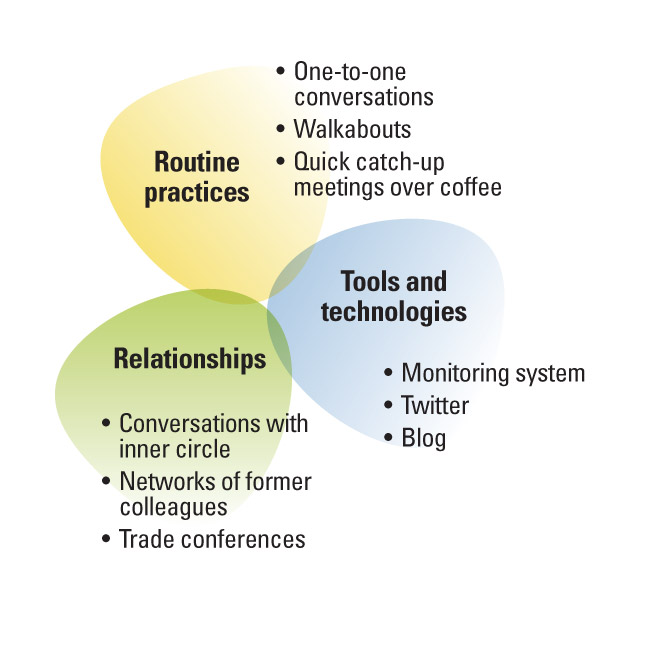
The CEOs we studied didn’t leave the process of staying informed to chance. Rather, they relied on a habitual and recurrent set of practices, relationships and tools of the trade, which constituted a personal knowledge infrastructure that supported them in their daily tasks of understanding, foreseeing and managing. This tacit and rarely discussed infrastructure, which was very different from their IT system, helped them to know what needed to be done and to get a sense of the right way forward. What made some CEOs more effective than others was not merely the characteristics of the individual components of their personal knowledge infrastructure but also the quality of the whole and its fit with the specific needs of the job. This personal knowledge infrastructure comprised three main elements: routine practices, relationships, and tools and technologies.

First, every CEO had a set of routine practices she or he relied on — things such as checking the morning news, running periodic review meetings, dropping by immediate collaborators’ offices to ask what was often “just a quick question,” walking around and occasionally even going to the cafeteria “to check how things are going.” These practices were not just internal. The CEOs also met with board members and managers of other organizations, attended conferences and staff events and participated in ceremonial functions such as charity events. Some of the gatherings were framed as leisure opportunities (having a drink, playing golf), but they weren’t entirely social. CEOs returned from such events with information and news they shared with various associates. Similarly, sitting on boards of other organizations was often seen as a necessary evil that helped the CEOs get a broader overview of what was going on beyond their organization.

Second, the personal knowledge infrastructure contained a number of social relationships. Like prior researchers, we found that most CEOs’ work was conducted verbally and was accomplished with and through others. Our CEOs used their relationships both to gather information and to make sense of it.7 For example, every CEO we studied carefully cultivated strategic relationships within and outside the organization. These relationships were usually engineered to produce a combination of breadth and depth of intelligence. Their network of contacts constituted a form of social capital that had been accumulated over time. On many occasions, we observed CEOs interacting with long-term colleagues, previous members of their staff and people with whom they had done business. They used their contacts to gather weak signals (on the principle that today’s gossip can become tomorrow’s news), triangulate information and confirm or contradict their evolving insights. Some of the CEOs were extremely strategic and nurtured relationships with various stakeholders (for example, management consultants, politicians or local leaders), whom they saw regularly for dinner or a drink. Some CEOs also relied on small groups of peers, whom they met with on a regular basis. These groups of peers, who were often also “comrades in adversity” facing similar challenges, operated both as a support group and as a precious setting where sensitive information was exchanged on the basis of reciprocity.

However, not all of the contacts were treated the same way.8 The CEOs appeared to have an informal hierarchy: those who were more distant, who could be used as a source of signals and needed to be taken with a grain of salt; those who were trusted and tended to provide reliable intelligence (for example, board members or colleagues, as well as their assistants); and finally, those with whom the various streams of information could be discussed and processed — the inner circle. All of the CEOs in our sample relied heavily on such an inner circle, usually composed of selected executive team members with whom they had the most intense interactions. The CEOs used these individuals not only to obtain information, often informally (given the open-door policy that was in operation for most CEOs), but also as sounding boards to test emerging understandings and reconcile possibly competing insights. These interactions allowed the CEOs not only to connect the dots but, more importantly, to figure out which information qualified as a dot that had to be connected further.

Finally, the CEOs’ personal knowledge infrastructures included a variety of tools of the trade. These included traditional tools such as phone, email, reports and journal articles from industry magazines, as well as less traditional sources such as Twitter, blogs and other social media. Most CEOs utilized some form of electronic reporting system or audit-based dashboard that helped them track critical performance indicators, and most consulted these tools regularly, but the sophistication of the tools varied substantially. (See “Components of a Personal Knowledge Infrastructure.”)

Components of a Personal Knowledge Infrastructure

To stay on top of things, CEOs need a combination of three elements: people who feed them information and act as sounding boards; routine activities; and technologies that allow them to track performance and pick up signals. These elements constitute a CEO’s personal knowledge infrastructure. What comes to the CEO’s attention and what stays under the radar depends on the makeup of this infrastructure.
Although most CEOs had a small pile of “will read” books in their office, they rarely had time for books or magazines during the course of a working day. Personal preferences played an important role here, more so than in the two previous categories. For example, while some CEOs relied heavily on mobile phones for calls and texts, others used email almost exclusively. Contrary to our expectations, most of the CEOs dealt personally with a range of emails — this was how their work was done. Some CEOs made very little use of written documents and required short summaries. Others wanted to have complete documentation “just in case.” Some CEOs still found comfort in printed paper; few were happy to go paperless.

One critical aspect of personal knowledge infrastructures was the extent to which individual elements were often intended to support each other. For example, CEOs who liked to run large formal meetings also invested significant time in social relationships, consulting collaborators on a one-to-one basis. The CEO of an organization that was struggling with issues of trust and hidden or misplaced information was working to triangulate soft data with hard knowledge. This often required him to follow up with people individually (for example, phoning staff members directly to corroborate information or requesting documentation from outside sources) while also working to set up formal structures currently lacking.

How the Personal Knowledge Infrastructure Evolves

Although all of the CEOs relied on a personal knowledge infrastructure, how these were composed varied greatly. We saw differences across all seven CEOs in terms of whether personal knowledge infrastructures had particular elements and also the amount of emphasis each element received. Two examples illustrate how different personal knowledge infrastructures contrasted with specific leadership styles in different situations.

CEO 1: Knowing the Details in a Struggling Organization

A newly appointed CEO was running a struggling hospital-based organization that was receiving increased regulatory attention for financial reasons. His personal knowledge infrastructure was designed to help him closely monitor his organization. He ran large, often long, weekly management meetings that provided an opportunity for all team members to examine operations and share and obtain a wealth of information. After the formal meetings, conversations continued in the executive offices. The CEO spent the bulk of his time in regular meetings with local managers of health-care organizations and funding agencies, picking up signals and providing insight into the work and progress of his organization. He also spent time working on wards and visiting and talking to staff. Moreover, he cultivated a wide network of colleagues whom he often consulted in rather informal ways and maintained external links to support his key strategic tasks. He had an open-door policy, both as a symbol of change and as a permanent invitation. He felt comfortable digging through reports and documents, and he set aside time on trains to go through what he called “the train pile of documents.” Though the CEO used the phone and the Internet, he liked to attend conferences and networking events to develop a broad view of the business environment.

CEO 2: Managing Via a Mix of the Formal and Informal

The second CEO, who had been in his position for more than five years, used a very different set of practices and tools. He worked with an established team to run an organization that prided itself on its ability to achieve operational excellence and strategic growth. Throughout the day, this CEO had a series of chats with executives, which often expanded into conversations between him and several people. Indeed, much of his working day was spent in what appeared as free-form interaction: sharing information informally, only sporadically framed by discussion about an immediate problem concerning a patient or a medical concern. 

This CEO rarely attended local meetings, so the other executives were an information gateway to local strategic issues for him. However, the headquarters-based, executive-team orientation was reinforced by several other structures, relationships and tools, purposefully arranged by the CEO so he could remain in the know. First, there was an executive who the CEO felt had a very different approach from the others, which gave him another voice and view to consider. The CEO also had an IT performance system, which he consulted every morning and which allowed him to identify any serious performance issues in the organization without needing to rely on reports from executives. 

The CEO supplemented such insights with visits to wards and other areas of the hospitals late in the evening and on weekends, which allowed him to gain informal insights from veteran staff. The internal systems were supported by national-level policy work and involvement via leadership positions in sector organizations and initiatives and networking. These allowed the CEO to both formally and informally stay in the know regarding strategic issues of potential relevance, and also to influence their direction to the benefit of his organization.

What Makes It Personal

As we have seen, different CEOs use different knowledge infrastructures that reflect both what they personally need and where their organizations are at a particular point in time. In each case, the context was particularly relevant. We saw different types of knowledge infrastructures (in other words, combinations of tools, practices and relationships) in relation to seven factors:

The CEO’s Experience

More experienced CEOs often had a more defined personal style that they carried with them when they changed jobs. Some had specific practices that they tried to reactivate in the new workplace and a network of contacts that constituted the social capital they had accrued over the years; we saw this in the case of a CEO facing an operational challenge in his new organization, when he called a former colleague for advice.

Job Tenure

The more time CEOs spent in the same organization, the more they learned, often the hard way, about sources they could trust and how they could make these sources work, given their existing infrastructures and approaches to work.

Makeup of the Executive Team and Board

The composition of the top management team, how competent its members are perceived to be and how well they work as a team affected the makeup of the inner circle. CEOs often included in their inner conversational circles directors who were easy to talk to or were particularly good at collecting and relaying intelligence. However, many CEOs, like the second CEO discussed above, also saw value in having friendly “devil’s advocates” on staff who were able to present different views and act as meaningful counterweights.

Organizational Conditions and Pressures

Organizations with different financial, efficiency, quality and safety environments posed different issues for the CEOs. When the conditions changed, they had to retune their antennae accordingly. A particular challenge involved the tools and technologies available. Systems can be powerful but are costly and difficult to change. Most CEOs worked to modify and develop existing systems but often they didn’t have a lot of room to make immediate changes. They worked with what they had while instigating long-term interventions so that the system would suit them rather than the other way around.

Strategic Vision

Entering new markets or introducing new products or services required CEOs to adapt their personal knowledge infrastructure accordingly. For instance, a CEO facing a possible merger began adding M&A events to his calendar.

Economic, Competitive and Regulatory Environment

The macro environment determined whether a CEO’s personal knowledge infrastructure was appropriate. Changes in the environment forced CEOs to adapt their existing personal knowledge infrastructure and reactivate old relationships.

The Kind of Manager the CEO Wants to Be

Ultimately, the above factors were filtered through the prism of “what kind of manager I would like to be.” For instance, a CEO who valued transparency and closeness to his organization’s users established a strong presence on social media and utilized this channel to garner insights into the experience of patients and their families. This sometimes allowed him to identify problems (such as low quality of service in a particular location or low staff morale) before his managers reported them.

Taken together, the factors above suggest that effective personal knowledge infrastructures tend to be unique and personal and conform to the preferences of the manager. They need to be continually adapted, tweaked and refined in keeping with the shifting nature of the CEO’s job, the environment and new opportunities.

Although most of our CEOs were reasonably successful, everyone saw room for improvement. Indeed, a CEO’s effectiveness was a reflection of his or her situation and person-specific alignment. For example, one CEO had spent years building a sophisticated IT performance monitoring system. Another CEO didn’t see having such a system as a priority; in his view, being an effective manager entailed moving away from operational considerations and focusing more on strategic and systemwide issues. 

The challenge of changing as the organization changes was highlighted by several CEOs: The personal knowledge infrastructure that serves you well during a period of crisis and turmoil may get in the way in calmer waters. The lesson is that there is no single best personal knowledge infrastructure. Through personal reflection, managers and CEOs need to learn how to ask themselves difficult questions regarding the quality and fit of the practices, tools and relationships that they rely on to become knowledgeable. They also need to develop structured ways of asking such questions consistently and over time — rather than waiting for something to go terribly wrong.

Four Traps

The quality and fit of the CEO’s personal knowledge infrastructure is critical because it determines how he or she sees the world and defines himself or herself as a manager and CEO. It is the prism through which managers understand what is going on, and it provides the horizon of information sources through which this understanding will be probed and evaluated. However, a poorly designed personal knowledge infrastructure can lock the manager inside an information bubble and create information biases and blind spots.9 Managers may only realize this when something happens that was not on their radar or when an incident exposes the misalignment between the current demands and needs of their job and their own role. By closely examining the work practices of our CEOs over time, we identified four potential traps:

1. Not Obtaining the Information You Need

Although conventional wisdom suggests that the main problem for today’s executives is too much information, the real problem is not enough relevant information. Due to insufficient monitoring, an inappropriate mix of monitoring practices, inadequate or insufficient social relationships, and information overload, managers can find themselves without the information they need.

EVALUATING YOUR PERSONAL KNOWLEDGE INFRASTRUCTURE

2. Developing a Personal Knowledge Infrastructure That Points You in the Wrong Direction

A typical problem with personal knowledge infrastructures is that they can be poorly aligned with the demands of the job. For example, if a CEO wants to foster innovation but the infrastructure informs her about operational issues only, the CEO is likely to focus on things that aren’t of primary importance. A personal knowledge infrastructure not only reflects the rules of attention but also shapes those rules. Researchers have highlighted lessons from major spectacular failures from the past, from the Challenger space shuttle disaster to the global financial crisis.10 Many of the managers in question were completely current on the wrong information — or information about the wrong things.

3. Setting Up a Personal Knowledge Infrastructure That Is Not “You”

A manager’s personal knowledge infrastructure can clash with his management style, both in terms of what he does, the tools he uses and the type of manager he would like to be. In our study, we observed a CEO who wanted to be a manager who delegated. However, his personal knowledge infrastructure systematically drove him to focus on details, which led him to take a hands-on approach — against his best intentions. The most effective managers we observed were those who reshaped their personal knowledge infrastructure to fit their work, their management style and what they considered important.

4. Starting With Technology Rather Than Personal Need

Last, some managers make the mistake of addressing the issue from the wrong end — considering technology first rather than later. Rather than being technology-centered, personal knowledge infrastructures need to be geared toward personal development, not toward buying new technologies. Rather than asking, “Is this technology good?,” CEOs should ask, “Will it do any good for me?”

Improving Your Personal Knowledge Infrastructure

So how do managers improve their personal knowledge infrastructures? We found that although CEOs easily recognize the importance of their personal knowledge infrastructure, they very rarely pause to reflect on its effectiveness and fit. More often than not, they discover its inadequacies through comparison with others’ practices or, more commonly, following breakdowns and failures. Developing, refining and testing the effectiveness or present fit of your personal knowledge infrastructure should be routine. (See “How to Improve Your Personal Knowledge Infrastructure.”)

How to Improve Your Personal Knowledge Infrastructure

For CEOs or other executives concerned about improving their personal knowledge infrastructure, we have developed six steps designed to initiate learning and reflection. Examine the following:


There is a great deal that individuals can do for themselves. The starting point is being aware of the composition and functioning of your personal knowledge infrastructure and also being candid about its internal contradictions, potential misfits and misalignments. In our study, we found that this was best done through discussions with others: a mentor, a coach, colleagues or a trusted counselor. After all, your personal knowledge infrastructure is very much a part of you. Having a personal knowledge infrastructure in place is one thing; being honest about how well-suited it is to your particular circumstances is very different.

To this end, in addition to studying CEOs in action, we developed the outlines of a reflection and developmental process one can apply to one’s own circumstances. This is a framework to guide individual and peer reflection, built around a set of questions. (See “Evaluating Your Personal Knowledge Infrastructure”)

Being a manager in today’s complex world requires becoming information-savvy in ways that are manageable and work for you in your specific context. What we learned from the CEOs we studied also applies more broadly to executives in general. Becoming and remaining practically knowledgeable is a critical task. It is a capability that managers need to learn, develop and continually refine, and it becomes increasingly important as the manager moves through his or her career and up the corporate ladder, when the risk of information overload significantly increases.

View at the original source

Tuesday, June 9, 2015

What Successful Project Managers Do 06-09


What Successful Project Managers Do

Traditional approaches to project management emphasize long-term planning and a focus on stability to manage risk. But today, managers leading complex projects often combine traditional and “agile” methods to give them more flexibility — and better results.


Coping with frequent unexpected events requires an organizational culture that allows the project manager to exercise a great amount of flexibility. Here are two examples of advanced organizations that took steps to modify their cultures accordingly.In today’s dynamic and competitive world, a project manager’s key challenge is coping with frequent unexpected events. Despite meticulous planning and risk-management processes, a project manager may encounter, on a near-daily basis, such events as the failure of workers to show up at a site, the bankruptcy of a key vendor, a contradiction in the guidelines provided by two engineering consultants or changes in customers’ requirements.

Such events can be classified according to their level of predictability as follows: events that were anticipated but whose impacts were much stronger than expected; events that could not have been predicted; and events that could have been predicted but were not. All three types of events can become problems that need to be addressed by the project manager. The objective of this article is to describe how successful project managers cope with this challenge.

A group of 23 project managers who had come from all over NASA to participate in an advanced project management course declared mutiny. They left the class in the middle of the course, claiming that the course text, based on NASA’s standard procedures, was too restrictive for their projects and that they needed more flexibility. With the blessing of NASA’s top leadership, the class members then spent four months conducting interviews at companies outside of NASA. This led to a rewriting of numerous NASA procedures. 

Among other things, NASA headquarters accepted the group’s recommendation to give NASA project managers the freedom to tailor NASA’s standard procedures to the unique needs of their projects. A similar movement to enhance project managers’ flexibility occurred at Procter & Gamble, where the number of procedures for capital projects was reduced from 18 technical standards and 32 standard operating procedures to four technical standards and four standard operating procedures.

Concurrent with these changes at NASA and P&G, a heated debate emerged within the wider project management profession regarding the need for flexibility, as opposed to the traditional approach, which emphasizes that project success depends on stability. According to the traditional approach, project success can be achieved by focusing on planning and on controlling and managing risks. Although the popularity of this approach has sharply increased across industries, research covering a wide variety of projects consistently reveals poor performance. A large percentage of projects run significantly over budget and behind schedule and deliver only a fraction of their original requirements.


The other side in this debate is best represented by a newer project management approach popular within the software industry. Called the agile method, it asserts that project success requires enormous flexibility throughout the project’s life. However, even proponents of the agile approach acknowledge that this approach is best suited to small projects and teams.


Our studies, employing experiential data collected from more than 150 successful project managers affiliated with more than 20 organizations, indicate that today’s successful project managers cope with unexpected events by a combination of the traditional and agile approaches, assuming four roles. (See “About the Research.”) Two of the roles are intention-driven and two are event-driven, with each role assumed on its own time schedule throughout the life of the project. The first role, developing collaboration, is performed early on during the project. The second role, integrating planning and review with learning, is performed periodically. The third role, preventing major disruptions, is performed occasionally. The fourth role, maintaining forward momentum, is performed continuously.5(See “The Four Roles of the Project Manager.”)

About the Research

In recent years, many researchers have concluded that one reason for the widespread poor statistics about project results is the wide gap between research and practice.i The overall objective of our research was to develop a practice-based theory of project management.ii To this end, we used three complementary approaches to collect firsthand data on the practices of successful project managers. Believing that management is best learned by emulating exemplary role models, we focused our studies on a selective sample of the best practitioners in their respective organizations.

Our first approach consisted of field studies and structured research tools, particularly 40 interviews (two to four hours each) and 20 observations (four hours to a week each) of practitioners in the following organizations: AT&T, Bechtel (the San Francisco-based construction and civil engineering company), DuPont, General Motors, IBM, Motorola, PPL Electric Utilities (an electric utility company based in Allentown, Pennsylvania), Procter & Gamble and Turner Construction Company (a construction services company headquartered in New York City).
For our second approach, we convened project teams and facilitated reflective dialogues in which participants shared their stories and practices from recent projects. We collected most of the cases, stories and practices through our role as the facilitators of the project management knowledge-development and -sharing communities in three organizations. In this capacity, Laufer and Hoffman worked for five years with NASA, Laufer and Cameron worked for three years with P&G and Laufer and Russell worked for two years with Boldt (a construction services company based in Appleton, Wisconsin). Project managers from the following organizations participated in these community of practice meetings: AeroVironment (a technology company based in Monrovia, California), Boldt, The Johns Hopkins University Applied Physics Laboratory, Lockheed Martin, NASA, Procter & Gamble, Raytheon and the U.S. Air Force.
To make sure that the principles we developed were a valid interpretation of the stories we had collected, we adopted a third approach — testing our interim results in real-life situations. Through consulting engagements with four project-based organizations — Boldt, Parsons Brinckerhoff (the multinational engineering and design firm headquartered in New York City), Skanska (the Scandinavian construction and property development group) and Turner Construction — we validated and refined our understanding and developed the four-role framework presented in the current article. 
We then tested and refined this framework in our work with the Boldt project management knowledge-development and -sharing community. The model presented in this article is the result of a final refinement process, which included a series of interviews with 10 project managers and 10 senior managers. We held these interviews (two to three hours long) with a carefully selected group of practitioners from companies that represented a variety of industries, including Cedars-Sinai Medical Center, NASA, PricewaterhouseCoopers, P&G and the U.S. Air Force.

1. Develop Collaboration

Since project progress depends on the contribution of individuals who represent different disciplines and are affiliated with different parties, collaboration is crucial for the early detection of problems as well as the quick development and smooth implementation of solutions. The importance of collaboration can be demonstrated by the following two examples in which projects failed.
Tim Flores analyzed the causes for the different outcomes of three Mars exploration missions initiated by NASA’s Jet Propulsion Laboratory: Pathfinder, Climate Orbiter and Polar Lander. Although all three projects were conducted under the same guiding principles, were of comparable scope and shared many elements (even some of the same team members), Pathfinder was a success, whereas the other two missions failed. Flores expected to find that the Pathfinder project differed from the other projects in a variety of factors, such as resources, constraints and personnel. 
Although this was true to some extent, he found that the primary factor distinguishing the successful mission from the failed missions was the level of collaboration. The Pathfinder team developed trusting relationships within a culture of openness. Managers felt free to make the best decisions they could, and they knew that they weren’t going to be harshly punished for mistakes. That trust never developed in the other two projects.
A different NASA project, the Wide-Field Infrared Explorer (WIRE) mission, was designed to study the formation and evolution of galaxies. Its telescope was so delicate it had to be sealed inside a solid hydrogen cryostat. When, shortly after launch, a digital error ejected the cryostat’s cover prematurely, hydrogen was discharged with a force that sent the Explorer craft tumbling wildly through space, and the mission was lost.
Jim Watzin, a project manager at NASA and a member of the WIRE project team, had this to say regarding the official report that NASA issued following the WIRE failure: “WIRE failed because people could not or would not communicate well with each other. … Individuals ... simply were uncomfortable allowing others to see their work.” Watzin added: “The real [lesson] from this loss is that any team member that does not participate as a true team player should be excused [from the project].”
In the next two examples, project success can be attributed to the project manager’s deliberate attempt to develop collaboration. (Note that in the discussions that follow, we use only the project managers’ first names.)
Allan, the payload manager for NASA’s Advanced Composition Explorer project at the Jet Propulsion Laboratory, has described how he developed trust between his team and the 20 groups of scientists developing instruments for the project, who were based at universities throughout the United States and Europe. Allan devised a three-stage plan. First, he selected team members who could operate in a university environment — people who knew when to bend or even break the rules. Second, he relocated his JPL team to a university environment (California Institute of Technology), recognizing that it might be difficult to develop an open, flexible culture at JPL. Third, he came up with an uncommon process for interacting with the scientists.
The challenge, with regard to interaction, was getting the scientists to regard his JPL team as partners. Having dealt with NASA before, they tended to believe that someone coming from JPL would demand a lot of paperwork, lay out sets of rules to be followed and expect things to be done a certain way. In fact, many of the scientists weren’t sure they should share with Allan’s team the problems they were encountering along the way — problems that could slow down the project’s progress.
When unexpected events affect one task, many other interdependent tasks may also be quickly impacted. Thus, solving problems as soon as they emerge is vital for maintaining work progress.
The primary role of Allan’s team was to review the development of the instruments, and Allan believed that the best way to do this was by focusing on trust and convincing the scientists that his team was there to help them solve their problems. To facilitate this, Allan and his team of five to eight members traveled to each university and stayed on site for an extended period of time. By spending days and nights with the scientists and helping them solve their problems — not as auditors but as colleagues — the JPL team gradually became accepted as partners.
Most projects are characterized by an inherent incompatibility: The various parties to the project are loosely coupled, whereas the tasks themselves are tightly coupled. When unexpected events affect one task, many other interdependent tasks are quickly affected. Yet the direct responsibility for these tasks is distributed among various loosely coupled parties, who are unable to coordinate their actions and provide a timely response. Project success, therefore, requires both interdependence and trust among the various parties.
However, if one of the parties believes that project planning and contractual documents provide sufficient protection from unexpected problems, developing collaboration among all the parties may require creative and bold practices.
This was the case in a large construction project that P&G launched at one of its European plants. After the contractor’s project manager, Karl, brushed off numerous team-building efforts, Pierre, the P&G project manager, finally found an opportunity to change Karl’s attitude. Three months into construction, the contractor accidentally placed a set of foundations 10 inches inside the planned periphery and poured about 600 lineal feet of striped foundation in the wrong place. Instead of forcing the contractor to fix his mistake and start over — a solution that would have damaged the contractor’s reputation and ego — Pierre chose a different approach. 
Through several intensive days of meetings and negotiations with the project’s users and designers, he was able to modify the interior layout of the plant, thereby minimizing damage to the users without having to tear down the misplaced foundations and hurt the project’s schedule. The financial cost of making the changes incurred by the contractor’s mistake was significant, but the loss in reputation was minimal. As a result, Karl gradually embraced Pierre’s working philosophy — namely, “If they fail, we fail.” The realization that the organizations involved in the project are all interdependent led to the development of a collaborative relationship.

2. Integrate Planning and Review With Learning

Project managers faced with unexpected events employ a “rolling wave” approach to planning. Recognizing that firm commitments cannot be made on the basis of volatile information, they develop plans in waves as the project unfolds and information becomes more reliable. With their teams, they develop detailed short-term plans with firm commitments while also preparing tentative long-term plans with fewer details. To ensure that project milestones and objectives are met, these long-term plans include redundancies, such as backup systems or human resources.11
One key difference between the traditional planning approach, in which both short- and long-term plans are prepared in great detail, and the rolling wave approach becomes evident when implementation deviates from the plan. In the traditional planning approach, the project team attempts to answer the question: Why didn’t our performance yesterday conform to the original plan? In the rolling wave approach, project managers also attempt to answer the question: What can we learn from the performance data to improve the next cycle of planning? In particular, they attempt to learn from their mistakes — to prevent an unexpected event from recurring.
Successful project managers do not limit the learning process to the planning phase but also use it for project reviews. For example, after a review session in the midst of a project at NASA’s Goddard Space Flight Center, Marty was a frustrated project manager. The existing review process may have fulfilled upper management’s need to control its operations, but Marty felt it did not fulfill his team’s need to learn. Therefore, he modified the process to give his team the best input for identifying problems and the best advice for solving them. This meant doing away with the usual “trial court” atmosphere at NASA review sessions, where team members’ presentations were often interrupted by review board members’ skeptical comments and “probing the truth” questions. In its place, Marty developed a review process that provided feedback from independent, supportive experts and encouraged joint problem solving rather than just reporting.
The first thing Marty did was unilaterally specify the composition of the review panel to fit the unique needs of his project, making sure that the panel members agreed with his concept of an effective review process. The second thing he did was change the structure of the sessions, devoting the first day to his team’s presentations and the second day to one-on-one, in-depth discussions between the panel and the team members to come up with possible solutions to the problems identified on the first day. This modified process enabled Marty to create a working climate based on trust and respect, in which his team members could safely share their doubts and concerns. At the end of the second day, the entire panel held a summary meeting. It was agreed that the review session had been a big success. In fact, other NASA project managers quickly adopted Marty’s process, including it in their managerial tool kits.
Successful managers of more traditional projects, such as designing and building manufacturing facilities, also practice learning-based project reviews. P&G has replaced review panels composed of external experts or senior managers with peer-review panels. These last four to eight hours and follow a simple protocol: First, the project team concisely communicates its technical and execution strategies, and then the floor is opened to all the invited peers for comments, critique and clarifying questions. Out of the numerous notes documented throughout the review process, five to 10 “nuggets” usually emerge that the project team uses to improve the technical, cost and scheduling aspects of the project. Sometimes, the invited peers even take one or two of the “nuggets” back to their own projects.

3. Prevent Major Disruptions

In their book Great by Choice, Jim Collins and Morten T. Hansen describe one of the core behaviors of great leaders as “productive paranoia.” Even in calm periods, these leaders are considering the possibility that events could turn against them at any moment and are preparing to react. Similarly, successful project managers never stop expecting surprises, even though they may effect major remedial changes only a few times during a project. They’re constantly anticipating disruptions and maintaining the flexibility to respond proactively. The following two examples illustrate that, when convinced that a change is unavoidable, a successful project manager acts as early as possible, since it is easier to tackle a threat before it reaches a full-blown state.
NASA’s Advanced Composition Explorer project, discussed earlier, was plagued from the start with severe financial problems arising from internal and external sources. Internally, the development of the nine scientific instruments led very quickly to a $22 million cost overrun. Externally, the project, which was part of a larger NASA program, inherited part of a budget overrun in an earlier project. As a result of these internal and external factors, the ACE project experienced frequent work stoppages, forcing the manager to constantly change his contractors’ and scientists’ work priorities.
Don, the project manager, believed that without immediate changes the project would continue down the same bumpy road, with the likely result that cost and time objectives would not be met. To prevent this, he made an extremely unpopular decision: He stopped the development of the instruments, calling on every science team to revisit its original technical requirements to see how they could be reduced. In every area — instruments, spacecraft, ground operation, integration and testing — scientists had to go back and ask such questions as: How much can I save if I take out a circuit board — and how much performance will I lose if I do take it out?
At the same time, Don negotiated a new agreement with NASA headquarters to secure stable funding. To seal the agreement, he assured them that, by using descoping tactics, the project would not go over budget. With the newly stable budget and the project team’s willingness to rethink its technical requirements, the ACE project gradually overcame its technical and organizational problems. Completed early and below budget, the spacecraft has provided excellent scientific data ever since.
To keep costs under control, Terry decided to have two contractors compete for the final contract. Terry quickly realized that both contractors were approaching the development too conservatively and that unless he took a more radical approach, the project would be canceled again. Therefore, he told the contractors to completely disregard the military standards and adhere to only three key performance parameters. One of the contractors, Lockheed Martin, took this directive seriously and changed its approach dramatically. It decided to build the missile fuselage not out of metal but out of composites. And to accomplish this, it found a company that made baseball bats and golf club shafts. 
The company had never built a military product, but it knew how to weave carbon fiber and was open-minded. Following trials with several prototypes, this company was able to manufacture a product of the highest quality. Lockheed Martin transformed this small company from a baseball bat provider to a cruise missile supplier, which led to Lockheed Martin winning the contract — as well as to remarkable cost reductions.The second example of preventing a major disruption from occurring took place during the Joint Air-to-Surface Standoff Missile, or JASSM, project. In this case, the Pentagon had decided to make another attempt to develop JASSM after the first attempt was aborted due to a cost overrun of more than $2 billion. The original project manager for the second attempt was dismissed in midcourse due to poor performance, and a new project manager, Terry, replaced him.

4. Maintain Forward Momentum

As noted earlier, when unexpected events affect one task, many other interdependent tasks may also be quickly impacted. Thus, solving problems as soon as they emerge is vital for maintaining work progress. As Leonard R. Sayles and Margaret K. Chandler wrote in their 1971 book Managing Large Systems, “In working to maintain a forward momentum, the manager seeks to avoid stalemates. Another penalty for waiting is that in a good many situations, corrective action is possible only during a brief ‘window.’ … The heart of the matter is quickness of response.” In a study of project managers on construction sites, it was found that they addressed (not necessarily solved) 95 percent of the problems during the first seven minutes following problem detection.
In a recent knowledge development meeting, a group of 20 project managers at The Boldt Company, a construction services company based in Appleton, Wisconsin, focused on how best to cope with unexpected events. It became evident that most of the managers employed three complementary practices: hands-on engagement; frequent face-to-face communication; and frequent moving about.
Regarding hands-on engagement, one project manager, Charlie, said that to solve problems he often engaged in activities such as making phone calls, convening urgent meetings and taking trips to local retail stores to purchase missing parts. Documenting the time it took him to resolve 10 recent problems, Charlie reported that three were resolved within 30 minutes, three within 60 minutes, and three in less than one day; one problem took two days until it was resolved. Charlie also said that, because of his quick responses, he made one mistake. However, he was able to quickly repair its damage the following day. The entire group at Boldt agreed that maintaining forward momentum was more important than always being right.
The second practice, frequent face-to-face communication, was described by Matt, one of the project managers, in terms of “daily 10-minute huddles” with all the on-site team members (the superintendent, field engineers, project coordinator and safety officer). Matt used these informal morning meetings to share the latest instructions from the client and to ensure that team members understood one another’s current workloads and constraints and understood how they could help one another. Very often, the meetings enabled the team to identify and resolve conflicting priorities before they became problems. Matt noted that, while the primary purpose of the huddle was to update everyone, it also reinforced a spirit of camaraderie and a sense of shared purpose. As a result, these meetings turned out to be very valuable for sustaining teamwork.
As for the third practice, frequent moving about, one project manager, Tony, described the three primary outcomes of spending 30 minutes a day roaming around the project site. First, he was able to develop rich and open communication with his team members. Tony explained that while many workers did not feel safe asking him questions during various formal meetings, they felt very comfortable interacting with him freely during his on-site visits, which had a great impact on their motivation. Second, receiving immediate information, and in particular a greater range of information, enabled him to identify problems early on. At times, he was able to detect conflicts before they actually became an issue. Third, Tony developed a much better understanding of where the project was with respect to the schedule, rather than having to take someone’s word for it. He found that coming to the weekly and monthly planning and scheduling meetings equipped with firsthand, undistorted information allowed him to address questions and solve problems much better. The Boldt project managers did not agree on the preferred timing for moving about and, in particular, whether one should schedule the visits, as Tony did, or leave their timing flexible. However, they all agreed that moving about is a most effective practice that should be applied as often as possible.
These three practices are not limited to construction projects. For example, in the previously mentioned JASSM project, which was geographically dispersed, all three practices necessary to maintain forward momentum were employed by the various project managers at each production site. Additionally, Terry, the customer’s project manager, spent much of his time moving about between all the different production sites.

Implications for Senior Managers

Although every project manager tries to minimize the frequency and negative impact of unexpected events, in today’s dynamic environment such events will still occur. Acknowledging the emergence of a problem is a necessary first step, allowing the project manager to respond quickly and effectively. Some organizations assume that almost all problems can be prevented if the project manager is competent enough — resulting in project managers who are hesitant to admit that they are facing an emerging problem. In fact, a recent study indicates that project managers submit biased reports as often as 60 percent of the time. When upper management fosters an organizational climate that embraces problems as an inherent part of a project’s progression, project managers are able to detect and resolve problems more successfully.
Management scholar Henry Mintzberg argues that today’s managers must be people-oriented, information-oriented and action-oriented. In contrast, the two prevailing project management approaches, the traditional approach and the agile approach, do not require project managers to encompass all three orientations. The traditional approach (primarily intention-driven) stresses information, whereas the agile approach (primarily event-driven) stresses people and action.
By assuming the four roles discussed in this article, the successful project managers we studied are both intention- and event-driven and embrace all three orientations. Developing collaboration requires them to be people-oriented. Integrating planning and review with learning requires them to be information-oriented. Preventing major disruptions requires them to be action-oriented. Finally, maintaining forward momentum, which is pursued throughout a project, requires them to adopt all three orientations. Senior managers must ensure that all three orientations are considered when selecting project managers and developing project management methodologies.